Batten the Hatches: On Sarah Hall’s Helm
Everything the wind blows on has decisions to make. The latest novel from Sarah Hall joins a growing conversation about non-human consciousness—and explores it with more joy, and more filth, than your average climate novel.
Of what fantastical, phenomenal and calculable things Helm is made! Maleficence and data and lore. Atmospheric principles and folktales, spirit and substance, opposite and inversions. So many identities and personalities; it makes Helm’s heads spin.
It takes a special kind of wind to earn itself a forever name. Obviously we name the hurricanes, but they’re just passers through. Even in the coastal places they torment persistently, they’re individuated; no consistent personality can really be affixed. On Australia’s west coast, I grew up with the Doctor that would arrive from the Indian Ocean just on time but nowhere near often enough to blow the heat off our sweltering mining city. In Italy and Northern Africa, there’s the dusty Sirocco and Haboob, and there’s the cold mistral that drags French air violently into the Mediterranean.
But there’s one kind of wind, the world over, that we most readily assign names and volition to, and which loom most significantly over the buildings and psyches of those in their path. These are the ones whose names gather in strength and foreboding over however long we’ve made lives in their path: the foehn winds.
A foehn is a dry wind which rolls down the leeward side of a mountain. On the windward side, cool air has formed into clouds, which deposit their rain before making it over to the peak. The resulting turbulence where this upslope wind meets cooler air from above pulls out both heat and moisture, creating a strikingly warm, dry wind in the rain shadow that shifts the climate of everything down hill in a snap. Wherever these persistent and generally brutal standing winds blow, in the places where locals learn to look for the portents, to batten the hatches of their houses and heads, these winds earn themselves names. In Newfoundland, we have the Wreckhouse blowing off of the western Tablelands. My phone often pings with a “Wreckhouse effect” warning. Off the Rockies, there’s the Chinook. Then there’s that most tote bag-literary of the foehns out west, the Santa Ana, whose fiery reign over Los Angeles is unavoidable in our California-seeded popular culture. If Joan Didion was that wind’s most famous ponderer, it’s because she was grappling with the deeper, less knowable connection, how the wind blows through us at levels we can’t name:
“I have neither heard nor read that a Santa Ana is due, but I know it, and almost everyone I have seen today knows it too. We know it because we feel it. The baby frets. The maid sulks. I rekindle a waning argument with the telephone company, then cut my losses and lie down, given over to whatever it is in the air. To live with the Santa Ana is to accept, consciously or unconsciously, a deeply mechanistic view of human behavior.”
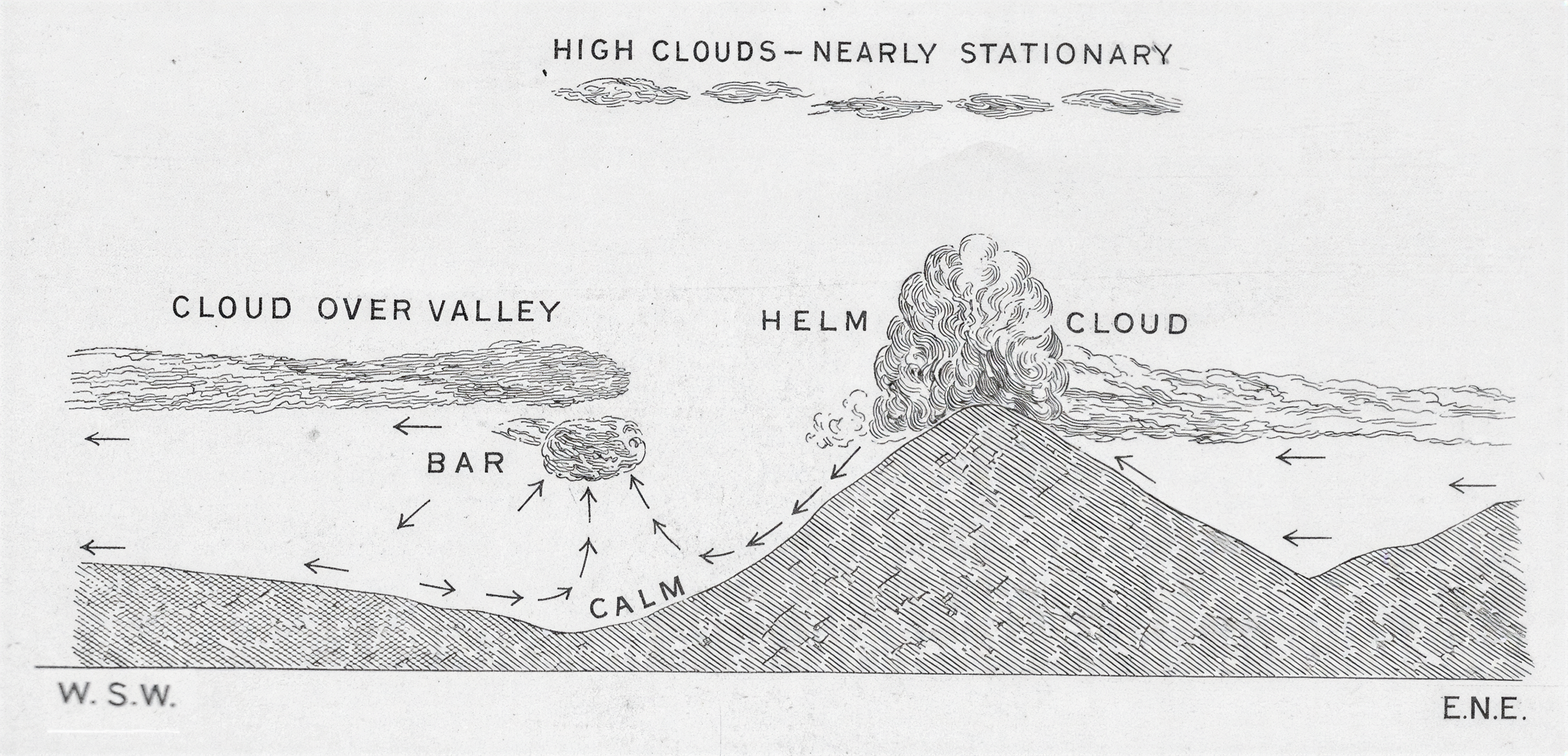
The Helm—the antihero and titular entity in Sarah Hall’s latest novel—is the only named wind in the UK. It stalks the western slopes of the Pennines near the Scottish border, blowing hot rage sometimes for days on end. You can tell it’s about to strike when two telltale clouds form. The Helm cloud itself sits above the peak of Cross Fell like the battle helmet worn by one of the book’s characters, and the long bar cloud that looms over the valley beyond is its banner raised against the locals.
It’s under that banner of Helm that Sarah Hall travels through time in her latest novel. She traces the ways that, as belief systems shift and human civilizations rise and fall, Helm has held a firm place at the core of each; as a god, as a devil, as something to be protected and something to be loved, even something to take as a lover. Helm’s not the only name it’s had (there’s a two-page list of others, amongst them “Swifty lang-gob”, “The barley thief, and “Auld Nick’s stripper”), but it’s the one that bonds most tightly.
“Time happens all at once for Helm,” the book opens, in the perspective of the “solipsistic, narcissistic” wind itself. We meet the wind before it was that—to Hall’s mind, Helm predates its geography. “Earth’s atmosphere had to stop fucking around and calm down,” after all. “Stratospheric forecastable order obtained — that is a climate.” And from there the book stays in Helm’s perspective of all-times, dropping in now and again on the human stories that redirect its free flow.
Once the climate settles, so too does Helm settle in to observe evolution—from creatures crawling out of the ooze to greenery beginning to sprout, and eventually new creatures “impervious to the sky and its inhabitants as they hunt and graze.” But of course there’s a cataclysm coming, first in the form of smoke over the hill, and then in the form of surprising trinkets, which through the book Helm will continue to collect and catalogue and treasure. “It is when humans evolve that things become interesting. Because humans become interested in Helm.”
In An Immense World, Ed Yong’s sprawling 2022 survey of the nature of animal perception, the author lays out a compelling argument for just how limited our sensory understanding of everything around us truly is, taking on the impossible task of finding frames of language to describe the world through the eyes, ears, noses, antennae, and follicles of the creatures that aren’t us. Zoologists, he explains, use the term Umwelt (coined by Jakob von Uexküll in 1909) to describe the perceptual world of any creature—the parts that they can experience, and the parts which simply sit outside their bubble, generally because they’ve had no evolutionary need to process them. If we didn’t filter down to only what we need to know, there would simply be too much.
“A scientist's data are influenced by the questions she asks, which are steered by her imagination, which is delimited by her senses,” Yong writes. “The boundaries of our own Umwelt corral our ability to understand the Umwelten of others.”
The questions we ask become a little more intriguing as we move beyond the realm of things with obvious brains and begin to think about the Umwelt of, well, everything else. That is to say, the majority stakeholders of our planet. We’ve all had fun thinking about this in the context of mycelial networks and trees, from the mushroomy noodlings of Merlin Sheldrake and Suzanne Simard, through to the somewhat cynical faux-scientific populism of the Peter Wohllebens of the world keen to sell you yet another book about the grand old wisdom of trees. Zoë Schlanger’s excellent 2024 The Light Eaters traced the journey of serious scientists to overcome the legacy of the 1970s grifters in the plant consciousness space and find something useful to say about the potential of plant personhood. It’s there, she wrote, and the science is legitimate, if you can just step back and look at it from a point of view that doesn’t just decenter us, but puts us properly in our place. “The world is everything the plants could make of it,” as she wrote.
There’s a longstanding argument slowly gaining legal ground around the world, that a natural system can and should have legal rights. If the legal fiction of a corporation can be a person under the law, why can’t something vastly more powerful? Is the Mississippi not as worthy of legal protection as the numbered corporation dumping its tailings into it? And if the Mississippi, why not the wind?
Yong writes that “a scientist's data are influenced by the questions she asks.” This is, of course, as true of a writer as it is of the scientist. Last year, Robert Macfarlane’s Is a River Alive? brought the river question into free flow, grasping with that very ancient idea that the life of a river isn’t the things in it, but the thing itself. The thing is, though, that Macfarlane, for as warm and urgent as his work always is, apparently never thought to ask, does a river fuck?
As she’s out flying her kites, this is not a question Hall is afraid to ask of the wind. She has always written wild things with great joy and a respect for the ways they’ll spring on you when you get too comfortable (notable among them the title creatures of her previous novel The Wolf Border, who involuntarily re-wolfed the same country as Helm blows over, the author’s familiar and treacherous home). Here, through language that is cacophonous and bawdy and multivalent, swooping down hills and gathering intensity before cartwheeling away in unexpected directions, she travels the span of the planet’s history in ways both beautiful and bonkers, through characters who are both scientists and not, to come sideways at three intertwined questions: What is the Umwelt of the wind? How does it continue to blow ours into shape? And what happens when we finally snuff it out?
Over 350-odd pages that blast through with the velocity of the title character (there are 12 grades of Helm’s force delineated in one chapter, from ennui to aloof engagement to naughty to berserker to the hand of God), the book weaves a tapestry of perspectives of humans in Helm’s way. Each of these is generous and deeply realized, and less frenetic (for the most part) than the wind itself, whose voice would become as exhausting at book length as it is exhilarating in its brief gusts. The first penetration of air travel into Helm’s perception, as humans finally figure out the trick, disrupting the ancient separation Helm has become used to, is met with the excitement of a single sentence paragraph:
“Ballooooon.”
The earliest of the book’s humans is NaNay, an old woman who sits at the head of a Neolithic tribe who have spent many generations hauling stones to their gathering place on that leeward slope so that the Halron wind, as they call it, may roar through. There’s Michael Lang, a wizard priest returned from the Crusades, fixated on vanquishing the demon of Helm by dragging a crucifix up the Fell to its peak. In Victorian times, Thomas Bodger of the Royal Meteorological Society aims to build a “Revelation Machine” that will best explain the wind in the new language of science, but will be waylaid by other more earthly revelations on his way new foundations of atmospheric understanding.
There’s the letter writer Catherine, who writes in 1788 to her friend Beatrice of her “stubborn as a bison” partner Nathaniel, angry about most things in his life but particularly fixated on his drive to destroy the standing stones NaNay’s people spent so long dragging there, which by this time have taken on the name of the “Daughters of Meg”. To Nathaniel, the stones are an affront to more modern mores, and a fine use for all this newfangled dynamite. “Had my husband an ounce of curiosity he might have learned himself the clever position of Meg’s stones before condemning them,” she writes, after observing the specific astral geometry of their ancient placement by stopping to watch the women of the community bring their offerings. Her attempt to tell her husband of the nature of this “ancient solarium” merely bring about more devout rage. It’s a purifying fervor that’s got him. “We shall be cleansed”, he barks, “There will be naught but witch stencils left.” As Catherine later writes of the eager men circling around his plan, helping haul the explosives and excited for the destruction to come: “Why do men fluff up and perspire like gamecocks before disaster? ‘Tis some blood deficiency.”
Much later, in the 1970s, there’s little Janni Calder, perhaps Helm’s greatest or only love. At least, the only one it deems to share with us about. Unlike every kid at her school, when she clambers up to meet it, ”Helm does not tease her or brag her with sticks. Helm never throws her books out of the window or twists her tit or twists her fingers in the sockets.” Nor does Helm treat her with the disdain that her mother does. Janni wants to fly. Helm wants to teach her. The psychiatrists have different lessons in mind. Where the rest of her life remains brutal, Helm’s time with Janni is caring, a warm foehn shroud, but still bound by the twists of the world she’s caught in:
Where is your hat, Janni? Lost. Cast away. Caught on the briar. She has run fast as a rabbit on the moors to get here, shedding bobbles and gloves, the garments Mammy made not good enough to sell. Beside her, Helm is floating and copying her, legs woven, knees pointy, sniffing.
Too cold for snow, Helm tells her.
Are you sombre today? Janni asks Helm.
Not now you are here. I am sad when you go. I will have a hole in me.
I have a hole too. It is in my vee. Mammy says it is wicked.
Janni tells Helm that Helm is bonnier than Elvis, the king of music. And when she is medicated away from Helm’s company, in the brutal 1970s style of such things, Helm floats and looms and longs, watching her with her hair cut short, feeding the chickens in the garden of the asylum.
Selima Sutar is the book’s only major character with a fully contemporary perspective, a somewhat solitary atmospheric scientist and Wolverhampton Wolves fan on the other side of a messy breakup, with an idea about what microplastics might mean for Helm’s actual end. Sutar spends her chapters riding an electric assist bicycle through the Cumbrian countryside and worrying about a couple of men skulking around the radar station at the peak, with a building sense of bucolic dread that would be worthy of a minor Le Carré character. Sutar’s story, though it weaves through all the others, feels like its culmination—an attempt to find space for reason and science against a backdrop of rising paranoia, doomsday cults, and the general, well, all of this that’s around you right now.
But Hall gives equal weight to ecstasy as she does to dread. Jude, a retired policeman turned glider pilot, is given the chance to find catharsis up there, to catch the flows—to leave the earth for a moment and soar somewhere that all that rushes through the body is “Hope, love, ecstasy, God, if there is a God.” You might call what he finds rapture. Hall does.
Every character in the book is pulled between those spaces of catharsis and dread, and each has their own relation to Helm, whether they know it or not. And Helm to them. In An Immense World, Yong wrote:
“To perceive the world through other senses is to find splendor in familiarity and the sacred in the mundane. Wilderness is not distant. We are continually immersed in it. It is there for us to imagine, to savor and to protect.”
What it means to savour, for each of us, is our own thing. For me, when I’m in the parts of my life where the wild things are close, I find a nice thing to do as the tides rise around you is to stick your fingers in the dirt and feel how the roots tangle into each other. As the goutweed runs out of control, another nice thing to do is step back and admire how it needs only the barest trace of rhizome to maintain its dominance. Or dive into the frigid cold pond out back and watch all the creatures that scatter, the only disturbance being you, not the conditions.
Helm is a book that sets out to find these moments of visceral connection—the rare treat of a climate novel that’s grounded in reverie and all the messiness of humanity, the good bits and the horrific bits both. Hall understands that as our Umwelten shift with shifting science, there’s a consistent dose of both idiocy and brilliance that continues to make us who we are. NaNay and Selima live facing into the same hot breeze, the same one that no crucifix can cast out. Everybody that it blows on has decisions to make.
“Moral attention is not a finite resource”, wrote Schlanger in The Light Eaters. “This business of drawing a line between what does and doesn’t deserve our respect and attention can feel like an exercise in absurdism.”
With whatever else feels scarce, in the face of a climate crisis you cannot solve, you can always ask what the wind wants. You can ask what the river fears. Thinking about such things can actually be fun. They may even help you find your place.
Share this post