
David Lynch, Beyond the Beyond, in Berlin
A Berlin exhibition of the beloved filmmaker's paintings and installations testifies to Lynch's 30-year connection with the city, from photographing its derelict urban spaces to an aborted attempt to establish a centre for Transcendental Meditation in Teufelsberg.
Recently I was at a concert at Funkhaus Berlin, an expansive GDR-era music mecca for electronic and ambient music. Located by the Spree River on the outskirts of the city, and housing several music venues, studios, and bars, there’s a liminal feel to this place of former plywood and ammunition box factories from World War II.
British producer and composer Jon Hopkins was playing his newest electronic album; 1,000 of us flocked to hear it. But this wasn’t just any show where you sit back and passively listen to the artist. Before the music started, we were asked to lie down and do meditation breathing exercises. While some black masked DJ played a beat several times faster than any normal human heart, the music set a rhythm for our collective gathering. Even the cream orange ceiling seemed to breathe as our inhalations merged with the music. It was a good way to start the evening.
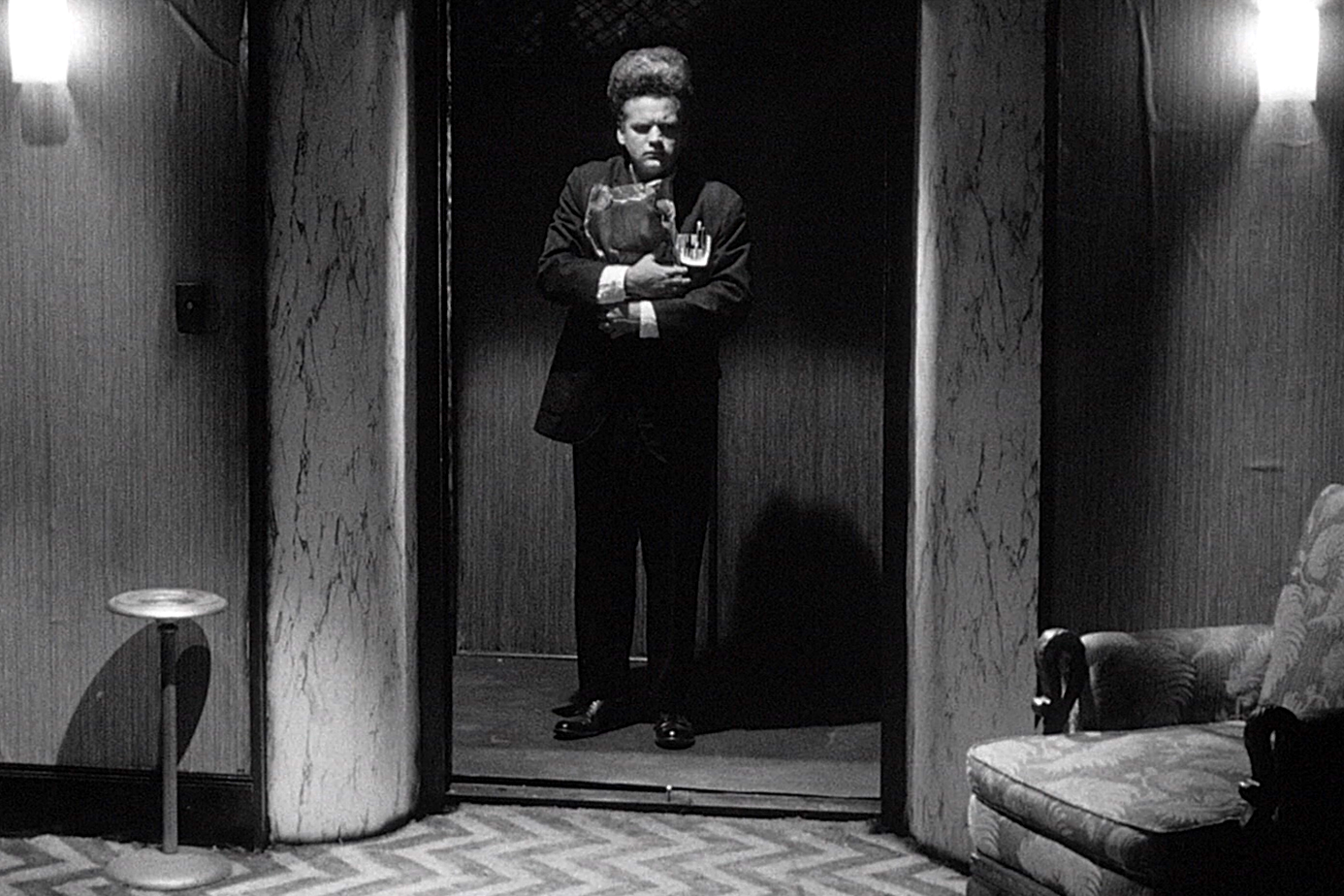
I thought of this concert while attending the David Lynch art exhibition now showing at the PACE gallery in Berlin. In part, it was because Lynch’s connection to Berlin is nearly 30 years running; in the late 90s, he snapped haunting black and white photos of abandoned Berlin warehouses, many of which would later turned into venues like Funkhaus. Some of these are on display at the show. The shadowy images of old water fountains and discarded radios made me think of his first film, Eraserhead, and the wondrous urban landscapes he both mythologized and terrorized in what is perhaps the most famous art-school graduation project of all time. In looking at his paintings and photographs, the clues to his films seem to reside in his visual art, and the embodiment of his visual art in his films. They speak to one another in fascinating ways.
The other reason I thought of the concert at Lynch’s current show is because Lynch was himself a devout practitioner of meditation—a practice that has become so ubiquitous in 2026 that we’re working on our mindfulness and breath at a concert. And it was in the 2000s in Berlin where, as an ambassador for Transcendental Meditation (TM), Lynch announced he planned to open the “Invincible University” at Teufelsberg. Choosing Teufelsberg, German for “Devil’s Hill”, was intentional. The highest point in Berlin, and built from the rubble and debris of the war ravaged city, it was home to a Cold War-era listening station where the Americans could intercept communications in the East. Now Lynch hoped to transform the hill, from a place of espionage and subterfuge into a centre for cosmic learning and love. While the endeavour didn’t work out for reasons I’ll come to in a moment, it does speak to a strange connection that Lynch had to this city. It also speaks to Lynch’s desire to make the ugly and violent beautiful, transforming darkness into light. Berlin—with its complex history, whether as a hotbed of creativity and artistic ferment, or as the capital of a genocidal, fascist regime—was perhaps the perfect place to do this. At least that’s what Lynch thought.
TM was a core part of Lynch’s every day being and what he believed was the root of his aesthetic. Starting in 1973, Lynch practiced it twice daily, claiming that it was indispensable to his artistic survival in Hollywood, that it both insulated and nourished him. In a Rolling Stone interview, he described his first experience: “I sat comfortably in the chair, closed my eyes and started the mantra…. It was as if I was in an elevator and they cut the cables. Within I went. And boom. I was in so much bliss, I couldn’t believe it… This is beyond the beyond.”
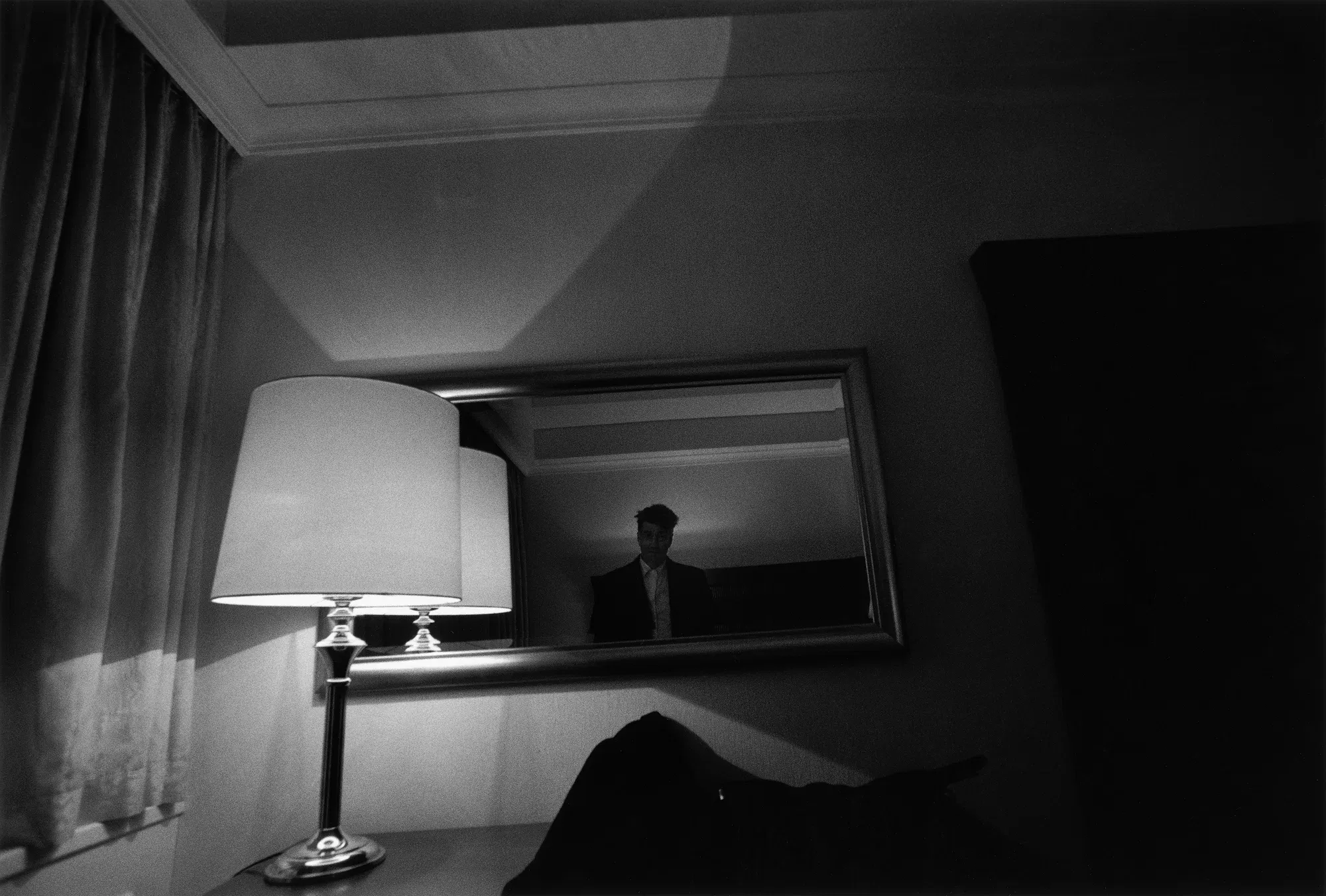
Lynch’s work traversed “beyond the beyond”, taking the normal and making it incredibly weird. From a common cup of diner coffee to the lawn mower, he transmogrified the everyday into an uncanny artistic experience. This sense of the “familiar unfamiliarity” is something many of us are drawn to. I confess I’m a Lynch junkie. I’ve watched all three seasons of Twin Peaks several times. Fire Walk with Me is one of my favourites. I grew up on Blue Velvet and Mulholland Drive, cried during Elephant Man and Straight Story. But I always return to his surrealist masterpiece, Eraserhead. To me it feels like his most free film and wildest piece of art, as he was most able to access whatever he meant by the beyond. It is also the film that most resembles his paintings.
Lynch never stopped producing paintings and installations throughout his career, and considered himself a visual artist first and foremost, referring to his films as “moving paintings”. Lynch studied visual art at the Pennsylvania Academy of Fine Arts in the late 60s, well before his first film Eraserhead premiered in 1977. It should come as no surprise while encountering his paintings at the PACE gallery in Berlin, that he was heavily influenced by the surrealists in general, and Francis Bacon in particular. That’s not to say Lynch wasn’t original—his work stands out for its visceral horror and beauty—but there are echoes of those who preceded him. The Berlin PACE exhibition is a small sample of his work; in fall 2026 a more comprehensive retrospective will open at PACE gallery LA.
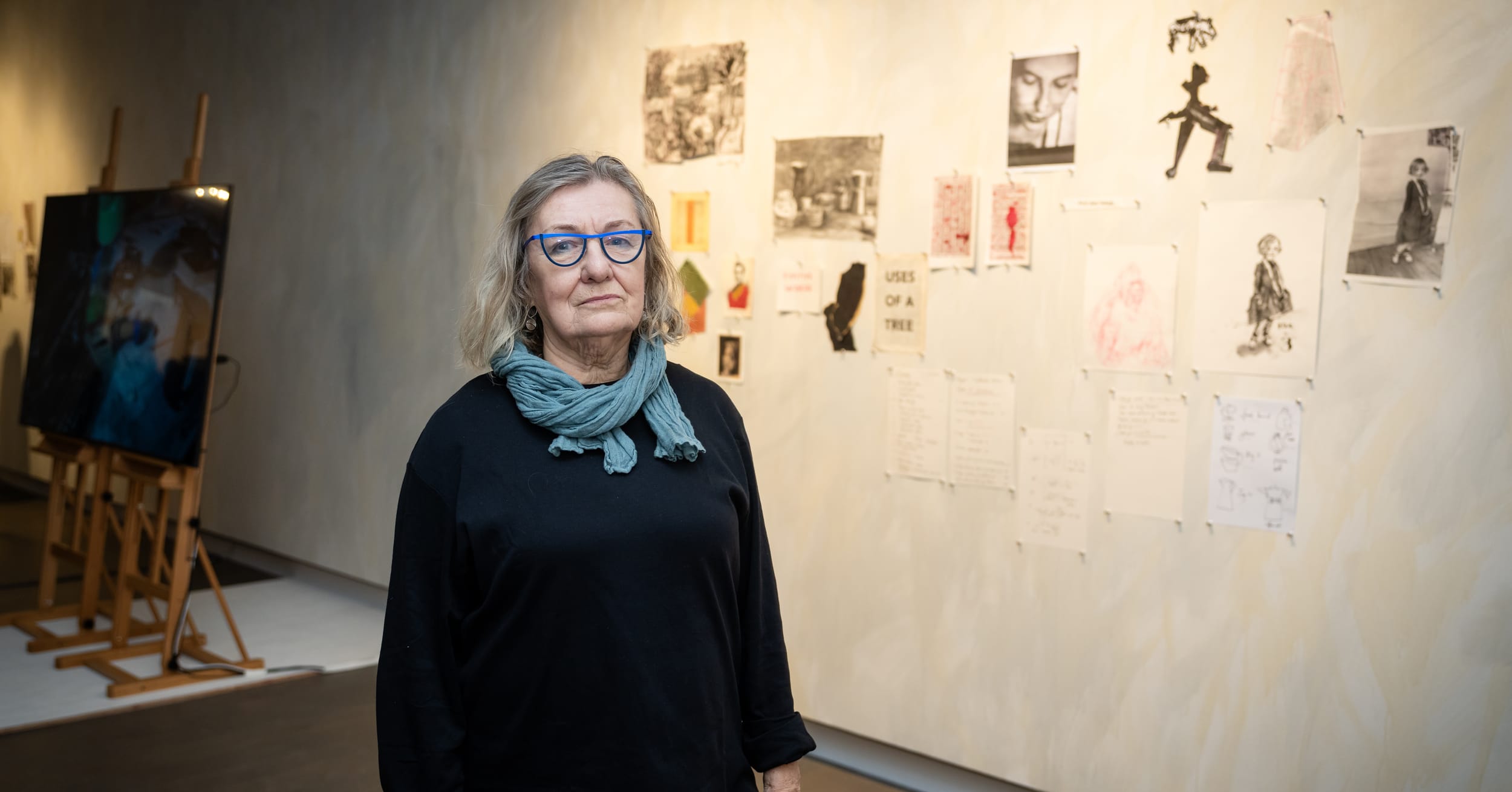
In Berlin, Lynch’s fascination with darkness living inside the everyday is on full display. On his larger canvases (he also built the quirky, elegant frames) one finds heavily layered oil that at times becomes sculptural, literally rising off the page. At other times, his images erupt into words. In “Billy (and his friends) Did Find Sally in the Tree”, a teenage boy lunges menacingly toward a tree with a knife. A young girl straddles a branch. Donning a mohawk, and a face that resembles a pumpkin, she screams in anticipation of the incoming violence. Perhaps this is the first lesson of adolescence.
There are several lightbulb installations part of the exhibition. Made of copper and iron, giving off a tall, skeletal, industrial feel, they reveal a gentle light while casting long shadows on the wall. There is also a 1968 short film Lynch made, The Alphabet, based on a dream his niece had, where she, in a state of nightmarish horror, recited the alphabet while blood dripped from the ceiling and walls (Lynch’s first wife Peggy played the niece in the film). Mixing live action with animation, the short film depicts a surreal perspective of what many of us think of as an innocent act of recitation, most often as a children’s song. Lynch challenges this by proposing an alphabet enshrouded by blood and gore. Even language is not guiltless in Lynch’s world; its capacity for unhindered violence—perhaps even the root of our brutality—is on full display. Given the PACE gallery is a mere two kilometres from Hermann Goering’s former office at the Reich Aviation Ministry on Wilhelmstrasse, the film takes on a different resonance in Berlin.
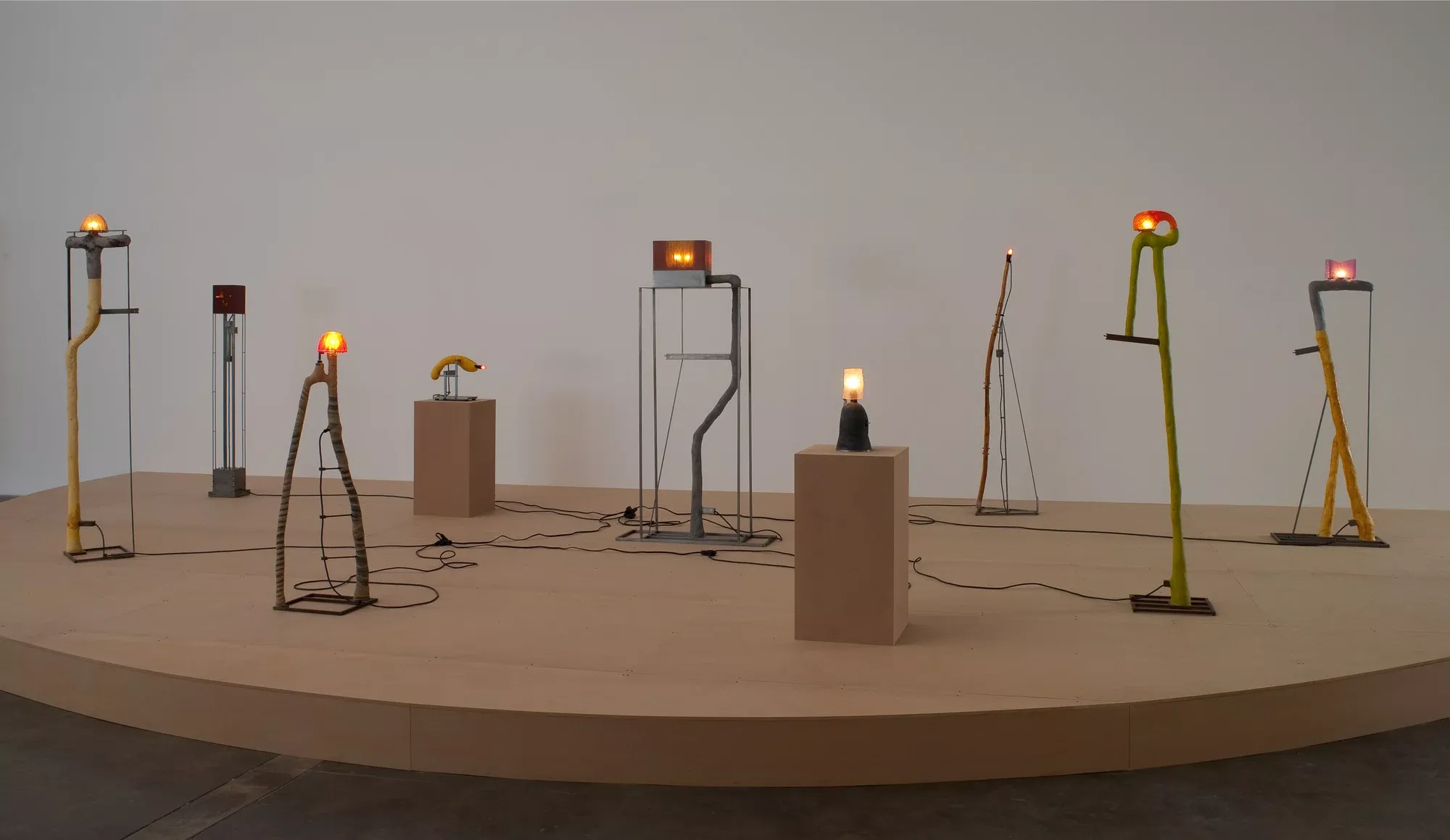
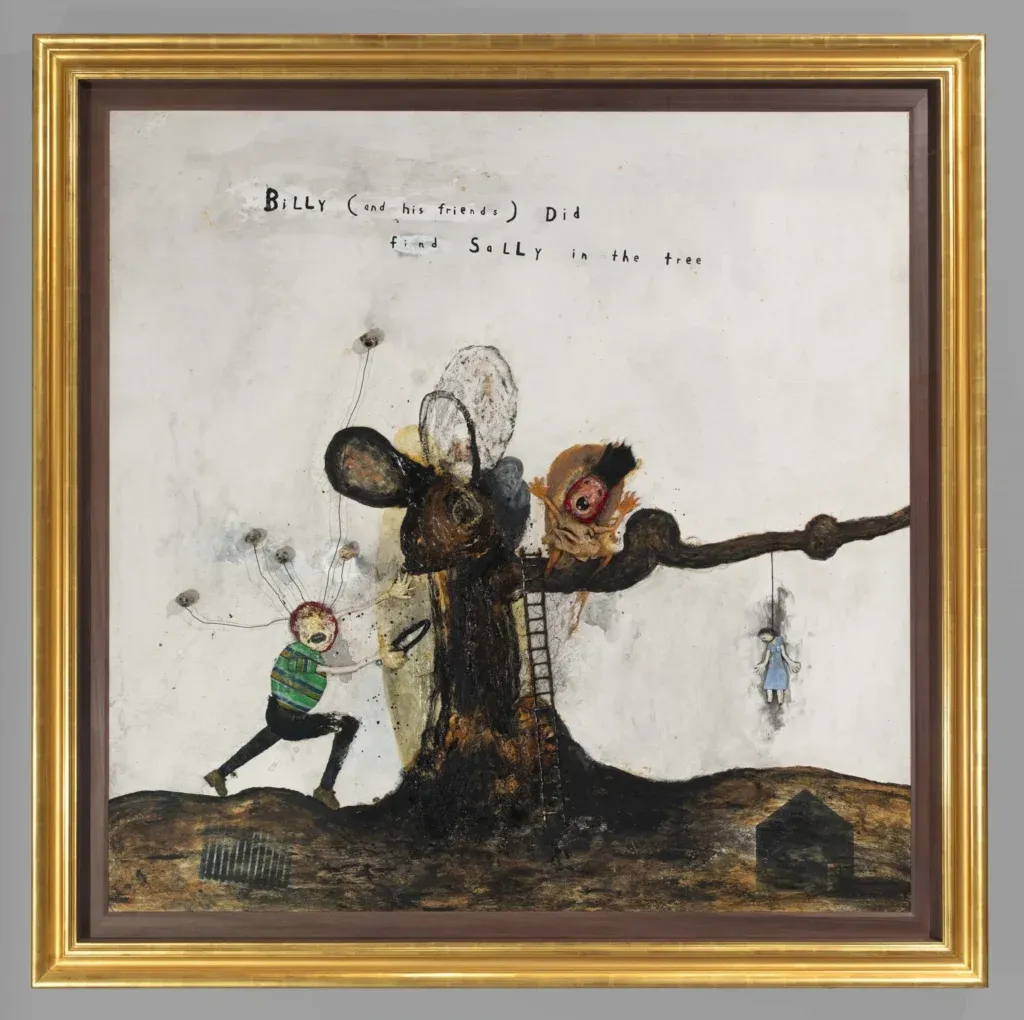
At left, a collection of Lynch's light sculptures at Pace Gallery Berlin and “Billy (and his friends) Did Find Sally in the Tree”. (Courtesy Pace Gallery)
There were two main reasons why the “Invincible University” never took hold at Teufelsberg. One was the building by-laws that restricted its development, given that the hill sat in the heart of the Grunewald, a protected forest in western Berlin. The other had to do with a local TM guru named Emmanuel Schiffgens, who Lynch had accompany him at a 2008 press conference announcing the school. As recounted in this article for Der Speigel, Schiffgens, clad in a white robe and gold crown, went on an unfortunate riff on the university’s name. “Invincible Germany! Invincible Germany,” Schiffgens proclaimed,“I want you all to say, Invincible Germany!” When someone in the audience shouted, “That’s what Hitler wanted,” Schiffgens replied, “Yes, but unfortunately he didn’t succeed.” The audience reacted with disgust and anger. (Incidentally, Schiffgens liked to call himself “The King of Germany”.)
Lynch didn’t speak German but understood that things were unravelling. He approached the microphone and said, “I don’t know what Schiffgens said, but I think he used a word from the Third Reich. It’s a new world now,” said Lynch. Later he added, “Somehow this beautiful plan has got perverted. Let’s march forward to a shining future.”
There was no future, however, for the Invincible University in Berlin. In wanting to create a beacon for hope, to radiate peace where so much bloodshed has occurred, Lynch’s was a noble if naïve endeavour. Perhaps his films and paintings speak to deeper, more persistent truths: the inescapability of horror and violence. Maybe people aren’t ready for the peace Lynch envisioned. Not yet at least. Though for one night at a techno concert on the outskirts of Berlin, some of us were.
The David Lynch exhibition runs at Pace Gallery in Berlin until March 29, 2026.