
Representing the Unrepresentable: On Claude Lanzmann's Recordings
An exhibition at the Jewish Museum Berlin, offers a penetrating glimpse of the legendary documentarian as he begins to unravel the complex layers of the Shoah, and the challenges of capturing the presentness of the past.
In 2009, while attending the John Demjanjuk war crimes trial in Munich, I was seated in the visitors’ gallery when a young man in his early 30s escorted a dozen German school kids to the seats next to mine. A history lesson. I asked the teacher what the lesson was. He said, “To get a glimpse of the past and understand what Germany was responsible for.” The children took notes on the trial of the man known as “the Last Nazi” in their spiral-bound notebooks. I did too. Like these kids, I wanted to partake in a lesson of living history soon to pass. But the lesson was difficult to grasp. Demjanjuk, an 89-year-old Ukrainian immigrant to the United States, lay silent and drooling in the courtroom in a hospital gurney. Few survivors from the Sobibor death camp were still alive to testify, and those who did, had never seen Demjanjuk during the war. While this was a court case in search of justice, the trial also felt like a last-ditch effort to come to terms with the past.
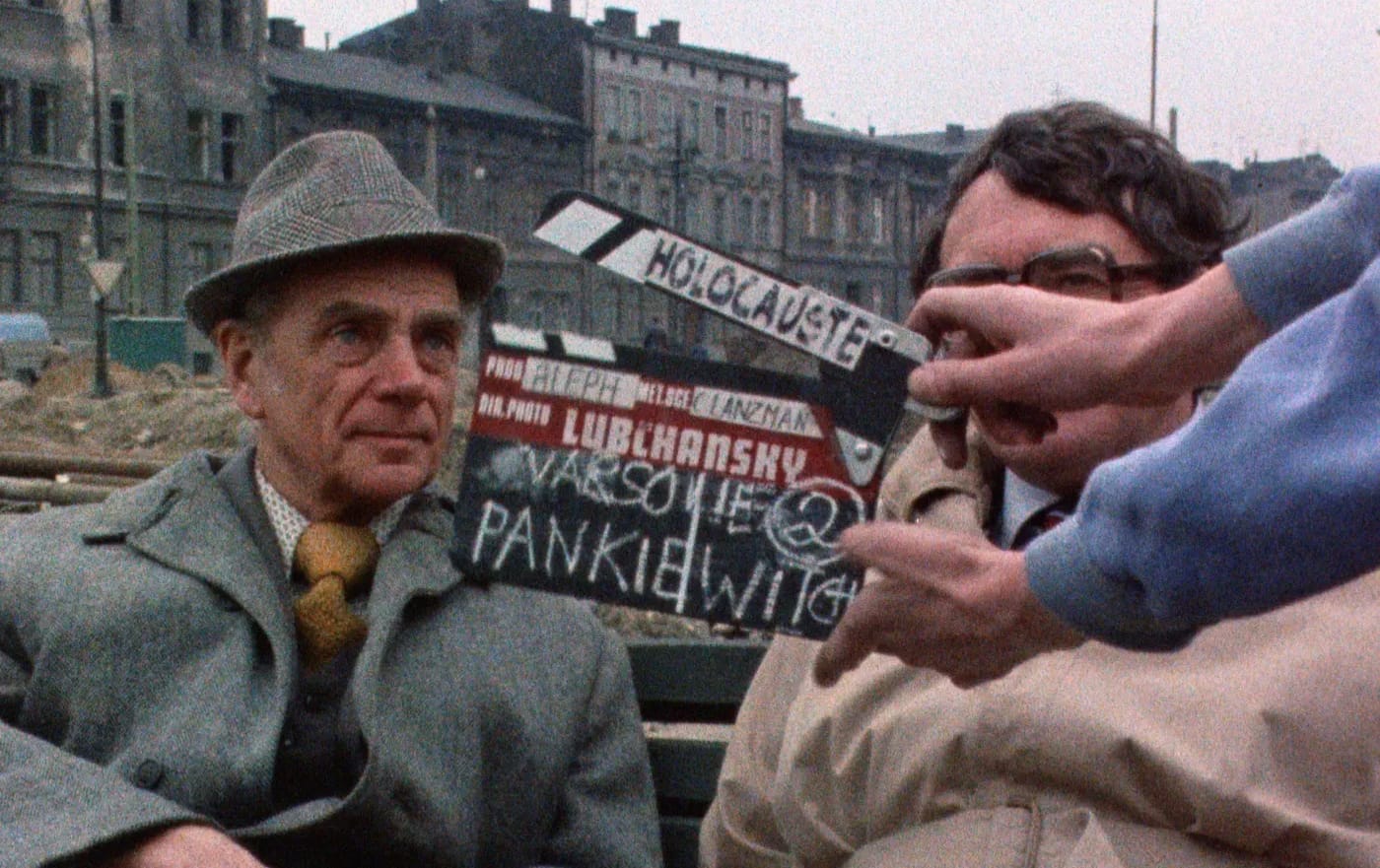
Attempts such as these, to reach out to a fading past, echo many of those who have previously tried to both understand and represent the Holocaust, perhaps none more than French filmmaker Claude Lanzmann, who understood both the urgency and complexity of preserving the testimony of those who lived through it. Between 1973-1985, Lanzmann tirelessly, obsessively, relentlessly, sometimes cruelly, interviewed survivors, bystanders, and perpetrators of Treblinka and Auschwitz for his epic nine-and-a-half-hour masterpiece Shoah. He travelled to sites of mass murder and to death camps, sat in people’s homes drinking coffee and smoking, listening, and questioning, accumulating more than 350 hours of film footage. Knowing the people he was interviewing would soon be too old to recount what they lived through, he understood this as a distinct moment in historical storytelling. The contingency of history presented Lanzmann with a window of opportunity to preserve these testimonies. It even necessitated the project.
But Lanzmann didn’t know what sort of film he was going to make when he set out. In fact, he wasn’t sure he even wanted to make Shoah. The project started thanks to a commission from the Israeli foreign ministry, who wanted him to make a tidy, two-hour documentary. Lanzmann became consumed by the work to the point that all sponsors, including the Israelis, backed out of the project. He worked slowly and methodically, understanding he needed not only to educate the audience, but himself. As he claimed in an audio recording I recently heard at the Jewish Museum Berlin, “I thought when I started, I knew many things about the Holocaust… I learned I knew nothing.”
Lanzmann has a slow, lilting voice. Listening to him at the current exhibition, Claude Lanzmann: The Recordings, I was touched by the intimacy of the experience—a 90-minute selection of audio recordings, whittled down from the 220 hours compiled while making the film (most of the people in the recordings did not appear in Shoah’s final cut). This private material, donated by the Lanzmann estate to the Jewish Museum Berlin, led to the exhibition, which offers a glimpse of Lanzmann-in-the-field as he begins to unravel the complex layers of the Shoah and himself. We hear not only the voices of perpetrators and survivors, but Lanzmann’s own voice as artist and Jew, doubting, probing, questioning, deducing, amazed, horrified.
When asked by survivor Maria Bobrow if he was obsessed with the project, Lanzmann answers, “There are times when I think I’m not obsessed enough… [Other] times I think I am too much.” In a recording during his first visit to Auschwitz, we hear the astonished Lanzmann reciting the family names inscribed on suitcases, muttering them like some kind of incantation for the dead. His attention to detail, and the haunting he allows himself to experience, guided his filmmaking.
It was a mountain of a project to undertake. While speaking to Auschwitz survivor Erich Kulker, Lanzmann set out the challenge before him: “The question is where to begin. Do you start in 1933? 1941? Do you start in 1850? Do you start in the Middle Ages? With Jesus? Moses? … The question is, if there is a fate of the Jews, or if the Holocaust is a very particular thing. It is both things, in my opinion.”
Lanzmann was a French intellectual Jew who lived through the Holocaust as a teenager in Nazi occupied France. He fought for the resistance, making this an intensely personal project. But the story he pursued went far beyond his own. It was, in his words, “an inquiry about the Holocaust.” For this inquiry, he didn’t want to use archival footage. He rejected traditional documentary approaches, fearing the sensationalization of the Shoah, creating a kind of pornography of horror that would pull at the heartstrings of its audience. Yet he understood that anything he made could not capture the “what” of the Shoah. He confessed to Kulker: “The Holocaust happened 30 years ago. You cannot make a film about it as though it happened yesterday. It is one of the reasons I want to start this story NOW. In 1975.”
So Lanzmann sought to create a presentness of the past, to explore how the past affects us today. He did this through oral testimony and landscape imagery. In this way Shoah is not a documentary, as former assistant Corinna Coulmas attests in a video interview that accompanies the exhibition, but a work of art. In trying to represent the unrepresentable, Lanzmann’s obsession with the “truth in the details” that he sought to draw out of his interview subjects became central to the art itself. Alongside slow, bucolic images of fields and forests where death camps once stood, with no visible clues of mass suffering nor murder, Lanzmann created a film to reflect on and ask impossible questions in the face of the inevitable passage of time.
The Recordings gives fascinating background to this artistic endeavour. Though the cassettes were never meant to be made public, they offer important and intimate contexts to the film. They remind us how Lanzmann took the Holocaust away from the number “six million” and towards individual stories. Or rather, he reminded us that each of the six million had a story and most didn’t get to tell theirs. In Vilnius, Lithuania, a survivor sings a Yiddish song that recounts the massacre at Paneriai, when Lithuanians and Germans massacred some 70,000 Jews from the Vilna ghetto. “If a stone could have seen us, it would cry.” Instead of statistics, we get poetry.
We are also privy to the attempts Lanzmann made to get interviews with former Nazis. Famously, Lanzmann didn’t tell perpetrators he was recording them, using a hidden camera or tape recorder buried in his assistant’s bag. If he did tell, he disguised what the film he was making was about. In one audio recording, Lanzmann makes a surprise visit to the home of Otto Horn, a sergeant in the Wehrmacht who worked at Treblinka. Using a hidden tape recorder, we hear a candid exchange between Horn and Lanzmann’s assistant, Irena Steinfeldt-Levy, saying she wants to know about his Treblinka past because they’re “making a film about World War II.” Horn is cagey, saying, “It’s done for me. I do not wish to talk about it anymore.” Steinfeldt-Levy insists, adding that it’s an important part of history that needs to be recorded. Horn says to come back in a week, he needs to speak to his lawyer. There is something both chilling and banal in hearing Horn’s evasion—the bureaucratic deflection to a lawyer, the insistence that “it’s done for me,” as if genocide were simply an unpleasant chapter to be closed.
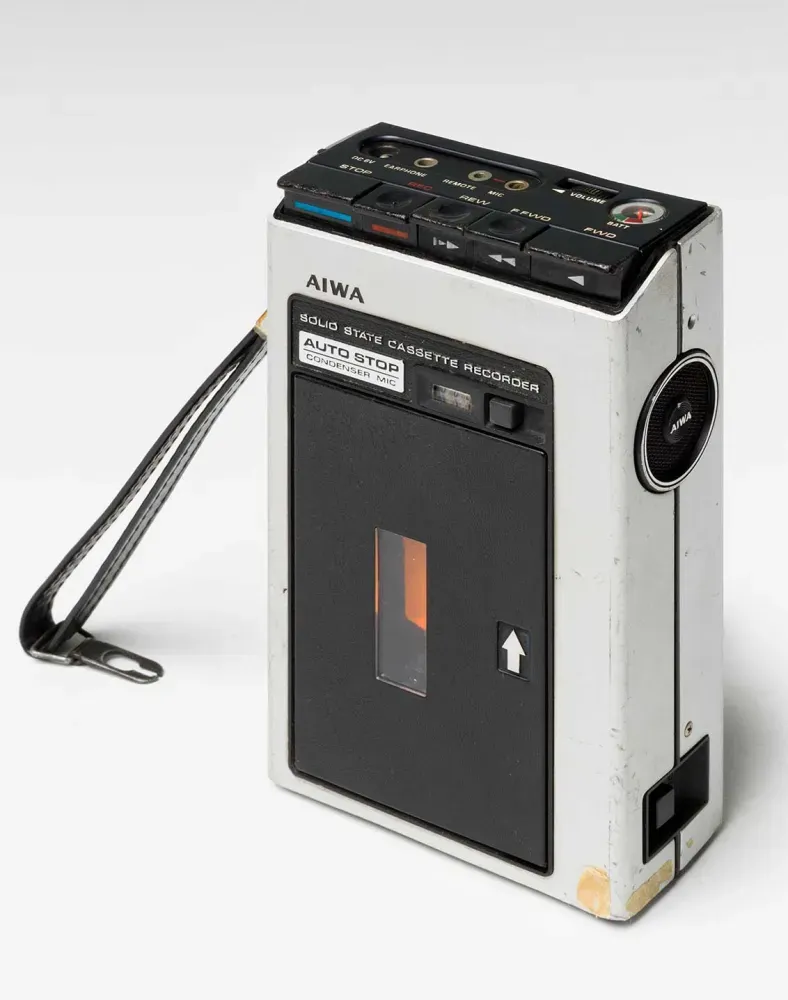
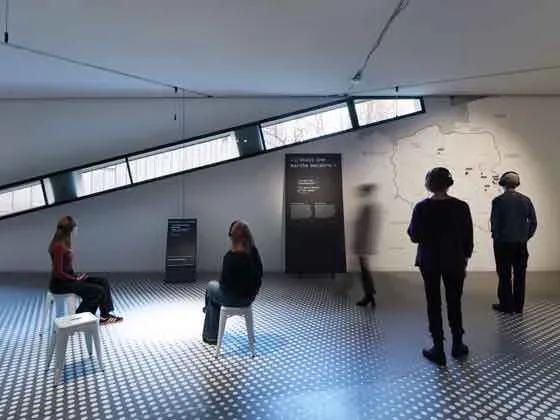
At left, the AIWA cassette recorder used by Claude Lanzmann while compiling interviews for the making of Shoah (photo: Roman März). At right, the exhibition space for the Lanzmann exhibition at the Jewish Museum Berlin (photo: Jens Ziehe).
The curator Tamar Lewinsky lets the recordings speak for themselves, arranging them by theme and easily listened to on headphones with text translated from German, Hebrew, English, and French. There are a few add-ons: one is a recently made video of Lanzmann’s two assistants, Corinna Coulmas and Steinfeldt-Levy, who hold a candid conversation about Lanzmann’s process and what it was like to work with him. The other is a juxtaposition of the testimonies of Maria Bobrow, a survivor who worked at a construction factory near Rivne, Ukraine, and her boss, Hermann Gräbe, who saved her and dozens of other Jews by giving them false papers and employing them as Gentiles. Interestingly, Gräbe was the only German who testified at Nuremberg against other Germans. In the years following his testimony, he was harassed for exposing a past West Germans wanted to leave behind.
It's easy to forget that when Lanzmann was making his film the notion of Holocaust representation was still in its infancy. Well before Spielberg’s Schindler’s List and 21st century German memory culture—what Angela Merkel called their “Staatsrason” or State Purpose—public conversations about the Holocaust were frowned upon in Germany (and Israel as well). Today Gräbe might be hailed a hero by German media; in the 1950s he had to flee to America to live in peace. Nobody in Germany celebrated his heroics.
Lanzmann only understood the film he was going to make when he got to the cutting room. It’s hard to imagine sifting through 350 plus hours of film footage to try and find a story. What is the story? What is this inquiry? And what are the differences between art and documentation? Considering both the film and these audio recordings are now part of UNESCO’s “memory of the world” archive as of 2023, these are questions worth asking.
If art is a work of creation, it means there are elements of the artificial constructed in any work, even documentary film. Lanzmann himself grappled with these boundaries. The answers, if there are any, lie in the nature of memory itself. The gap between the actual and remembered event creates a core tension in Shoah. It also speaks to the horror of losing those capable of telling these stories. In passing down these cassettes, in listening and re-listening, we create spaces of contemplation and mourning, where we are afforded, for a single afternoon, the time to step out of our lives and grieve yet again.
Claude Lanzmann: The Recordings runs at the Jewish Museum Berlin until April 12, 2026.