A Precarious World in Suspended Animation
With her new exhibition, Glorious Catastrophe, Toronto artist Gillian Iles seeks out the paradoxes and possibilities in moments of extreme transformation.
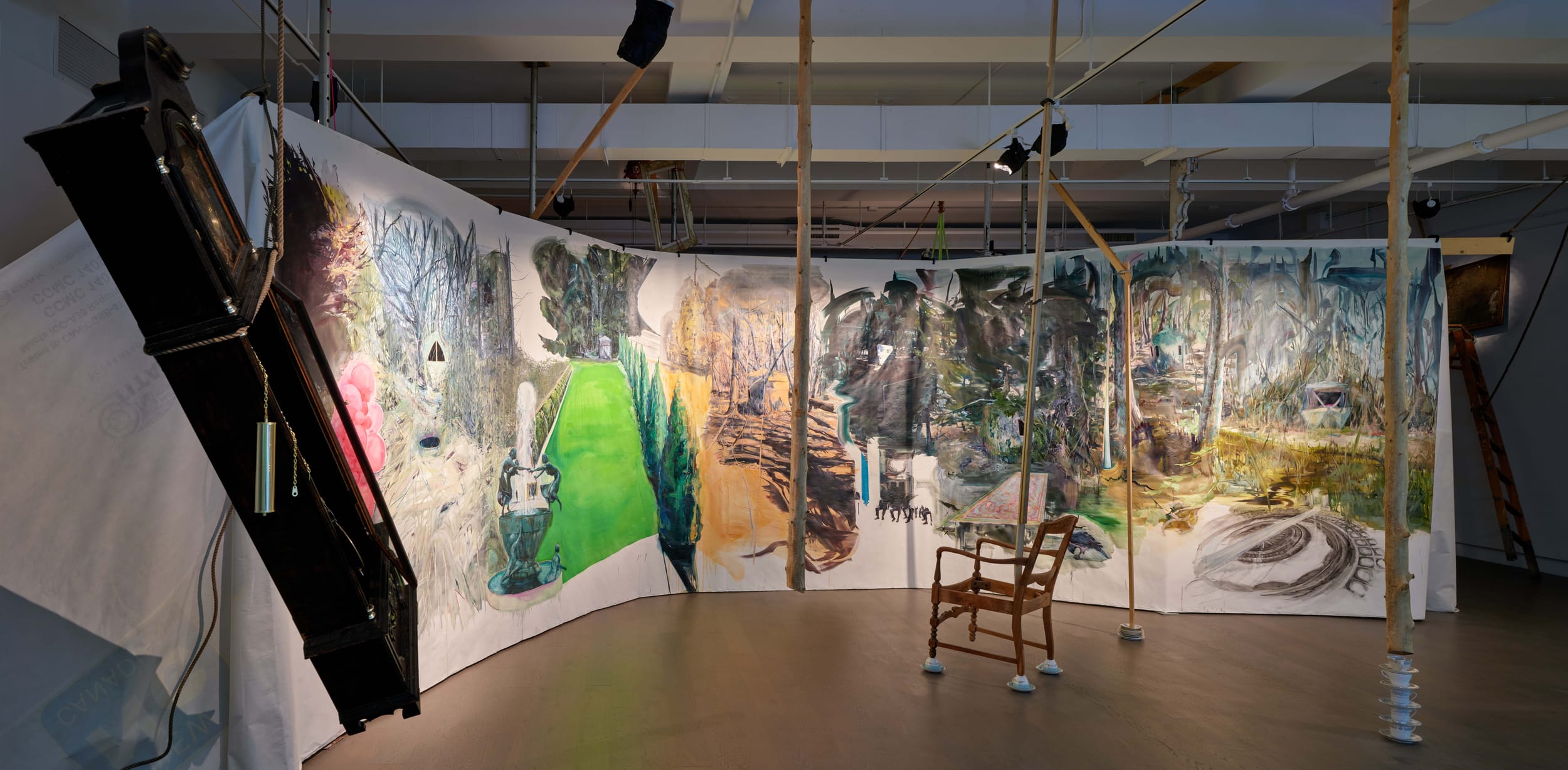
Walking into Gillian Iles’s current exhibition, Glorious Catastrophe, what immediately impresses is the peculiarity of its overall construction—how her work and the way it’s installed in the gallery space manages to feel both meticulously composed and deliberately unstable. As though it was all some dubious and fragile feat of engineering.
A grandfather clock hangs askew in mid-air. Furniture balances precariously atop teacups. Paintings on Tyvek and glassine sheets are supported by jack posts and further fastened by colourful tendrils of rope. A chair propped at an angle appears to hold up a wall of projections. A ladder teeters to one side, mid fall.
If the show, as its title suggests, grapples with uneasy dualities—devastation and wonder, fragility and power, collapse and possibility—Iles manifests these tensions materially. It’s as though the entire room was caught mid-shift, in a moment of suspended animation, presenting an image of the world that hasn’t quite decided whether it’s falling apart or reassembling itself.
Iles, whose studio is in the Youngplace building, has long showed a deftness at moving easily across drawing, painting, video/projection, sculpture, and installation, often mixing her own imagery with fragments of found materials into compositions that feel both intimate and eerily off-kilter. She has exhibited in New York, San Francisco, Brooklyn, Chicago, Miami, and Montreal, and was a founding member of two artist-run Toronto galleries—Propeller and Loop. She teaches at OCAD University and Sheridan College.
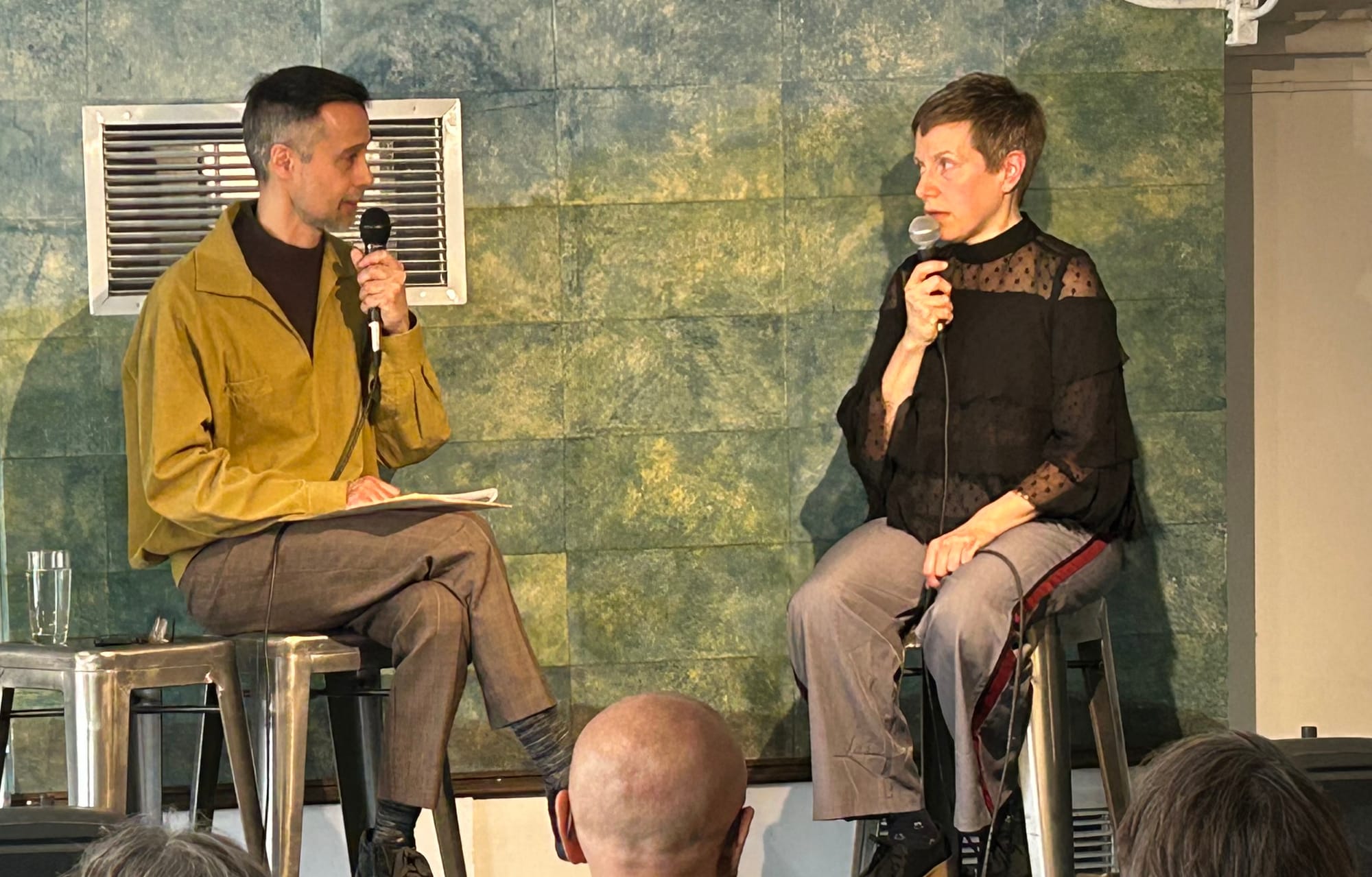
On March 29, Koffler Arts hosted a conversation between Iles and Rui Pimenta, a Toronto-based curator and programmer. The following is an edited transcript of their talk. (Glorious Catastrophe runs until June 7.)
Let’s start our conversation by discussing the exhibition’s provocative title—Glorious Catastrophe—which is clearly more than just a clever oxymoron. Tell me more about how these two seemingly contradictory concepts function in your work. And what does it mean for a catastrophe to be or become glorious?
“Glorious catastrophe” was this phrase I spontaneously wrote down on what I like to call my thinking paper, which are large pages of newsprint I have in my studio. When I’m developing an idea or have the inkling of an idea, I start to jot down words and random bits of images.
“Glorious catastrophe” was something I had written down at the very bottom edge of one of my newsprint pages a couple years ago. And it lived there, without me really understanding how I wanted to use it, but I thought there was something there.
A lot of my work in the past has explored the idea of contradiction and paradoxes, like the push-and-pull of attraction and repulsion, allure and threat simultaneously coexisting. I think that feeds into this idea of glorious and catastrophe, that you can see them as two very separate words, where work can be about glory and the glorious, and other work and images can be about catastrophe. But you can also think about the idea that a catastrophe can be so perfect that it actually could be described as a glorious catastrophe. I don’t intend that to mean it’s a positive thing, just that there is a notion of the perfect catastrophe.
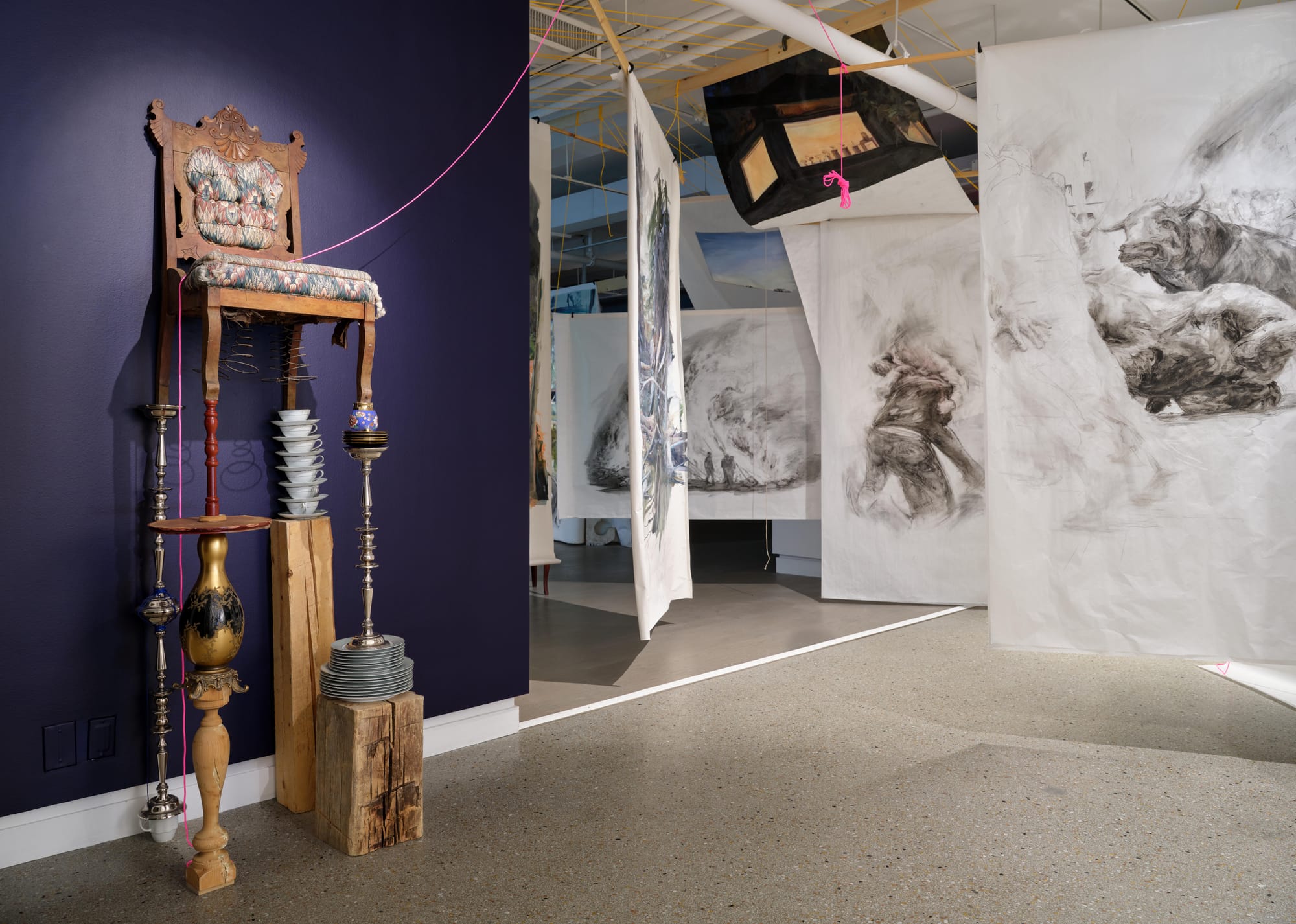
The way you’re talking about catastrophe, there’s definitely something quite nuanced and paradoxical about it. It brings to mind the concept of apocalypse or the word apocalypse. It’s a word that’s come to be almost exclusively understood as representing the end of the world, the ultimate expression of destruction. The way you seem to be presenting catastrophe holds these two positions at the same time, that of revelation and destruction, or revelation through destruction.
I’m inspired by the world around me, whether it’s locally or things happening globally. On some level, my work is often about the cognitive dissonance of the way some news is presented, and the interpretation that is given. Sometimes with extreme events, when things are pushed so far, the only option left is to push against it. If you’ve swung so far to one end of the pendulum, there’s only room to go in the opposite direction. I don’t see this show as being pessimistic, more that out of destruction comes hope and out of these extremes there can be moments of glory, and moments of joy, and moments of connection. That’s where I’m going with it.
Moments of joy as revelation perhaps. This brings to mind the images of hunting blinds you see scattered throughout the exhibition. How the person or the hunter who’s concealed within the hunting blind is in a position that reveals the world that they look upon in a hyper-focused way. Can we talk a little bit about the hunting blind, which is clearly a very important metaphor in your work?
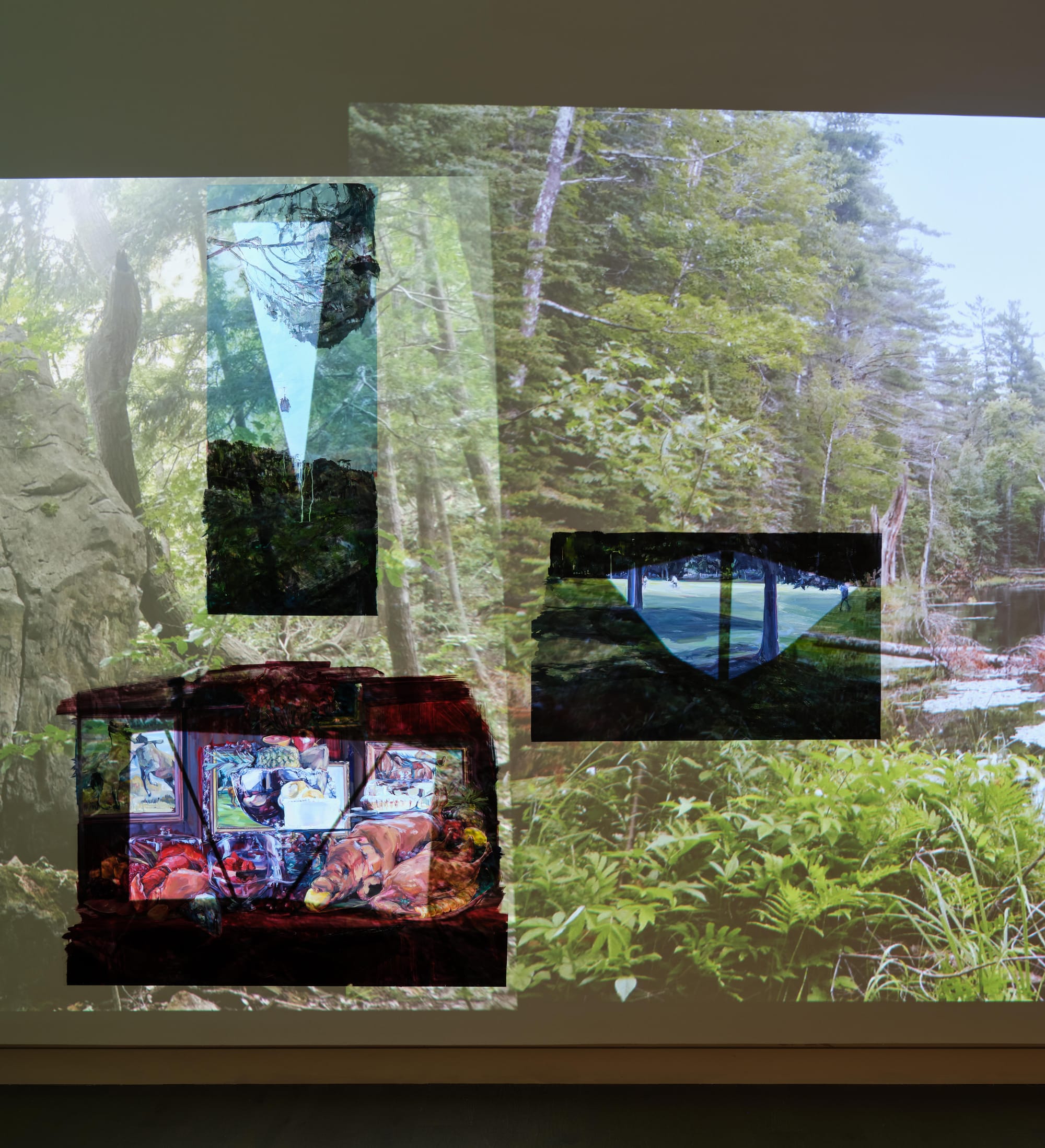
As you walk into the gallery you’re walking through the first installation, which has all the work hanging on angles—that essentially started with a body of work called All and nothing. Then as you walk into the gallery you’re presented with the large Tyvek sheet, an installation with the title the one-eyed man is king. Then you have the projection images, Not like the other, that’s the most recent body of work in the exhibition.
I conceived the latter two bodies of work at the same time, as companion pieces, and the hunting blind is relevant to both of them. What interested me was how everything in society is becoming more and more polarized, the divisive nature of things. I was interested in how do I capture that? For many years, I’d been fascinated with the image of the hunting blind, and hunting imagery more generally. I jotted a few things down and left it. I didn’t know what to do with these ideas. So the hunting blind just kind of sat there.
What interested me on a purely aesthetic and conceptual level was that a hunting blind is built to camouflage and disappear [the hunter], but at the same time they have these windows you can unzip that are bold, unnatural geometric shapes that you target your prey through. I found it really intriguing how, from the outside of the hunting blind looking in, the windows appeared like flat voids. This void shape is looking back at you.
What I realized about the hunting blind is that when it’s placed in an environment, it completely defines the nature of that moment, by creating a division. When you place a hunting blind into an environment, you create the “us” and “them”: you’re either inside the hunting blind, in which case you are the hunter, or you’re outside of it, in which case you are conceivably,, the hunted, or at least, you’re not part of that interior place.
A lot of my past work has been interested in the specific act of changing the nature of a moment. You take a whole, you draw a line, and immediately you’ve split that whole into two parts. Division is invented. What fascinates me is the idea that everything coexists until somebody decides it doesn’t anymore. That you’re either on one side or the other. So for me the blind represented the idea of “us” and “them” or, at the very least, division and the notion of the “other”.
When you look at the wall of projections, the cutouts are suggestive of being inside and looking out through the window of the hunting blind. Then on the [large] Tyvek piece I’ve put you outside the hunting blind, as if you’re being gazed at. What I’ve asked the viewer to do, as they move between the two sections, is to take on both roles, and experience both sides, forced into playing a role without really having a choice.
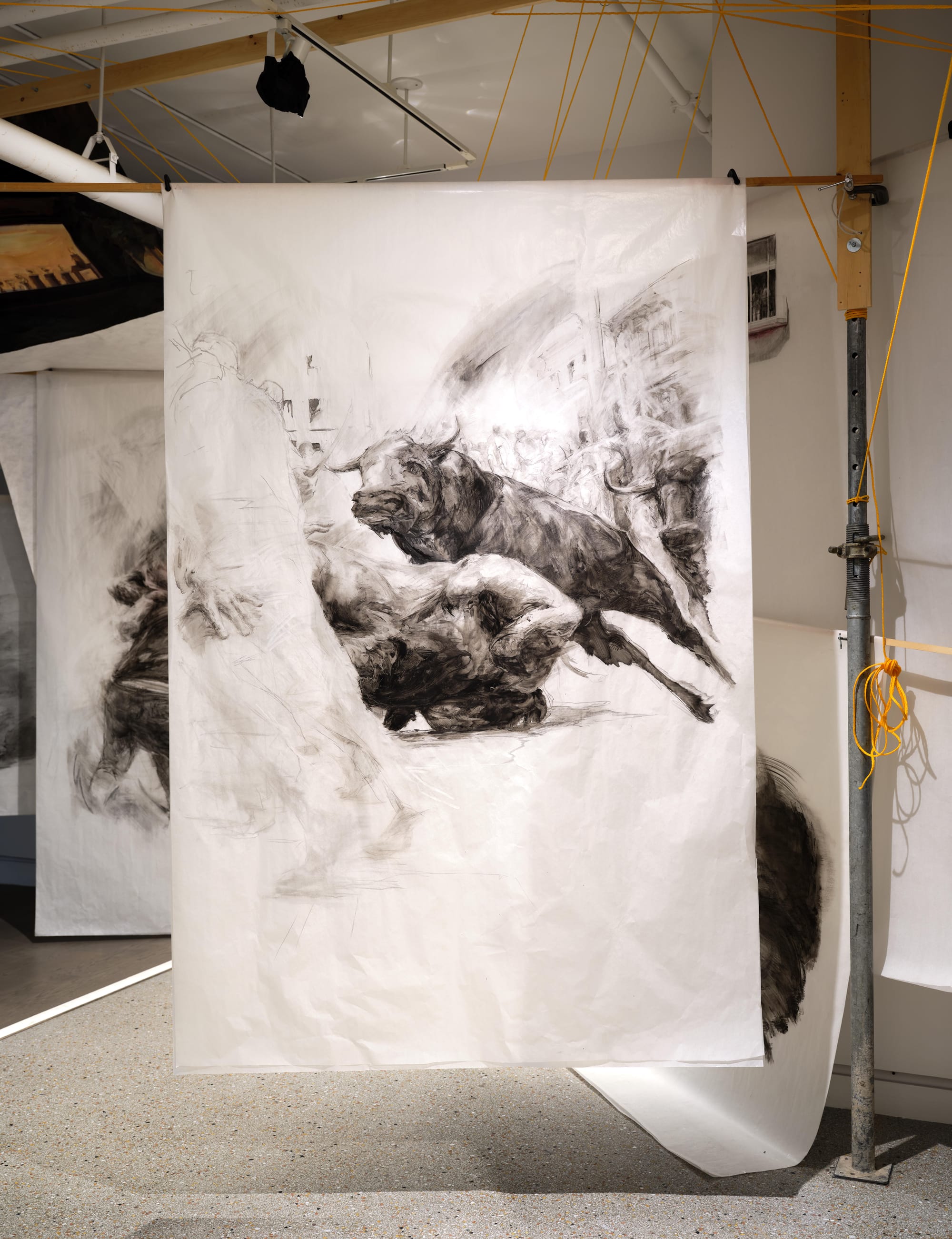
From Glorious Catastrophe. (Image: Jeremie Warshafsky)
All of those relationships, particularly with regards to the hunting blind, the relationship between hunter and prey, between the human and the natural, they definitely come to mind for me. But there’s also the relationships between the artist and work, or the viewers and the exhibition that we’re looking at. There’s this through line, essentially acts of looking, that ties all of these relationships together.
But each of these relationships is also shaped by dynamics of power, control, and even ethical responsibility. Experiencing this exhibition, I find myself quite self-aware in my role as a viewer, asking larger questions about what it means to look at art or how to look at art. I’m curious to hear your thoughts about this.
What interests me about my role is more about creating an experience versus thinking about creating an object. Even though imagery is important, the role of the work is to affect a space and create a very particular sense of place. I’m not really interested in having the viewer think about, “Oh, I’m looking at paintings right now,” or that they’re looking at a drawing, but more in trying to evoke a sensation, and when necessary to implicate the viewer.
For instance, with the projection piece, Not like the other, its intention was planned out, I knew what I wanted to achieve—selective, partial views. I didn’t first try out the projections on the imagery, I just painted the imagery. When I was working on those in the studio, they were intact, complete images, but working with the knowledge that the majority of the image was going to be obstructed by a projection; that you were only going to be shown a small portion of the image clearly through the cuts of the windows. But that was okay. Even if I love this painterly section that I’ve done in the corner of an image, none of you are ever going to see it.
The whole point of that is that you’re supposed to be hyperfocused on only one part of the moment. The rest of the moment is slightly expendable, but it still has to be there because the idea is lost if the rest of that painting isn’t there. The individual value of each object and element is less than its contribution to the larger experiential moment.
The concept of power, and the hierarchical ways in which it’s typically structured, is an important theme in your work. You’ve also spoken to me about your interest in a suspended moment between power and powerlessness. Perhaps it can also be understood as the moment between glory and catastrophe. Can you say more about this and how it comes through in your work?
I did an undergraduate degree in science, I was always really interested in science, then opted to go into fine art. There is potential energy, and there is a clear moment when something turns from potential into kinetic energy or a different form of energy. For me, there is so much in the possibility of a moment. I’m fascinated with that split-second that creates a change, for example, between thought and action, between action and outcome.
All and nothing was a response to that, the fact that a location or place can be defined by what is occurring in it at that moment. Initially, that whole body of work was about the idea of the unused spaces in our city, and how different people occupy them in very different ways and, therefore, define them for that moment that they’re occupying and using them. They take on a very specific quality and definition. Like unhoused individuals living in a space in a park, you’ll walk down a path and suddenly realize, “I’m in someone’s living room”, and I need to respect that.
As I said, drawing the line in a location or in an idea and dividing it into two parts, there’s this moment where change is about to happen. In a broader way, Glorious Catastrophe is about that relationship between action and outcome.
In the way the exhibition is designed the viewer is really being set up to have a kind of exploration or discovery. As soon as I entered the space I felt like I was going on a bit of a journey. I’m curious to know more about your approach when making an exhibition like this, and your thinking when it comes to the viewer.
I’m fascinated by that feeling of not knowing what’s right around the corner, and wanting to see what’s around the corner. That comes across in my work, finding reasons for small, mundane moments of joy, but also moments of discovery in the exhibition. Some of these are not planned, it just happens as the work gets put into its location and I start to respond to the location.
I’ve done bodies of work before in which I’ve been intrigued by the idea of manipulating the viewer into having to interact with the work in a certain way. Like physically having to climb a ladder in order to see a painting, or bend down and turn their body in an uncomfortable way to look at another painting. A lot of that speaks to how we are constantly manipulated by how things are presented to us, and the impact of bias variables. So, when it comes to the presentation of my work, I’m interested in using bias variables to shape the way you’re potentially going to interact with the work and relate to the subject matter. And that might affect how you perceive that subject and what you take away from it. I request that the viewer moves through a space and ask them to relate to the content in a certain way and to trust me.
Years and years ago, maybe in art school, somebody said, “The worst thing you can do is think about the viewer; you shouldn’t be thinking about the viewer when you’re making the work.” Because then you’re worrying about whether people are going to like this, rather than being genuine and honest and making work that feels right for you. That’s the way you really resonate with people.
On some level that totally makes sense, right? It can be difficult to put this into words, but I become the viewer as I think about my work and while I’m making it. Of course, I know that I’m making it, but on some level I’m more like the viewer, I get excited about how I’m manipulating my own reality as I’m making the work, and the sensations I am making myself experience.
Glorious Catastrophe runs at the Koffler Gallery from March 26 - June 7, 2026.
Share this post