
Curating From a Sense of Necessity
As Koffler Arts closes out 2025, General Director Matthew Jocelyn looks back on a year of exhibitions, experiments, and encounters—and makes the case for why cultural institutions should resist being easily summed up.
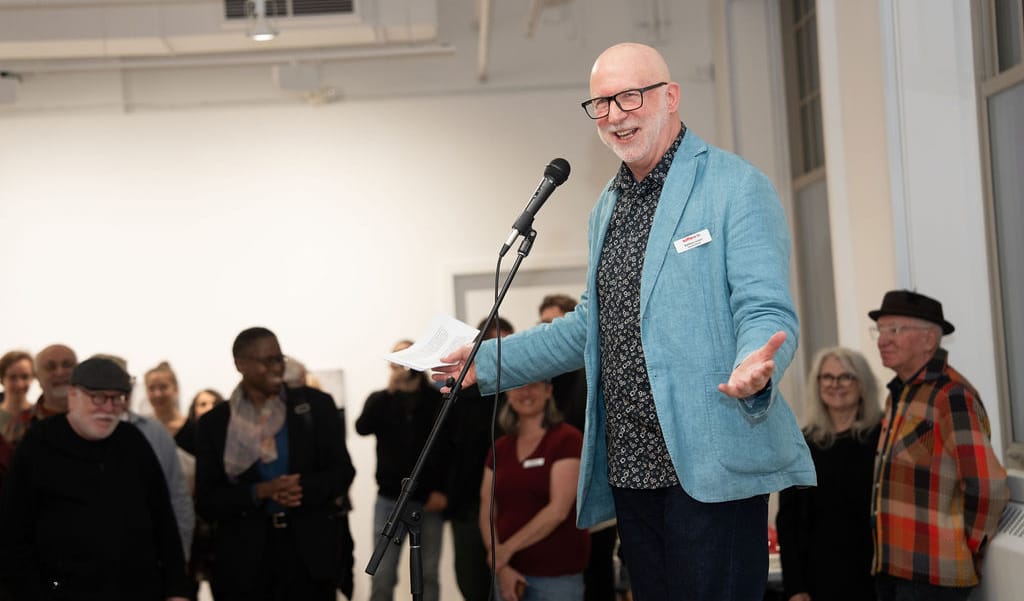
As 2025 draws to a close, we look back on another dynamic year of programming and activities at Koffler Arts in this wide-ranging conversation with General Director Matthew Jocelyn. It was a year of programming that defied easy categorization, from Christopher Morris’s controversial play The Runner and the formalist experiments of pioneering artist Elana Herzog, to Tracey Snelling’s immersive sculptural dreamscapes in Intergalactic Planetary—to offer but a sliver of examples. It was also a year of new beginnings, with the inauguration of a second gallery, Koffler301, dedicated mainly to showcasing the work of Toronto artists.
Jocelyn reflects on the thinking behind the year’s programming, what it means to curate out of a sense of necessity, and how Koffler Arts continues to evolve its role within Toronto’s cultural ecosystem.
What were some of the works you encountered in 2025 that particularly impressed you or blew you away?
I saw a Liliana Porter exhibition in Buenos Aires, which absolutely knocked me out. She’s one of the great artists of her generation, now in her eighties. There was Marta Minujin work as well in Buenos Aires. These are two extremely strong women artists of their generation that have voices like nobody else. Those were very exciting encounters.
Normally when I think back over a year, the most spectacular experiences are usually with dance—because dance is the thing that systematically touches me the most. There are contemporary choreographers I gravitate towards because I know my world is going to be enriched by the experience. But I have to say that hasn’t happened so much this year.
You know, one of the things that jumped out from this year was a textile show called Fuzzy Thinking at the Art Gallery of Guelph, which included a number of 19th or early 20th century Indigenous pieces along with contemporary textile artists. Notably, many of the Indigenous pieces credited the artist responsible for the work as “once known.” It was the first time that instead of saying “artist unknown” or “anonymous,” I had seen this accreditation: artist once known. I felt this wave of emotion, as though this simple formulation enabled me to feel that this artist was also a mother, for example, and her family knew her. Or this artist was a father and a hunter for the community, and people depended on him. And now, 200 years later we have no idea who he or she was.
Then you look further back and you say, okay, this Etruscan work or this Egyptian work, where labels generally indicate “unknown artist” —no, that’s wrong. It’s actually “artist once known.” By those simple words it humanizes a whole way of perceiving the work itself. Maybe that sounds weird as a big experience from this year, but it was a penny-drop moment.
Tracey Snelling’s exhibition Intergalactic Planetary, which recently completed its run at Koffler Arts, resulted from you encountering her work at a show in Berlin. What was it about her work that appealed to you and how did it fit into your vision for Koffler Arts?
If I had to name an a-ha moment from this year, it’s the Tracy Snelling show at Koffler Arts, because I think it’s an absolutely spectacular show and unlike anything that I have experienced in Toronto before.
When I first encountered her work in Berlin, it was in an old 19th-century home that has been turned into a gallery called Haus am Lützowplatz, where it occupied the whole ground floor, filling it with architectural structures much like the main one that was in our gallery, these piled cinderblocks of habitations—a habitat of 10 storeys with 200 animated windows, some of them with photographs, some of them with films, some of them with little pictograms or sculptural features. And then a whole wallscape of imagery and iconography and posters and flashing lights—the kind of pop cultural emblems we have all around us, from all around the world. Just standing in that space and feeling there was a deep atavistic connection with what she was creating. The immediate image that came to me was the prehistoric cave paintings at Lascaux—the handprints, the images of the bison, deer and other animals, these very identifiable icons.
The same images are repeated over and over again: nobody’s looking for originality as it were, but they are looking for identity. In the same way, when I put something on the wall it reflects some part of me; I exist and my sense of existence is reinforced by creating identity in my space. So Tracey’s iteration of that is a Star Wars poster and a Bruce Lee poster and a Barbarella poster and a flashing neon light promoting ramen. It suddenly confers a personal value to these things that from a more “sophisticated” cultural perspective might be disregarded as “just a bunch of tropes,” or as vulgar pop art. Tracey transforms these things into something so profoundly human and atavistic. Primitive, but in the sense of being primary, like the primary gesture of how do I confer identity to myself and to my space? That’s something that connects us to 20,000 years of people creating identity, and connects us to all cultures, because all cultures do that in some way or another.
When we checked in with you last year we talked a little about your curatorial or programming vision, and you said “the principle of incoherence is precious to me,” that you were more interested in eclecticism than being able to sum up your programming in a sentence or two. In the time since you started at Koffler Arts, it’s been interesting to see how well the exhibitions have made use of the gallery space itself, albeit alternating between the more maximalist and immersive approaches of Botannica Tirannica and Intergalactic Planetary, and maybe the more intimate and classical staging of the joint Elinor Carucci-Hannah Altman show.
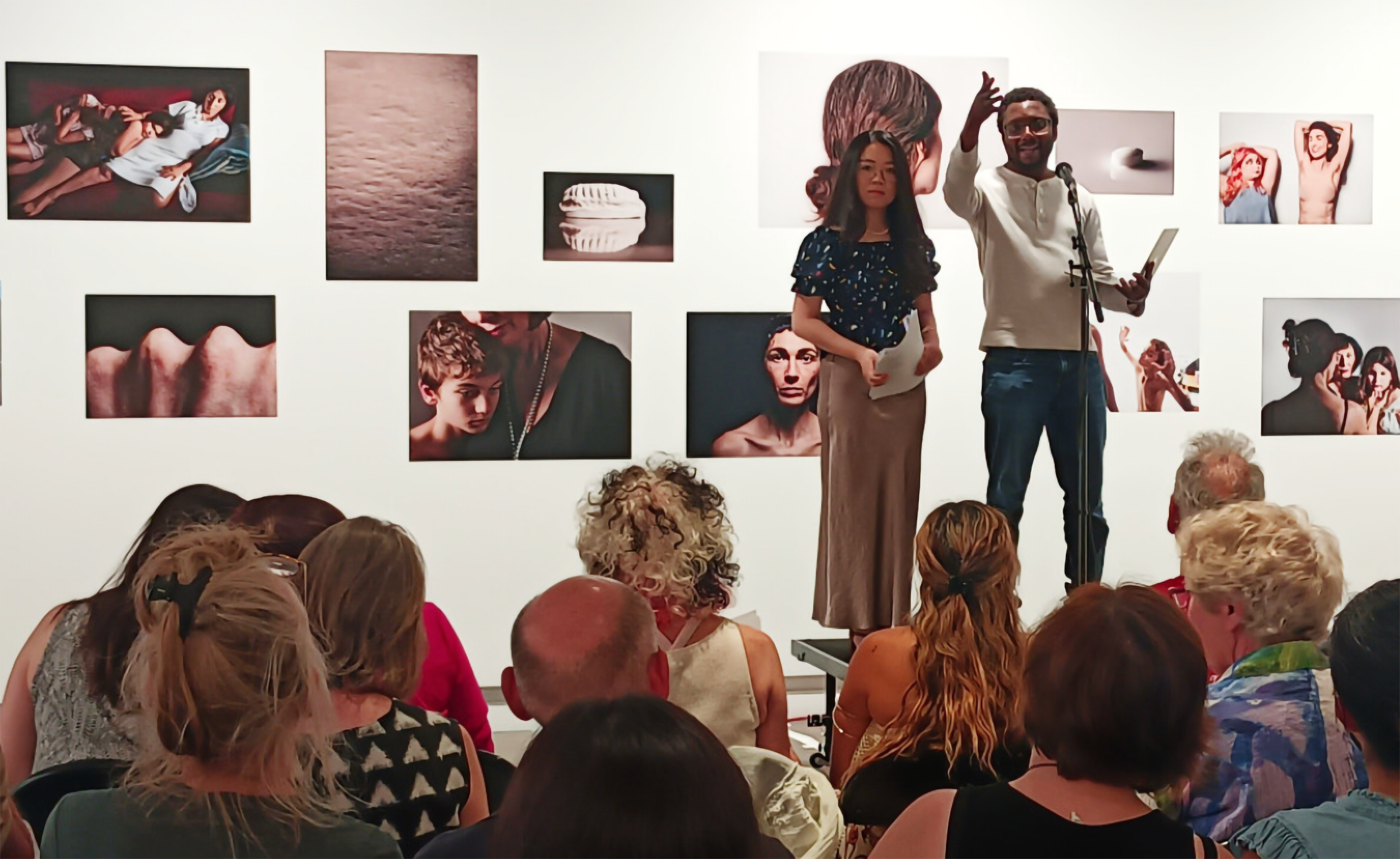
Even in the case of Elinor Carucci the point was to do something different. We invited her to imagine a salon-style installation. Elinor is one of the world’s major figurative photographers and this was the first time she had been invited to theatricalize or dramaturge her work in this way. Printing the photographs in different sizes and arranging them as a multi-layered tableau creating a wallscape, as opposed to a simple line of photographs. We wanted to give the work its greatest storytelling potential, and yes, that might have involved some understanding of theatrical space or theatrical narrative.
What does that mean for me? It’s that I want the body of the spectator to be engaged. When you talk about the immersive aspect in work like Tracey Snelling’s, the body is forcibly immersed. You have to crouch down to see some of it, or stand on your tippy toes. And maybe you have to go around something. Then you are assaulted from behind by something else. With the Elinor Carucci-Hannah Altman it was more subdued and contained, but the layering effect engaged the spectator in a different way.
For most of our shows, we have also invited a clown to give a gallery tour. Of course, we have our more erudite interventions by curators, art history scholars, university professors. But I love the idea of a clown talking to us about contemporary art and translating it through their clown language and through their clown perception.
There is a clown-artist and dancer we have worked with, Susie Burpee, who has a marvellous alter ego called Allegra Charleston. The people who were on her visit of the Elinor Carlucci exhibition ended up performing some of Elinor’s photographs. The exhibition is about midlife: when the lines start to appear or the hair starts to go gray, or the flesh starts to sag a little bit. It’s all self-portraiture of her own body as it ages, in relationship with her family. One of the photographs was simply five or six little pubic hairs that are turning grey on a blank background. So Susie had us perform the pubic hair. We had 30 people being led around by a clown, dancing as though we were pubic hairs. That for me is a perfect example of what we’re trying to achieve at Koffler Arts.
That’s one way of living up to the principle of incoherence.
We recently got a review from one of the arts councils informing us that the jury couldn’t get a clear read on our curatorial line. My response was, “Well, how fantastic. And what if there isn’t a clearly definable or reductionist curatorial line?” Like, let’s be honest. It’s funny you remind me of that comment of 2024 because it is so true.
What is necessary now and who gets to deem that? Well, a curatorial team gets to deem that, but so does a certain amount of spontaneity. What is necessary now might be Tracy Snelling, or it might be a gorgeous series of portraits of Toronto artists and art professionals by Dimitri Levanoff that take the creative pulse of our city. Both of those things can have a sense of necessity.
Another thing you spoke about early on in your tenure was about thinking through questions of legitimacy, like what is Koffler Arts’ legitimacy as another arts organization in the city, one that examines Jewish culture through a broader intercultural lens. A year later are you still thinking about legitimacy?
It’s weird, but the word that comes immediately to mind when you ask that is “appropriation.” You have to appropriate your own legitimacy at some point. You have to just say this is legitimate, because if you encumber yourself or addle yourself with too much doubt or self-questioning, then inevitably the response becomes something that is slightly more timid and intellectually structured. Whereas what feeds Koffler Arts is something more visceral.
When I was talking a moment ago about this sense of necessity, necessity is a visceral thing. Necessity is: this lands at this moment in a way that is going to make its resonance palpable and pertinent. We look to the poetic gesture to displace us, give us a nudge or a push, and here I use the term poetic gesture to mean any artistic rendering. In emotional terms we call something “moving,” which literally means being displaced from one position to another. And so we’re looking for the poetic gesture to nudge our heart, or nudge our brain, or nudge our worldview, to blow on us like a leaf and make us tremble.
That’s where the sense of legitimacy is for me. I’ve been at Koffler Arts for two years and there’s a team of incredibly devoted and competent professionals I get to work with on this project. We have reached a place where we can be authorized to blow with more assurance, to nudge with more insistence, or to try to displace with a more affirmative conviction.
This year saw the conclusion of Young Changemakers, a program supported by Koffler Arts that brought professional artists directly into classrooms to provide hands-on arts education to elementary school students in Toronto. How do you look back on its success?
Young Changemakers was a three-year project led by two very experienced art professionals, Annie Vandenberg and Paula Gallo from Recreate Space, who worked with grade-four students in developing art projects within schools. Funnily enough, there was almost a Tracy Snelling aspect to it, because each one of these classes created a project that was put on the wall of their classroom or became a permanent fixture of the hallway, or became part of the school gate. So now three years later, you might be walking through the school gate and there’s still something that you and your friends and classmates made. Again, there’s that sense of imprinting your identity on your environment, like putting up that Bruce Lee poster.
Certainly getting to meet the kids and hear them talk about how this program was a really foundational experience for many of them was very satisfying. I loved the fact that Koffler Arts was able to work with the students of Thorncliffe Park Public School, one of the most diverse schools in the GTA and of the largest elementary schools in North America.
Earlier this year in Arcade we published an interview with Alex Sarian, the CEO of the Werklund Centre in Calgary, about his book The Audacity of Relevance. In it he argues that our non-profit arts organizations and institutions need to shift to a more relationship-based model with audiences rather than play the traditional role of cultural gatekeeper. With your recent experience at Koffler Arts, what advice would you have for other organizations when it comes to navigating these challenging times?
It’s hard to do that without sounding a bit demagogic, so my top advice would be don’t come to me for advice. The arts councils have become particularly politicized and now have very clear mandates and content criteria of what to finance and what not to finance. But that mandate has the potential risk of homogenizing arts institutions dependent on public financing, or partially dependent, because they may end up working to cater to the political agenda of the funding bodies. Whether or not that agenda is legitimate, it has a huge impact.
I’m an older guy now, I don’t have career ambitions at this point. I don’t need to worry about getting a better job three years down the road. I was never very good at that in the first place, but I’m liberated from any velleity of that. So in a way, while always defending the interest of the institution, it allows me to think in terms of the above-mentioned agendas as important only insofar as they allow me to encounter and share work that corresponds to this mandate of necessity for Koffler Arts as an institution.
So the way I would format that advice is promoting the idea that what’s most exciting about institutions is their personality, including the contradictions inherent in any personality, and not the way they ascribe to a foregone recipe or mandate established by others. What’s exciting is going to an institution and saying, “Oh my God, I never would’ve thought I would see that here,” or “I never thought I would be exposed to work like that.” That’s what’s exciting about content, but it’s also what’s exciting about how the institution sees its role. Arts institutions should constantly want to surprise us, not just reassure us as to what the institution is.