A Show for Good Fortune: Gamelan for Beginners
David Powell went to Java for the puppets and came home with a lifelong obsession with the sound and craft of the gamelan. Ahead of his interactive gamelan workshop at Koffler301, Powell on tuning with gum, and the interplay of strings, shadows, and steel.
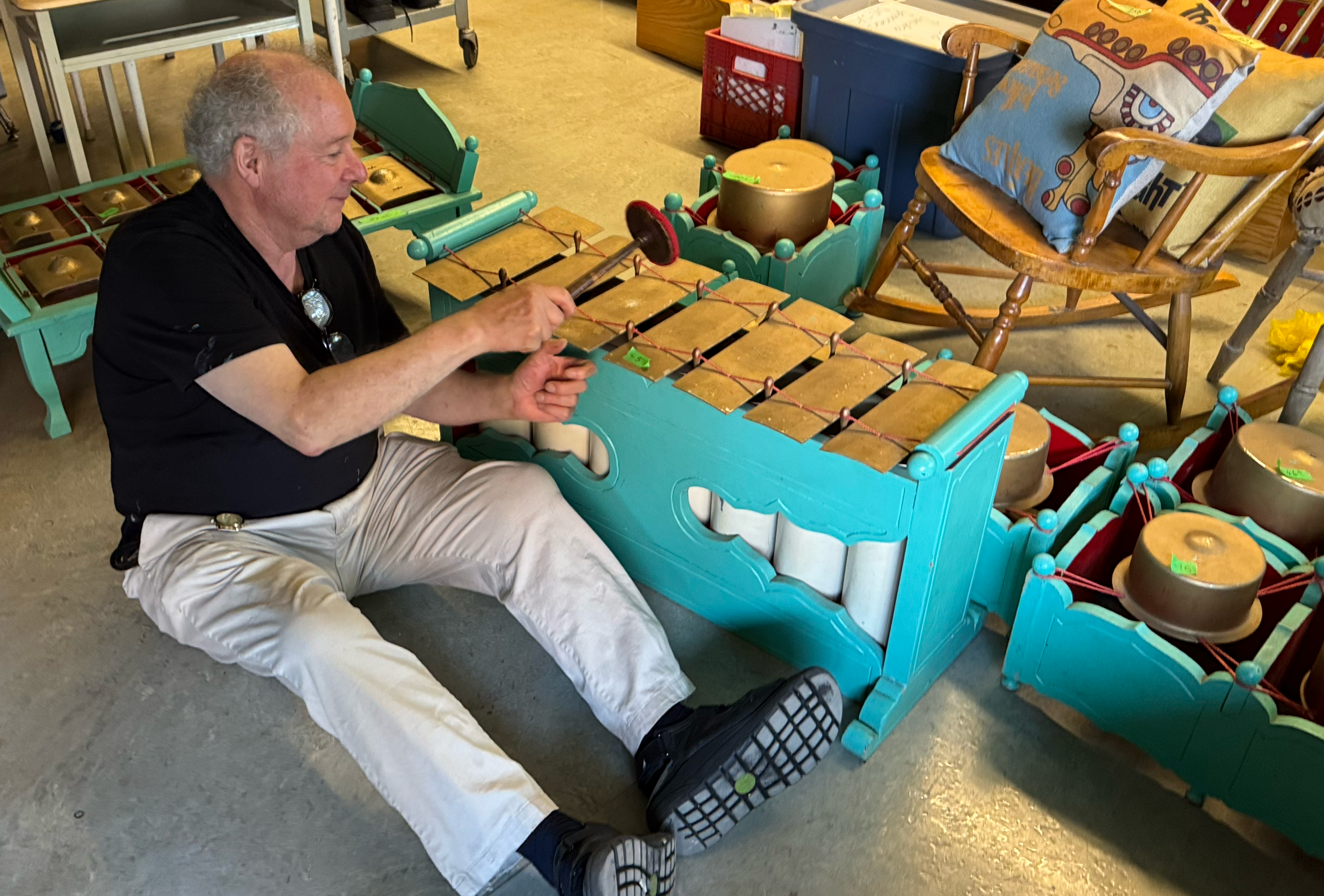
David Powell’s gamelan is living, for now, in the back room of a primary school in Toronto’s east end among stacked milk crates, rolling carts, and a wood rocking chair occupied by a teddy bear in a knit sweater. Powell is on the floor beside a row of turquoise frames strung with red cord, a padded mallet in hand, working out which keys have drifted. Strips of green tape mark the notes. He has been making a list of everything that needs re-tuning, and trying to do it without disturbing the classes on the other side of the wall.
“If we hammered around here, that would have maybe brought it up,” he says, tapping near the edge of a key. “Bringing them down is trickier. I think I’m going to use the cheap technique, which is to put gum on the inside. It’ll give it more weight.” The real worry is the straight keys. If those have gone out, the fix is a grinder, which nobody wants running in a school.
The set’s regular teacher is off sick, so Powell is cleaning and tuning it before it travels to Koffler301 for the gamelan workshop he’s giving on December 4, after which it goes to another school up the road, whose teacher was rear-ended on her way in on the first morning of term. I ask whether the instruments are cursed. “They’re cursed,” he solemnly concurs with a nod. I gently sidle away.
Most people in Toronto know Powell for puppets, through Puppetmongers, the company he runs with his sister Ann. His fascination with gamelan emerged naturally from his puppetry practice. Indonesia, he says, is “one of the only places in the world that for a long time has taken puppetry seriously as an art form,” for hundreds of years before Europe caught up and North America started catching on. Many years ago, he got an arts grant and travelled to Indonesia for three months to see its puppetry up close. It was ritual as much as theatre, he says: you hire a show to bring good fortune. “But the music is just stunning,” he says of the gamelan that accompanies the shadow plays. He came home having “actually fallen in love with the music rather than the puppetry.”
But there was no gamelan in Toronto back then. Instead, he read whatever he could find, starting with books from the 1920s, and spent time in Java with a Dutchman who had gone there after Indonesian independence to help build the national radio station; as a boy in occupied Holland he had made himself a little gamelan out of pots and pans. Inspired, Powell began building his own gamelan. By the time this set was finished, ten or so years later, the city had caught up a little: the Evergreen Club, a Toronto-based contemporary gamelan ensemble, was founded; a Balinese set arrived at the University of Toronto; as did another large gamelan set at the Indonesian consulate. Eventually the Toronto Board of Education bought a set big enough to split three ways, rotating through schools each term. Powell still visits with teachers to show them how to use it.
The set we’re tuning today has its own name, as all sets do. This one was christened Anak Enak, “delicious child.” It has spent most of its life in classrooms, where it suits beginners perfectly. There’s no need to learn where your fingers have to go, as on a fiddle or a trombone; the keys have numbers, there’s a beat, you play your part. There’s a drum that leads, and a gong pattern underneath everything. The kids learn melodies, and sometimes they move on to composing their own. “It’s all to do with listening to each other and interlocking all the parts,” he says. “It gets the kids actually listening and playing.”
It’s a form built for play and improvisation as much as for preservation. When I ask how he went about mastering it, Powell stops me. “Learning, definitely not mastering. I’m very much a beginner. That’s why I can work in the school. Me and the kids are all beginners.”
The big gongs hang in a frame across the room, made from steel storage drums. He finds a mallet and gives one a strike. It’s a kiddie version, he says, pitched high; the real thing “would make your heart throb.” One of the pleasures of a live set is hearing them at all. Look for gamelan online and you mostly can’t, he says, because recordings can’t access the required octave.
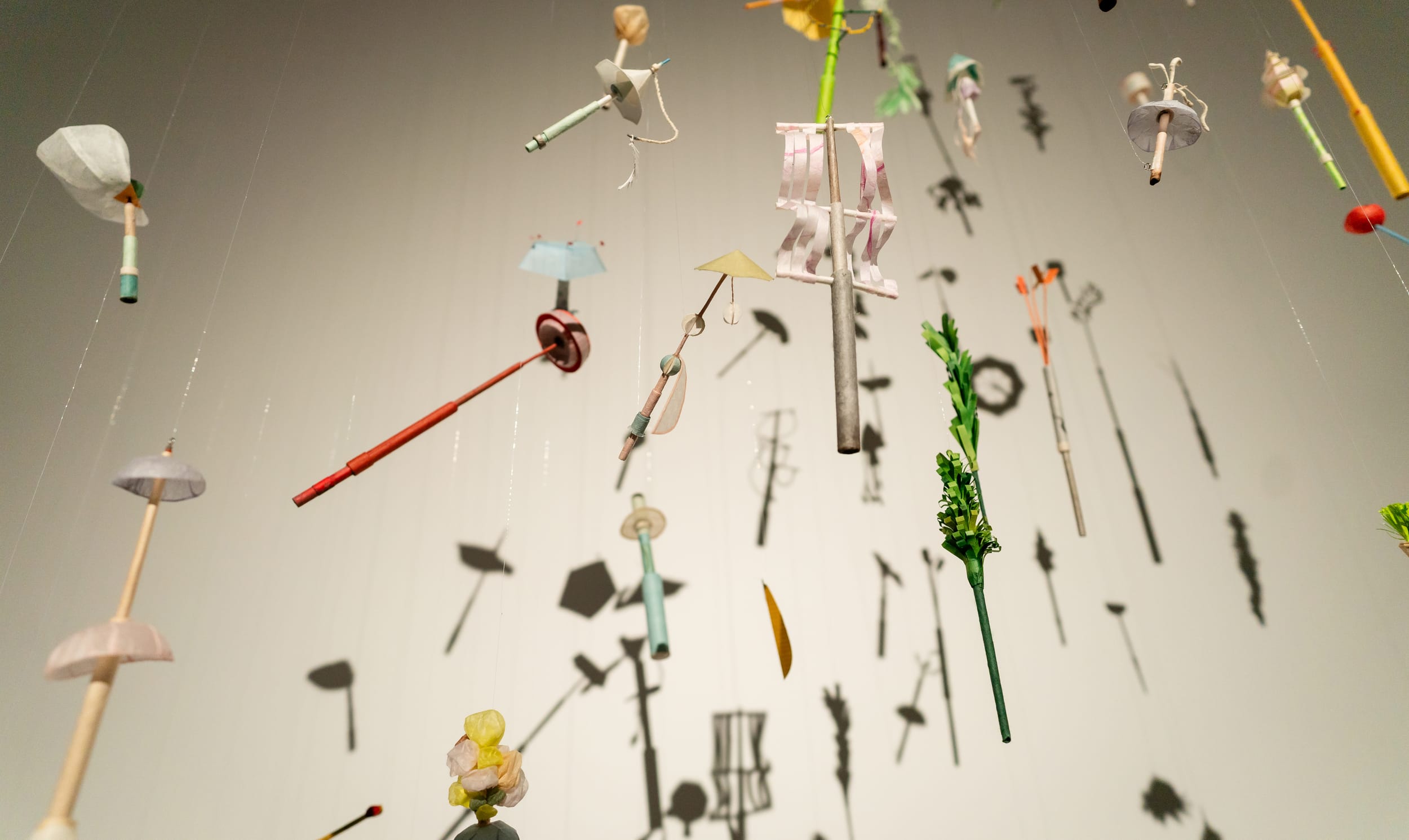
This term the school board isn’t sending its instruments out at all, so Powell was delighted to get the call “to actually get back in and get my fingers dirty.” In a small world moment, he had been talking through lighting ideas with Cybèle Young for Kamiphony, her exhibition of kinetic paper machines that fills the Koffler Gallery with small repeating movements, amplified sound, and dancing shadows. Young’s great-uncle was Colin McPhee, a composer who went to Bali, wrote the first major Western study of its music, and folded its ideas into his own. When the gamelan came up in the conversation, Young got very excited. Though his instruments are more in the Javanese tradition, Powell says, the Balinese mode allows for a little more energy.
The gamelan is already in the gallery, in a sense. Young built the idea of one into Kamiphony’s Machine Pantheon, a series of paper sculptures driven by mechatronics that click, grind, and whirr their way through a shifting musical environment. The title joins the Japanese kami, paper, to the ancient Greek phonē, voice or sound. For the workshop, Powell will set Anak Enak up among them, talk about it a little, then invite people to come up and play, assembling some simple pieces together. “Because that’s the fun.”
His creative life these days is still mostly puppetry. Puppetmongers now anchors the Puppetry Exchange, a donated space in Kensington Market. Their new landlord, who owns a few spaces in the market, is an artist herself and wanted to keep art happening there among the coffee shops and boutiques. They share it with Shadowland, Clay & Paper, and Jumblies. It’s eleven feet wide at most, he says, but it goes back and back, room after room, with proper workshops. In a city where artists routinely lose their spaces, it’s a remarkable thing to have, as Powell agrees. Naturally, he’d like more of it. Asked whether the gamelan could live at the Exchange, he laughs. “I’d love to have this set there and not in a school, but there’s just not the room.”
Through September the Exchange opened on Sundays to show other companies’ puppets alongside a collection gathered from around the world, which keeps growing as people clean out their own basements, or other people’s, and call to ask what to do with what they’ve found. The latest arrival is a trove of old Asian shadow puppets, pre-tourist, many of them a little too sexy for school visits.
Before I go, I ask him for a photograph. He gets down on the floor beside one of the melody instruments, mallet raised, and gives it a couple of strikes for the camera. Then he picks up his list. “Now I have to figure out if I can do it without making too much noise.”
Music in the Machine: David Powell leads an interactive gamelan workshop at Koffler301 on Friday, December 4, 6:30–7:30pm, upstairs from the exhibition Kamiphony by Cybèle Young, on view until December 13.
Share this post