Everything Made of Glass Will Eventually Break: The Glass Orchestra
Forty-nine years after a York University class concert that never quite ended, Eric Cadesky on candlelight, breakage, and the world’s only ensemble that builds, plays, and tours its own glass instruments.
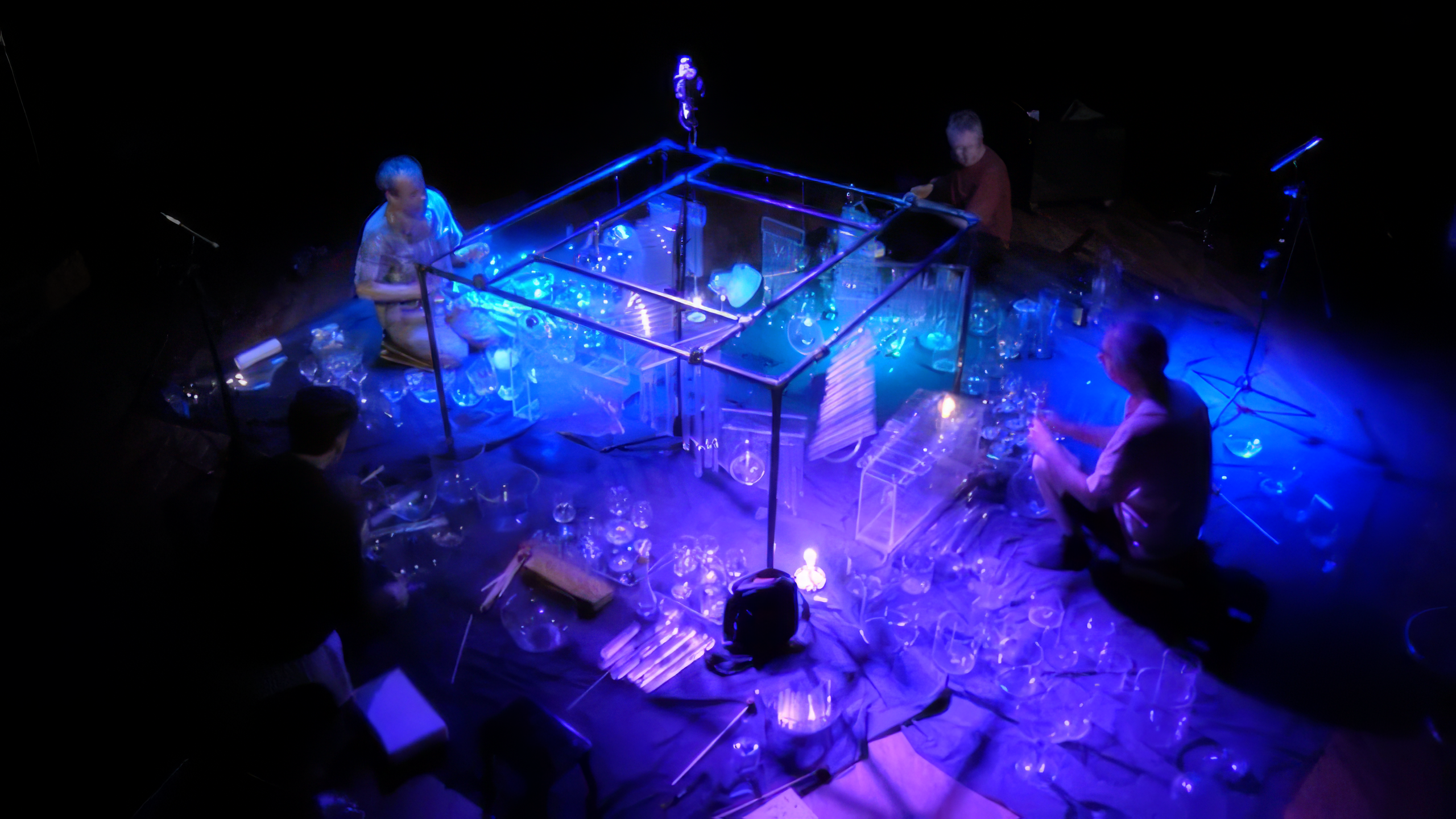
The Glass Orchestra performing at Array Space in 2016 (Courtesy Eric Cadesky)
The first time I saw the Glass Orchestra, at Array Space somewhere in the mid-2010s, in my first years in Toronto, I remember having one of those moments of clear satisfaction at being in my new home: good, I’m in a city where musical things are happening that are as weird and beautiful as they are genuinely great. A roomful of players on the floor in near darkness, candlelight catching on half a tonne of glass, coaxing music out of it that seemed to arrive from a different realm of sonics entirely.
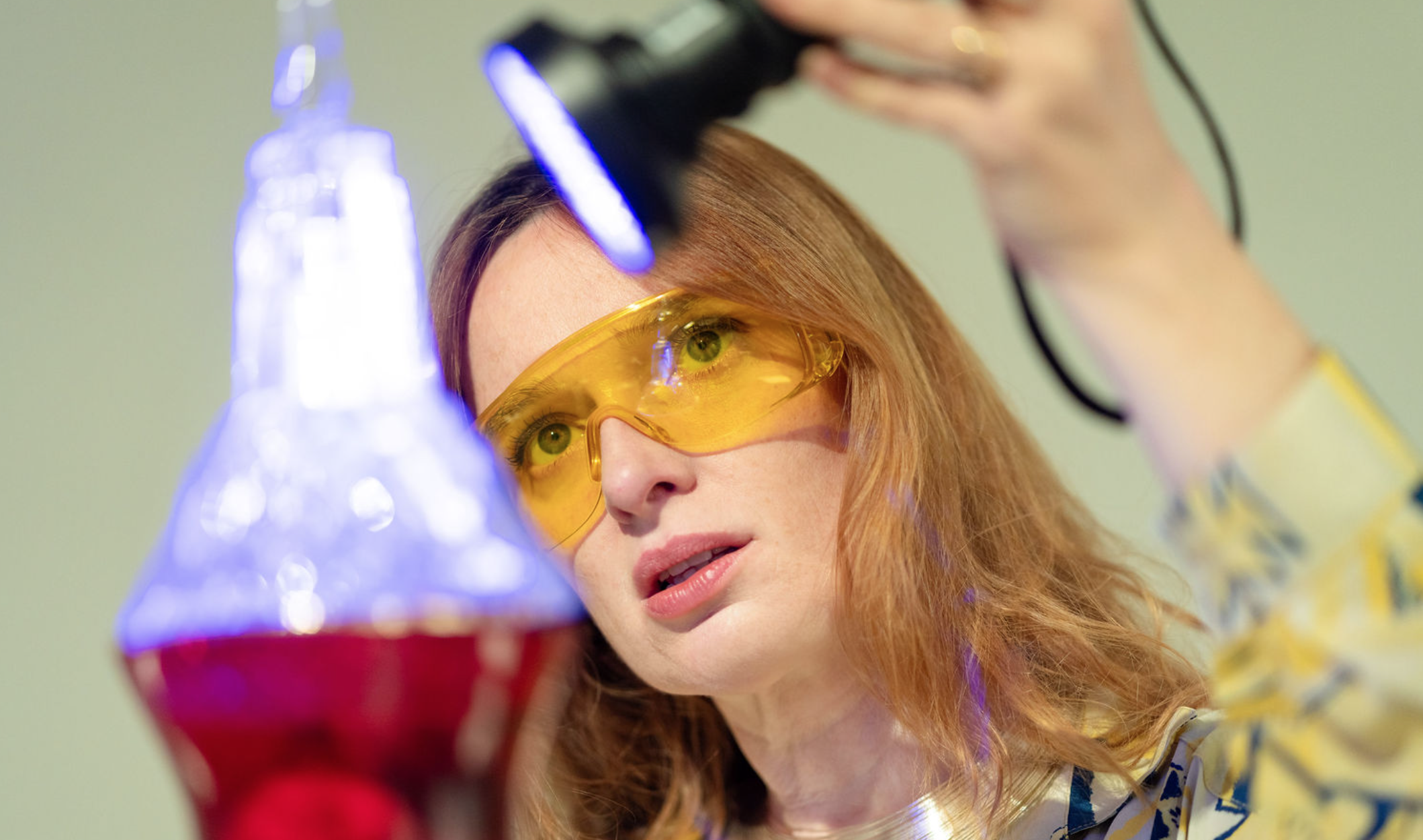
Ahead of their performance at Koffler Arts on July 24, presented alongside Natalia Romik’s Plague Crystals, I called Eric Cadesky, the ensemble’s artistic director and the inventor of many of its instruments, and asked him whether it still feels the good kind of weird to him, forty-nine years in.
“Sometimes,” he says. “But not as weird as the early days. It’s always been fun, though. And as you can imagine, over the years, the challenge has changed. The original one was to explore the sonic properties of glass. After forty-nine years we’ve covered a lot of ground.”
The Glass Orchestra came out of York University in 1977, a mythical moment in this city’s experimental music history for those of us who arrived too late for it: the early Music Gallery, a music department stocked with professors pushing at the edges of what audio could be. “That created an atmosphere where we basically weren’t afraid to try anything,” Cadesky tells me, “whether it seemed weird or not.”
The ensemble itself began as a class concert. Somebody, and nobody quite remembers who, suggested trying all glass instruments. An entire class played a twenty- or thirty-minute piece by finger bowing, running a fingertip around the rims of wine glasses, bowls, or whatever else they could liberate from their parents’ cabinets.
A few of them didn’t stop. Cadesky joined when it was still “a glass orchestra,” he says, before it became the Glass Orchestra; the exact history depends on which member you ask of those still around from that time. Everybody stayed on the lookout for anything glass you could get a sound from, and some of them were decent with tools, so they taught themselves blowtorches and built what Cadesky calls primitive glass woodwinds, reed instruments, tube drums, roughly copying the sections of a conventional orchestra. “There was no specific time where we said, okay, we are going to now develop some instruments. It sort of grew organically along with the evolution of the ensemble.”
The building earned them an entry in the New Grove Dictionary of Musical Instruments, and a distinction nobody has taken from them: the Glass Orchestra is still the only ensemble anywhere that designs and builds its own glass instruments, writes and improvises for them, and tours. A German professor’s class formed a glass ensemble after hearing their first LP and lasted about as long as the course did. The Japanese performer Akio Suzuki came through the Music Gallery in the early days with a one-man show Cadesky still thinks about. Others have built glass trumpets, and remade traditional instruments in the material. “People have been carrying the torch in their own ways, but no one else seems to be experimenting with the way we’ve been experimenting.”
Everything made out of glass will eventually break: this is understood among the players. “It’s still great fun to break them,” Cadesky says, “and hopefully it will happen on stage during a performance. Where there was once one, now there was more than one. And harmonically, they usually become more interesting.” The shards go back into the set, played, he says, “as if it was just a natural thing to do.”
They perform in near dark, a few candles set among the instruments, every flame multiplied in the glass. “One of our concerns was that the ensemble should be about the music and not the performers,” Cadesky says. “By lowering the light and using candles, it put the focus more on the instruments.” The same instinct named the tracks on their first LP A1, A2, A3, the point being “so as not to influence the listener at all, and to try and minimally impact what they would bring to their first listening. Kind of a purist approach.” They gave in on titles eventually. The candles stayed.
At Koffler it’s the four of them, Cadesky with Rick Sacks, Bill Parsons and Paul Hodge, plus possibly a guest from New York who has never played with the ensemble. “It might be fun to throw him into the deep end and see what he comes up with.” As for the show itself, he offers no guarantees: “It’s always a 50-50 chance whether it’s interesting or not.”
Those are the stakes they like. An improvising ensemble at the start, then years of members composing for the group, then works by other experimental composers, and now improvisation again, because after this long together it’s what makes the most sense. “We’re comfortable just to go out there, sit down and play without any discussion,” Cadesky says. “There seems to be this connection between all the players of when something’s going to change, when something should end, and then maybe when something should almost end and then keep going.”
The Glass Orchestra perform at Koffler Arts on Friday, July 24, 6:30–7:30 PM, alongside the Summer 2026 exhibition Plague Crystals by Natalia Romik.
Share this post