We Must Study Our Insides
With Lessons in Objectology, his new exhibition at Koffler301, Gord Peteran explores how the furniture and objects we chose to surround ourselves both reveal and conceal who we are.

We tend to think of objects in terms of what they do for us. A chair is for sitting, a table for eating, a drawer for organizing and keeping things out of sight. But what happens when these familiar forms seem to refuse the functions we normally assign to them? Or when an everyday object begins to suggest something stranger, more ambiguous, perhaps even vaguely threatening? For Toronto artist Gord Peteran, the things that furnish our lives are never quite as innocent—or self-evident—as they appear.
With this latest exhibition, Lessons in Objectology, now at Koffler301, the 70-year-old Peteran culminates more than three decades of an artistic practice that marshals furniture-making, sculpture, craft, and conceptual art, in his pursuit of transforming the materials and conventions of domestic life into striking, surreal, and often darkly humorous assemblages that avoid easy classification. “My work is all about our interiors, and our interiors,” Peteran tells Arcade, alluding to both the most personal and private spaces of our homes and the inner lives of the people who dwell there. If objectology, an invented word, is an inquiry into anything, says Peteran, “it’s the study of objects as symptoms of our neuroses.”
Central to Peteran’s practice is the recognition that it’s through our earliest experiences with furniture and other domestic objects in the home that we first encounter ideas about form, shape, and function—the mysterious thinginess of things. As time goes on, objects become more than simply possessions or passive elements of our surroundings, but repositories of histories, associations, and social meanings, while speaking to our desires to collect and preserve, our need for order, and some of the more discomfiting impulses that shape our relationships with the material world.
While Peteran’s assemblages often retain the traces of their former use, their functions are typically dismantled or redirected—whether through their suggestive juxtaposition or integration with other objects, or ingenious adaptation toward a new purpose. The familiar always becoming an occasion for uncertainty.
Peteran recently spoke with Arcade about what an object can tell us about ourselves that we don’t already know, his interest in “the things that won’t go away”, and the productive uncertainty that emerges when familiar things are made strange.
How has your own relationship with objects changed over the course of a career spent exploring that very relationship?
Well, just to say that the furniture thing is not going away. I often wondered why I can’t just get on with things and dump all those forms, but it’s impossible.
My work is all about our interiors, and our interiors. What we have in the home is who we are. It just doesn’t appear to be at first. But I’m old enough and I’ve studied enough human beings to know how we operate, where we hide things, and how we reveal ourselves. All of our first encounters with concept and objects, how objects and concept merge, happen in the home through furniture, at a very early age. From day one these things in the home are not furniture yet. We’re learning all of the mechanisms for modern sanity from them, with our parents and our families, and they become these complex things. Then later, at about 18, we start dismissing them as design and decoration.
I’m curious about the title of the exhibition, Lessons in Objectology, and what that word objectology allows you to articulate. People have struggled to categorize your work—is it craft, is it furniture, a form of collage? You once called it “furnitural sculpture”, others call it “dysfunctional furniture”. It’s the first time I’ve noticed you use “objectology” in reference to your work.
Of course, I suspect it’s a made-up term, a generalized term. But it’s simply the study of objects as symptoms of our neuroses, our affections, our passions, our violence, and aggression. The objects we surround ourselves with are symptoms of all of that. If it’s public, it will be disguised; the subconscious hides itself really well. So the only place you’re going to really get inside is in the private space of a home, where our guard is down, or I say the “art guard” is down and lowered.
And yet, perhaps especially in the home, we arrange things so that they will make an impression on visitors. We edit our objects so that we can control what they reveal about us.
Bless our hearts, we try our hardest to disguise, romanticize, or exaggerate. We’re a funny beast. Dogs don’t do that or squirrels. They just don’t do it. While we’re very busy doing it.
In the show I take that idea and noodle it along a little bit, exaggerate something just ever so slightly, so that the true nature of a table, for example, begins to appear because it gets hidden. A table is exactly the same shape as a cow—when a straight-backed cow was a prized detail. The skirt, the weight of the body, the tiny little legs. If you go back into history, many of these forms came directly out of the farmyard and into our homes, as innocently as possible.
If you remember, there’s a table in the show with the legs broken. That’s a very hard thing to do, break a beam of wood, it does not snap easily. But I had to break it, because that is what we do. Then I put a hinge on it, as if that break can be repaired.
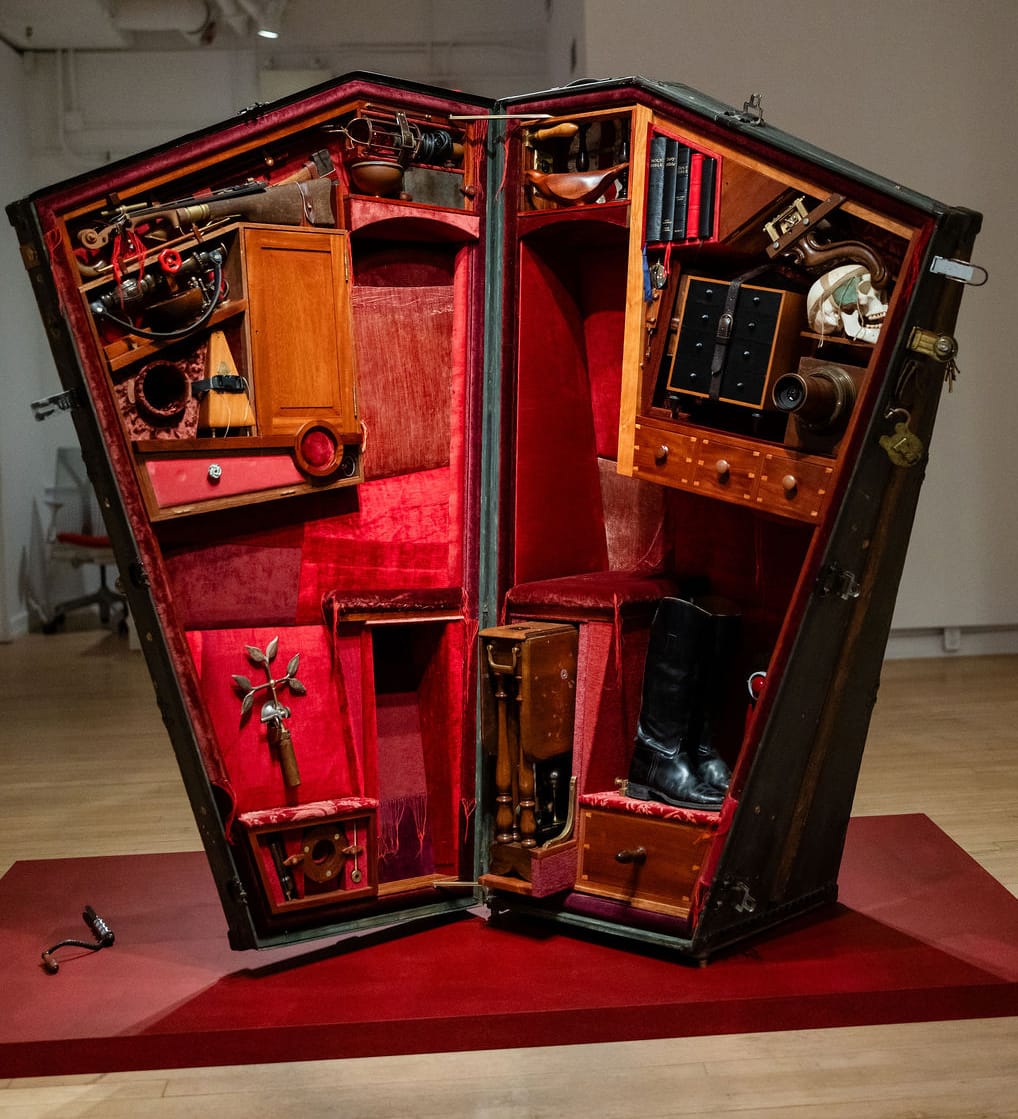

At left, Harp by Peteran; at right, the 70-year-old former OCAD prof takes aim. (Images: Shay Markowitz)
As for the other part of the show’s title, the lessons—you’ve been working in this medium for a long time, what are the lessons for you now, as you continue doing this work?
The lessons happen in the studio with trial and error and learning, but also with the many times I visited the gallery and encountered visitors seeing the show, and hearing their comments. I listen very carefully. Their comments are instant, honest, and unrehearsed. I get so much out of that, the lessons. But also, the gallery that the show is in was once a classroom. I’m showing in a classroom. It’s hilarious.
Speaking of, how has being an educator at OCAD influenced your work after all these years?
Once you’re someone’s professor, you’re always their professor, until the day you die. That’s just the way it works. A lot of my students stay in touch with Instagram or email. I enjoy watching where their careers are going. They’re in their 30s and 40s and much smarter than me now. They’re at the top of their game. But I’m still teaching the lesson, I’m still conducting the class. I find it funny that whenever we encounter each other at a wedding or something, I’m still the professor.
The objects you work with tend to be very old, and there are ways in which your work engages with ideas of restoration. I’m sure the students you’ve taught have a very different relationship to objects and materiality, or immateriality, that you or I would have grown up with. Has exposure to them and their culture changed your own thinking about or approach to objects.
Already near the end of my teaching days, the cultural references were changing quickly. It’s their world, we’re out of it. We’re not part of the formation of this new world, which is an exciting time. But the principle or the lesson can still be presented in the same way. They don’t have to get with my program, and I don’t have to get with theirs.
When I worked with students, I always asked them, what are the earliest roots of your interest—culturally, socially, personally? Go back to the formative years. I think that’s just a smart way to start any project. So my work looks incredibly old, it looks like antiques. I’m not interested in new. I’m interested in the things that won’t go away. I’m looking for the extremely familiar. Like, the most familiar thing I can come up with. The more familiar, the better.
What role does intuition or improvisation play when you’re creating these juxtapositions that are so richly suggestive? Or do you take a more deliberately conceptual approach?
I usually know what I’m going to end up with, because I’ve had an idea simmering for quite a long time before I pounce. And that goes with teaching, because it takes a long time to study your insides and study your history and study your own habits and study your own intuition, study your own humor… you know, to sort of reretrace all these things.
So there are a number of gates that an idea has to check off before I go, "Okay, that’s it. We’re good to go now." I don’t just sort of play around. Maybe some of my work is humorous and playful, but it’s also dark and cryptic too. Those are the gates I look for when I’m ready to make a work. Has it got some slapstick? Has it got an intelligent observation about human nature that goes back to the 1400s? Has it got a method to appear? Has it got a craft? Has it got a system of moving into the visual that’s appropriate to this? I think about something for quite a long time. I have a lot of ideas. Maybe I have to stop that.
Uncanny is a word people often reach for when describing your work. But I think of the uncanny as something difficult to reproduce deliberately. It often happens by accident. Which is perhaps a compliment to your work.
There’s nothing on the stage that isn’t part of the performance, it’s theatre. I don’t let things happen by accident, it’s strategic. I don’t know what “uncanny” means actually, I think it’s a word that sounds intelligent but doesn’t mean anything.
I play a lot with neurological triggers. I believe in using your full arsenal when I go into a work, and that means addressing the full spectrum of what we’re capable of as humans. Now that I’m this age, 70, I know exactly who we are. We’ll make a joke as we’re eating someone, you know? Life is big, it’s broad. To make an artwork, you want to bring all of that into it. You’d want to bring everything you can to the encounter. That may not be wise. Maybe that’s how it becomes uncanny.
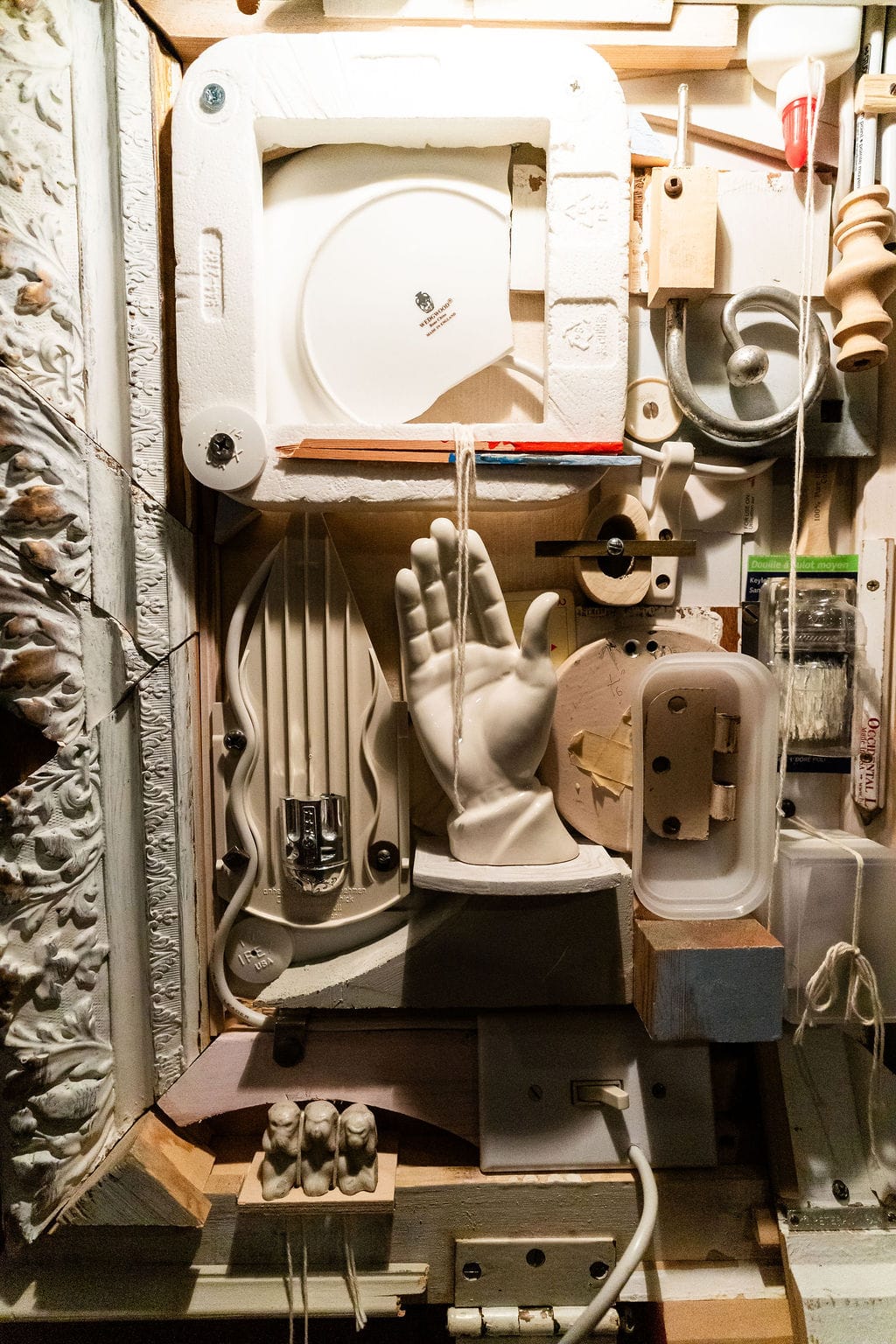
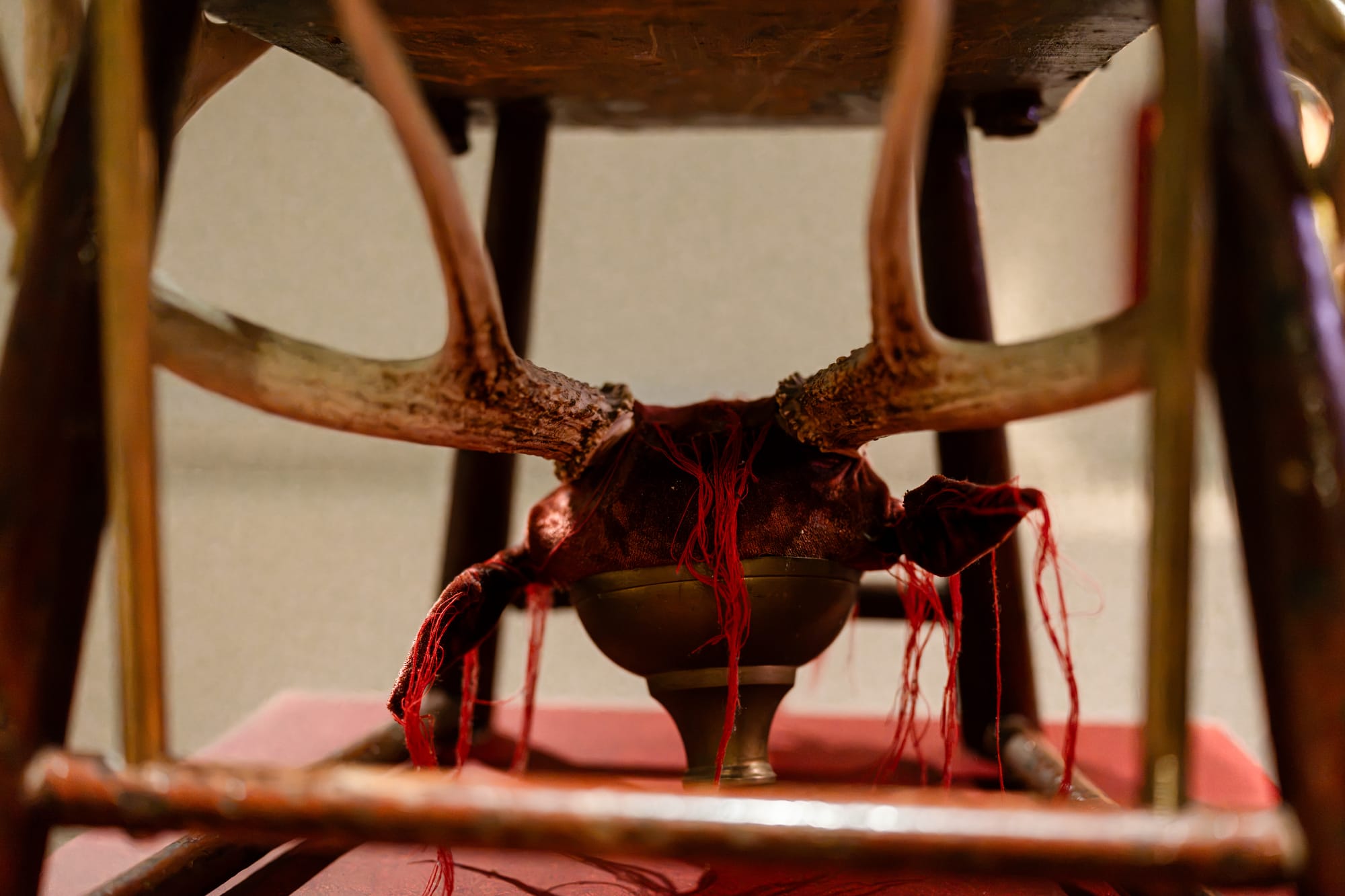
At left, detail from Composition in White by Gord Peteran, and detail from Chair with Deer Head (collection of Matthew Evans) at right. (Images: Shay Markowitz)
At this point in your career, I wonder about your relationship to the idea of technical mastery. You’ve been doing this a long time, presumably you know your way around your tools. Ideas about mastery, tradition, and problem-solving are very much associated with furniture making and craft. But you put your technical mastery to work in this opposite direction, rather than solving a problem, you’re creating one, introducing all this uncertainty around what one is looking at.
I hope to present people with a problematic form if possible, something that doesn’t unpack easily. Some of my work is difficult to sell until it’s really discussed and explained. If you’re not willing to do that as an artist, you don’t really care about the audience. I sometimes have to take my time and be patient because there are a lot of aspects to the work that are quite lovely, but also a lot of aspects to the work that are quite dark.
When I started my career, like a lot of young people, it was about mastering a craft—I include painting in that, I did that too—whether the craft of woodworking, or the craft of metalworking, which I almost got caught up in. But you’re young, so those are easy to accomplish, and I could accomplish them quite easily. I was a very good woodworker and designer. Form and material came together once I focused on wood.
But that’s just the medium, that’s all that is. You have to really calm down quickly or your work will just look like finely made things, you know? I learned it was about what’s appropriate for the idea. Like I was saying, once I’m ready to pounce and make something the degree of craft has to show up and also be right on the money. In the exhibition you have examples of extremely fine woodworking. Like the drawers in the parts of the harp—it helps sell your ideas if there’s a way of instilling trust in its physical nature.
Then sometimes you have to have some “bad craft” because some ideas desperately require bad craft. Whatever bad craft is... let’s find a better term, let’s say appropriate craft. Where the messiness of making is evident. Because the idea is messy, the making of it has to be messy too, or it’s not a resolved form. If the idea is messy and the craftsmanship is immaculate, well, you’re out of sync with your own idea.
Earlier you said that you’re most interested in those things that won’t go away, that the more familiar they are, the better. Where does that leave room for originality in approach?
There is nothing new. There is no future, everything’s in the past. In art-making, you don’t find original ideas in the future, it’s about connecting two things from the past that haven’t been connected yet. That’s all originality is.
How can I connect a glass of milk and a table—that’s what I’m interested in. And making something people have never seen maybe before. I mean, they have certainly seen the glass of milk and they’ve certainly seen the table. It’s creating a new situation for very familiar things.
I’m not looking to build an identity as an artist or, you know, trying to stay on some course as an artist. I didn’t really ever want to be an artist. I don’t really like art.
So this was all just an accident?
In some strange way, I’m just following my nose and it’s led to some success. But I never wanted to be an artist. Maybe I wanted to be a psychiatrist.
That brings me back to something you said earlier, jokingly I assume, how you haven’t been able to escape furniture.
None of us can. I’ve never met anyone that could’ve escaped it. I just keep delivering the poison, I cultivate an addiction so people keep coming back for more of my work in their homes. As I said, the home is a pretty sacred place. It’s a nest, of course, but it’s also the womb, and it’s the temple or cathedral. It’s you in your coffin. That in your home you’re assembling the final orchestration of the things, the physical world, that you’ll need.
We keep working at it. My clients keep working at it, perfecting and perfecting, getting rid of that and bringing this in. Finally, by the time they’re 65 or 70 years old, everything’s in place. That sounds an awful lot like a coffin to me.
Gord Peteran’s exhbition Lessons in Objectology is showing at Koffler301 until November 8.
Share this post