A Zen-like Garden of Paper Machines
Artist Cybèle Young, creator of Kamiphony, on how tiny bits of paper, tiny windows of time, and a tiny desk can lead to some big discoveries.
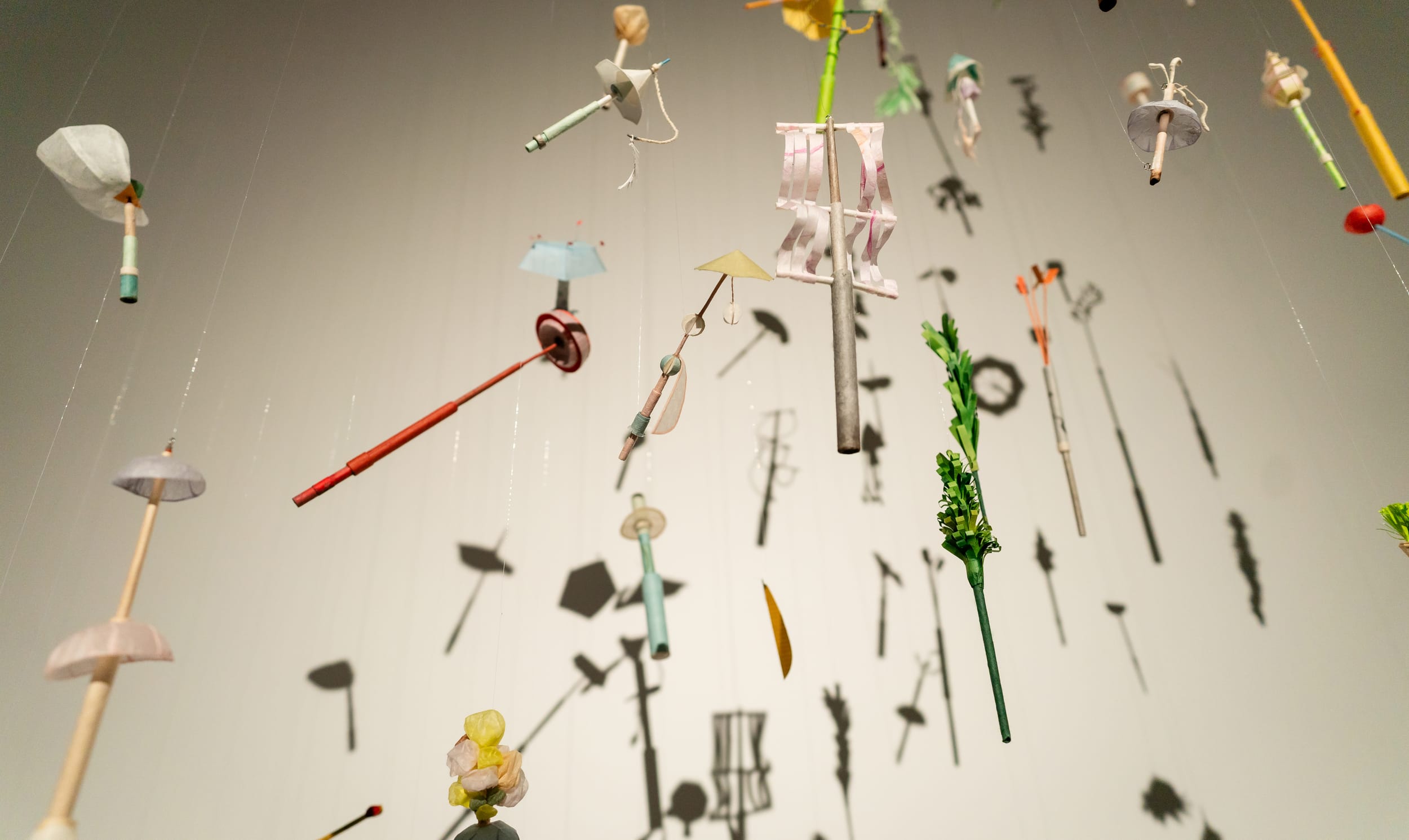
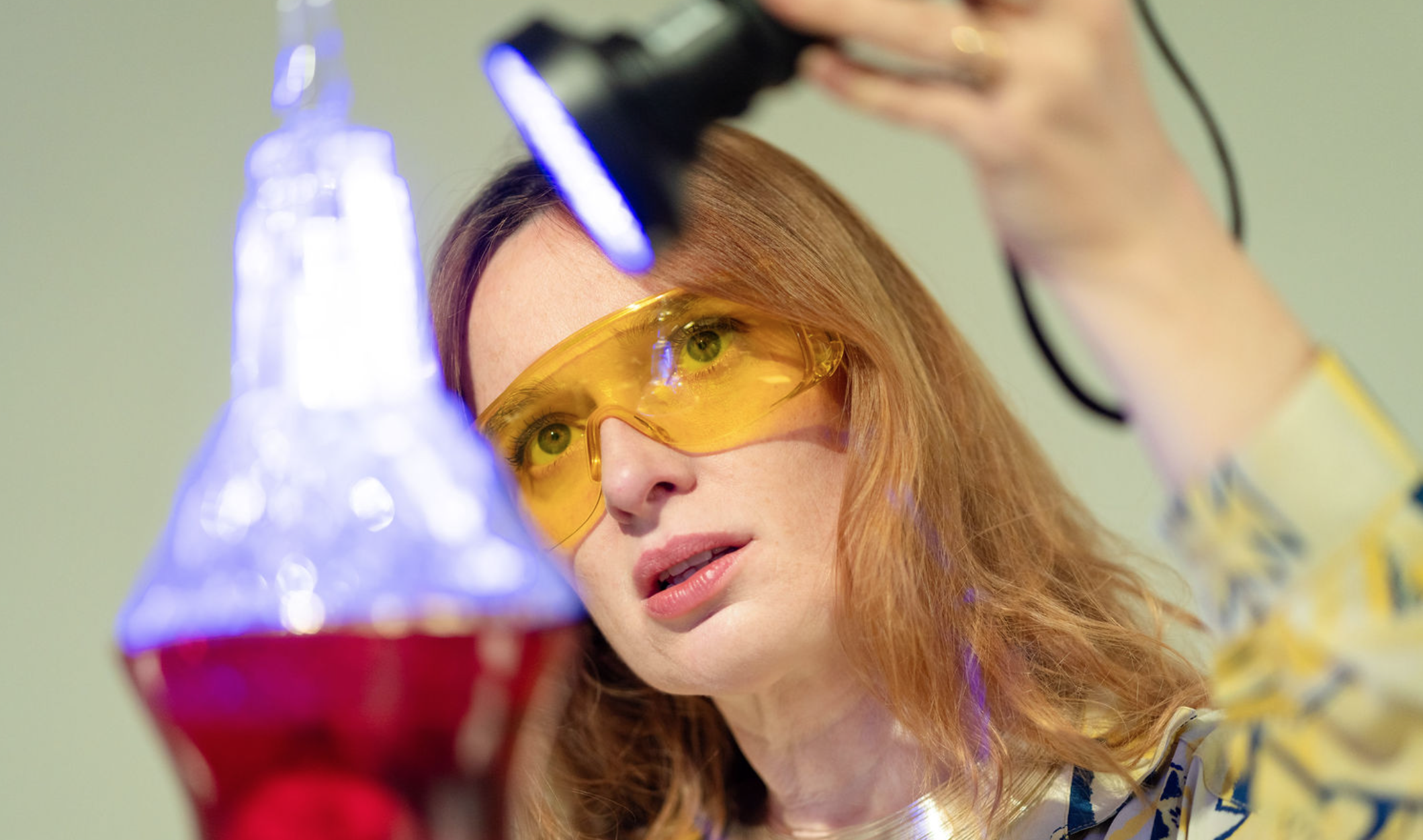
For more than three decades Cybèle Young has explored the expressive possibilities of Japanese paper, transforming its delicate fibres into intricate miniature worlds populated with improbable objects and strange, whimsical creatures. Although her work has long suggested a latent sense of animation—things caught in the act of moving, transitioning, or coming to life—her latest exhibition, Kamiphony, now at the Koffler Gallery, pushes this impulse all the way. Combining her paper sculptures with mechanical devices, electronics, video, sound, and shadow play, Young has created elaborate, kinetic environments in which seemingly autonomous objects perform a quiet, eccentric choreography.
While the Toronto-based artist and writer had been playing with the idea for Kamiphony for several years, Young worried about her ability to pull it all off. There was a moment, too, when she nearly lost interest in her whole artmaking practice. “I had long since come to a point,” she tells Arcade, “where I had no spirit left in me to continually make tiny things to put into frames and send to galleries.”
Then came her first trip to Japan, last year, on a two-month fellowship. There she visited the traditional papermakers whose work had been integral to her practice for so long. She observed the cultivation of mulberry plants and the rhythms of its production, and how it was inseparable from the natural environment and centuries-old ritual practices. “When you’re making the paper,” she says, “it holds all of the environment, and it is extremely alive.” Not only did she discover a deeper feeling for the material itself, she now had the confidence to tackle her ambitious designs for Kamiphony. “A lot of impossible things get made in Japan,” she says. “That bolstered me.”
Drawing inspiration from the carefully choreographed approach to a Zen garden, Kamiphony invites visitors into a world that feels both theatrical and contemplative, familiar and otherworldly. In the following conversation, Young, also an award-winning author and illustrator of children’s books, reflects on the evolution of her relationship with paper, the revelations from her recent time in Japan, and the pleasures—and occasional anxieties—of making things that seem to have a life of their own.
When it comes to sculpture, you initially started working with metal and wood, things with a much heavier material presence. How did you end up working with not just paper, but particularly Japanese paper?
My earliest tactile memories are from Chinatown and discovering rice paper, which is not what I work with now. But at the time rice paper drew me because it has this crunchy, ephemeral, semi-transparent quality and crispiness. I remember very vividly, when I dove into sculpture and installation at OCAD, playing with all the ways that things fit together and move, even holography, all sorts of things.
But by the end of my time at OCAD, I was disappointed in the discourse and community around sculpture—it was the opposite of community. It was very competitive in ways that didn’t feel expansive, and because this was the time of postmodernism the need to theorize before making was hammered into us. I felt like I’d been turned inside out. I was depressed and needed to find meaning again.
Then my partner and I had a daughter and it no longer felt safe to go into those wood shops and metal shops, so I went into printmaking. I found a much more welcoming community there, and I loved how process-oriented you had to be to do it. That led me to quickly discover Japanese paper. And I was able to take everything I had learned in sculpture and installation, everything I was still excited about in terms of formal discoveries, and play that out in copper plate etchings, which have a very three-dimensional quality to them. I could take one copper plate and chop it up into many one by two inch plates and really explore what my visual language was.
I was already working on ideas about how to show things moving, implying movement in the images, and that led very quickly to a sculptural dialogue between me and the paper, and thinking, “Oh, what if I make a bag out of this?” And then once I made a bag, I realized that you could stretch the material to make thread really thin, which led to this back and forth discourse of what’s possible, so I would push it, and the paper would kind of whisper, “How about a little further?”
I later found out that my grandmother had also used Japanese paper back in the 1930s, for her printmaking practice.
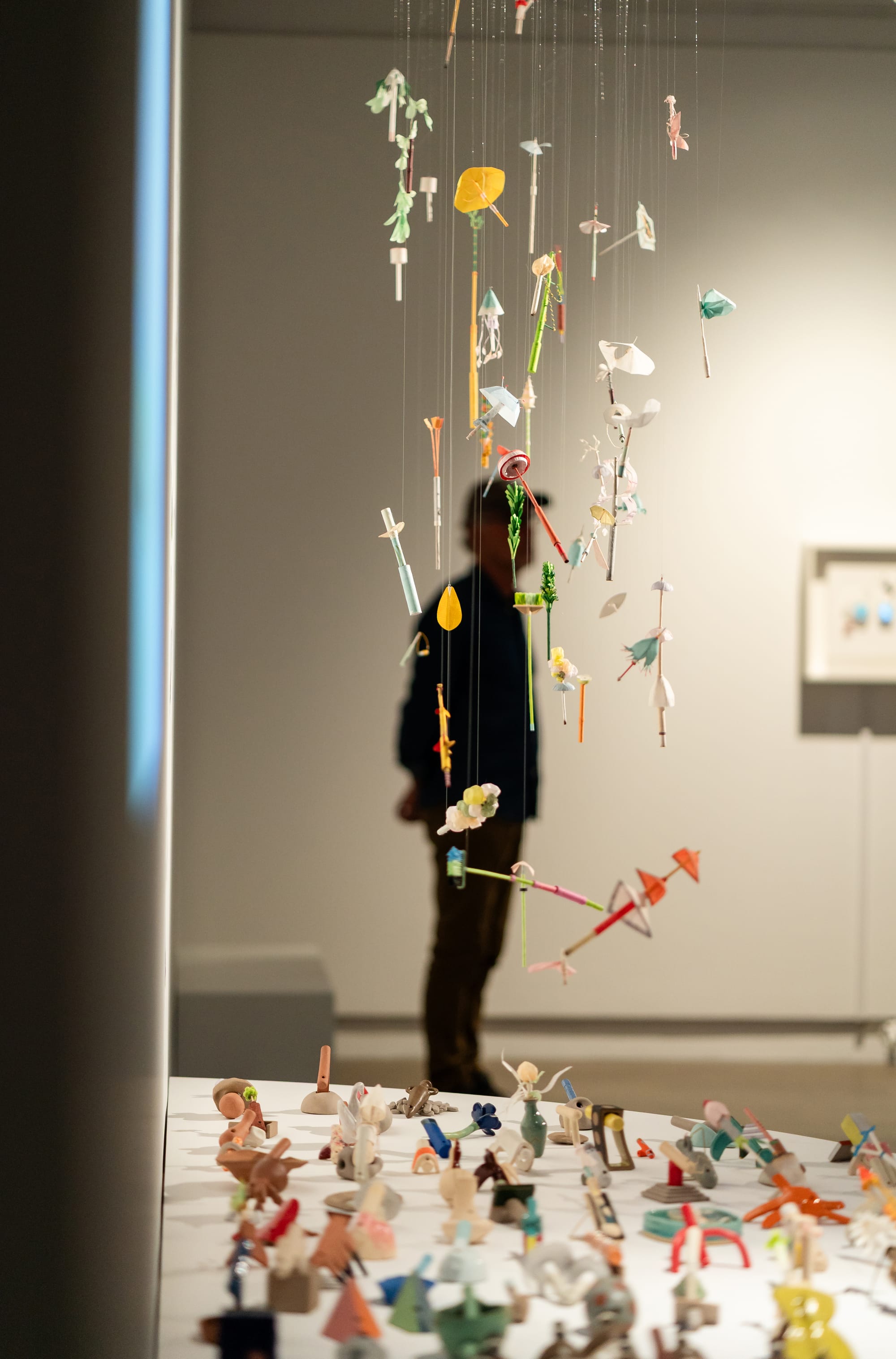
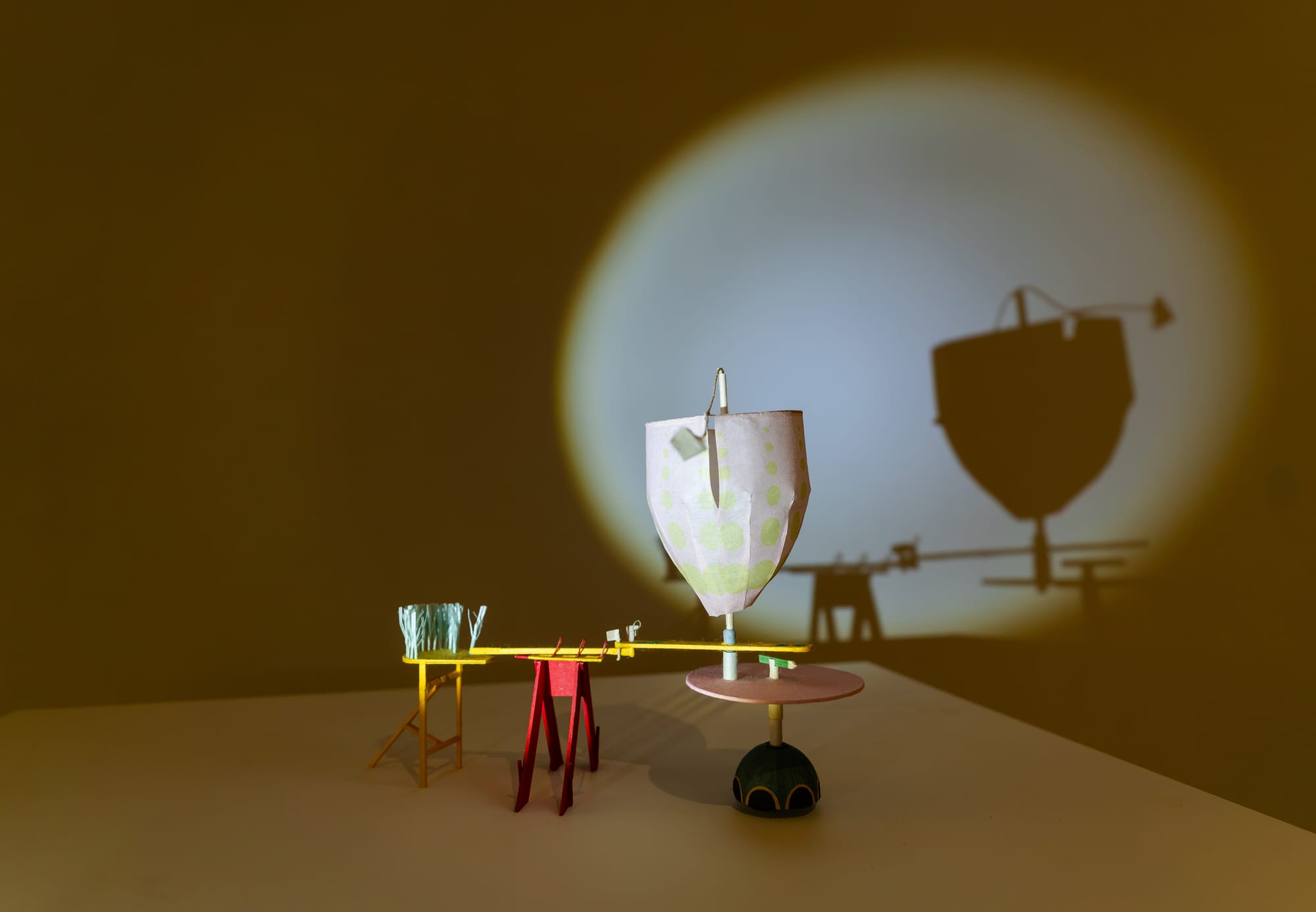
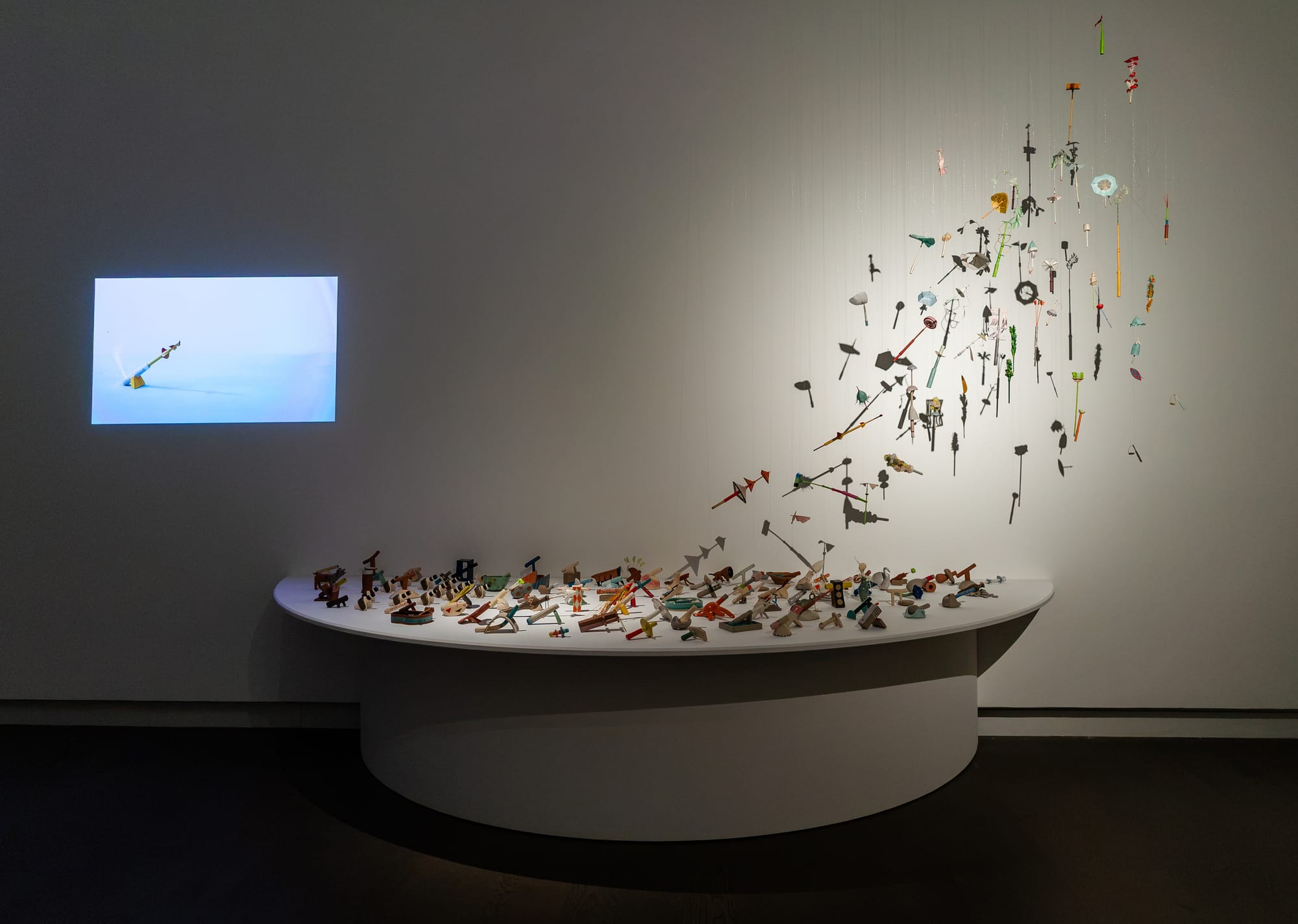
Detail from Cannons, ceramic and Japanese paper sculpture, by Cybèle Young; at right, The Giveth, Japanese paper kinetic sculpture. (Photos: Shay Markowitz)
This makes me think about the scale you’re able to achieve with paper. What is it about going smaller and smaller, toward miniatures, or even the microscopic, that tends to truly expand or enlarge the universe being created?
I found great pleasure in realizing that I could not just build an object, but I could create little worlds. For practical reasons, because I did make my living from my work, they had to eventually end up in frames, which gave a context, you’re working in a field. I don’t know if you’ve ever been to the War Museum in Paris, but they have a room with all the low relief reproductions that Napoleon would have used.
Like battlefield topographical maquettes?
Yeah, where you had a view of the territory, and you could determine, for example, what’s the grade of that hill. Suddenly you’re stepping into this world that’s been created, and you can manipulate it, see what pieces talk to one another.
I loved the book The Borrowers as a child. It was a book about little people living in the wall and all the ingenious things they would do with buttons and pins and things like that. I’ve always been pretty enchanted by that. But it was also just a pragmatic thing of how much can I explore my ideas and the worlds I want to make with how little?
Also, the paper’s very expensive. I had tiny amounts, only windows of time, and a tiny little desk. There were pragmatic reasons that led to pretty magical discoveries.
Earlier you alluded to the meticulousness your work demands—these are very small paper sculptures that are sometimes quite elaborate, incorporated into larger installations or set-pieces, then you add in other elements like motion, video, shadow play, sound. There is an astounding level of detail and complexity to a show like Kamiphony. But which also means the greater potential that some elements will occasionally break or fail. It makes me wonder a little if you are a bit of a masochist, though probably there’s a better word for it.
When I conceive of these things I’m wonderfully unrealistic, horribly unrealistic. I just ask myself, “Well, why couldn’t that be made? How hard could that be?” When we first installed Kamiphony, it was like, “Oh, shit, this isn’t some opening where you put up some paintings on the walls and walk away. This is a garden that needs major tending.” This is a delicate nursery. Although I’ve always played with mechanical and electronic elements, I still feel like I’m on tenterhooks.
But there’s this term, “You gotta let it soak.” You have to turn it on and let everything soak for a few days. Like, soak. Like you would in a nursery. They will hiccup and burp, sometimes they stop working, they have little toddler tantrums. And some of them need to be rethought altogether. There is something kind of masochistic and crazy about it, but I love it.
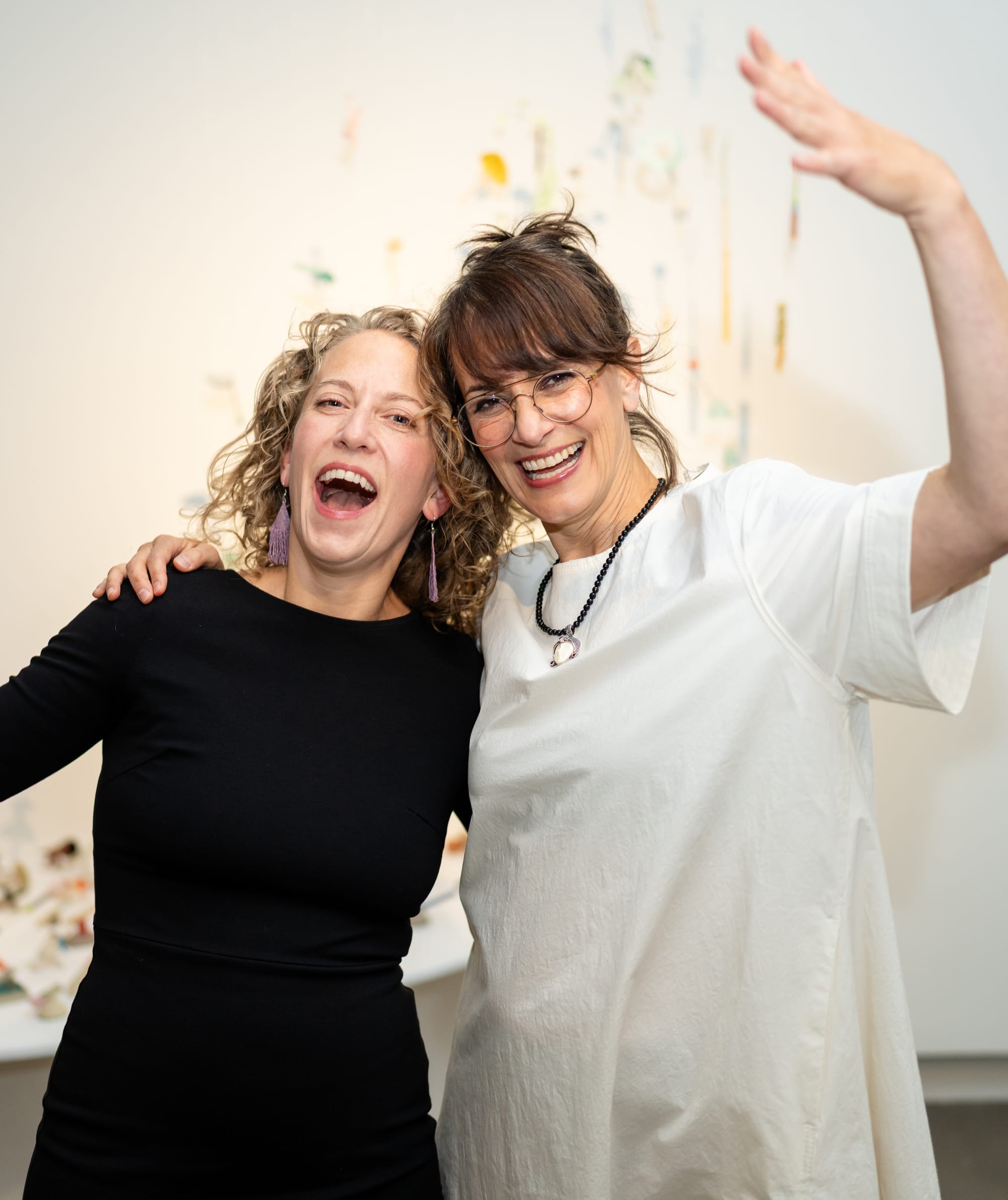
Young with friend and producer Vanessa Rawecki at opening of Kamiphony. At right, Cannons, installation with film. (Photos: Shay Markowitz)
I’m curious about the decision to leave much of the machinery and technology behind the work exposed, unconcealed. In some cases you place the installations atop what looks like an old school desk, and you can see the mechanisms whirring inside the desk. Yet it all looks a bit fragile.
It’s uncanny that the main gallery at Koffler used to be a classroom. I loved the idea of the school desk being a part of the aesthetic. When I was a kid, I would hide all my secrets in my school desk. I had my caterpillar collection, my secret notes to friends. There is something about that, how your world can live in there, and people can peek inside but it is still somehow private. Then when it comes to the under workings of things, the shadows of things, I do want those conceptually exposed.
I find it interesting that people aren’t actually that curious if I show them how something works, as though exposing the workings doesn’t actually reveal anything about the art. And yet it does at the same time. It’s like, come peek behind the curtain—it’s a bit dark and messy back here.
One of my favorite artist-couples and collaborators were Niki de Saint Phalle and Jean Tinguely. Her playful goddesses and creatures, and he would always have these black, grinding, clunky metal workings exposed underneath. I’ve always appreciated that—that paradox or dichotomy within any kind of living system. Think of a butterfly and how disgusting it must look inside its chrysalis.
There’s also this durational or time-based dimension to the work, where there is motion and some form of metamorphosis or transformation taking place. What were you trying to invoke by calling the exhibition Kamiphony—what with kami meaning not only paper but also diety in Japanese? And this idea that even everyday objects can be imbued with spiritual properties.
I went to Japan for the first time last year, as part of an art fellowship for two months. Even after having worked with Japanese paper for 30 years, I didn’t know that kami is the word for both deity, meaning the sacred “everything”, and also the word for paper. To thank the powers that be, you often say, “Kami, kami.”
Meanwhile, paper is such an integral part of Japanese culture, and you see it so prominently in the Shinto shrines and Buddhist temples. It’s used in the priest’s rituals, you see all those braids of paper containing people’s wishes. It’s a sacred substance, and after making paper there last year, boy, did I feel that.
You know, you go up to the fields where the kozo plants, the mulberry plants, are grown, and there’s still five feet of snow in March, and you just kind of fall to the ground, there’s something so amazing about the place. Then you’re working with the plant, taking these stalks back down and there’s the river where the salamanders are laying their eggs, and then you bleach it in the snow and the refracted light in the snow gives it this super unique kind of slightly bleached creamy colour, and it is imbued with the sunshine. When you’re making the paper it holds all of the environment, and it is extremely alive.
The trip sounds like it was revelatory for you.
Initially the idea for this whole show came to me very clearly about six years ago, but it was hard to believe I could pull it off. There was a lot of, “Am I going to be able to figure this out, oh shit—maybe I can’t.” But a lot of impossible things get made in Japan. That bolstered me.
Also, I had long since come to a point in my practice where I had no spirit left in me to continually make tiny things to put into frames and send to galleries. I just couldn’t feed that beast anymore. It was killing me. I thought, I need to learn why I love paper again—anew.
I visited all the major paper makers, and the people whose paper I’ve been working with for years in their environments, and in some cases made paper with them. I found myself asking them, ”Why are you doing this?” They’re making very little money. They’re working in the same ways that they’ve worked for 400 years, because it’s really the only way you get that quality of paper. They could do so many other things. I was almost a bit jaded, like why are you bothering? But then you’re there, and you’re experiencing this rhythmic, repetitive action, and routine—daily routine, weekly routine, yearly routine—and how important it is to them that you don’t question it. Almost like carrying and honouring an ongoing ancestral spirit through the mundane repetitive actions. It brought new excitement for me, as well as a reverence for the ritual itself.
And then that ritual can almost be anything you want, it can be artist-led. Kamiphony is inspired by the different components of Zen gardens, like how there is great attention given to something called the approach, which is how one enters the space, and helps you to grow from one state into another state to be able to receive what’s there.
I was able to play with that in the show and create a scenario where you feel sort of elsewhere, but still closer to your centre. There’s something about rhythm, repetition, and ritual that was totally galvanized in me from being in Japan.
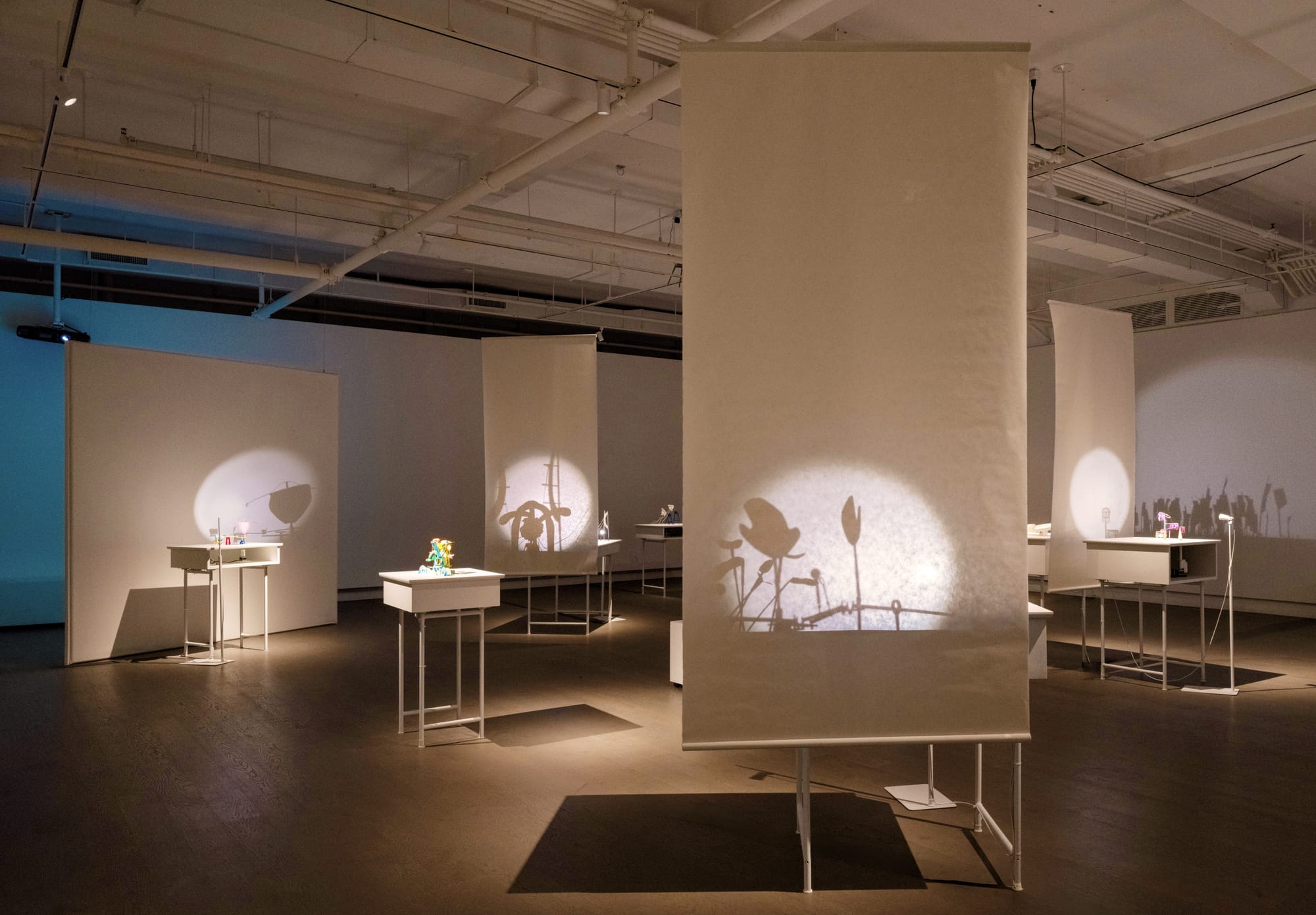
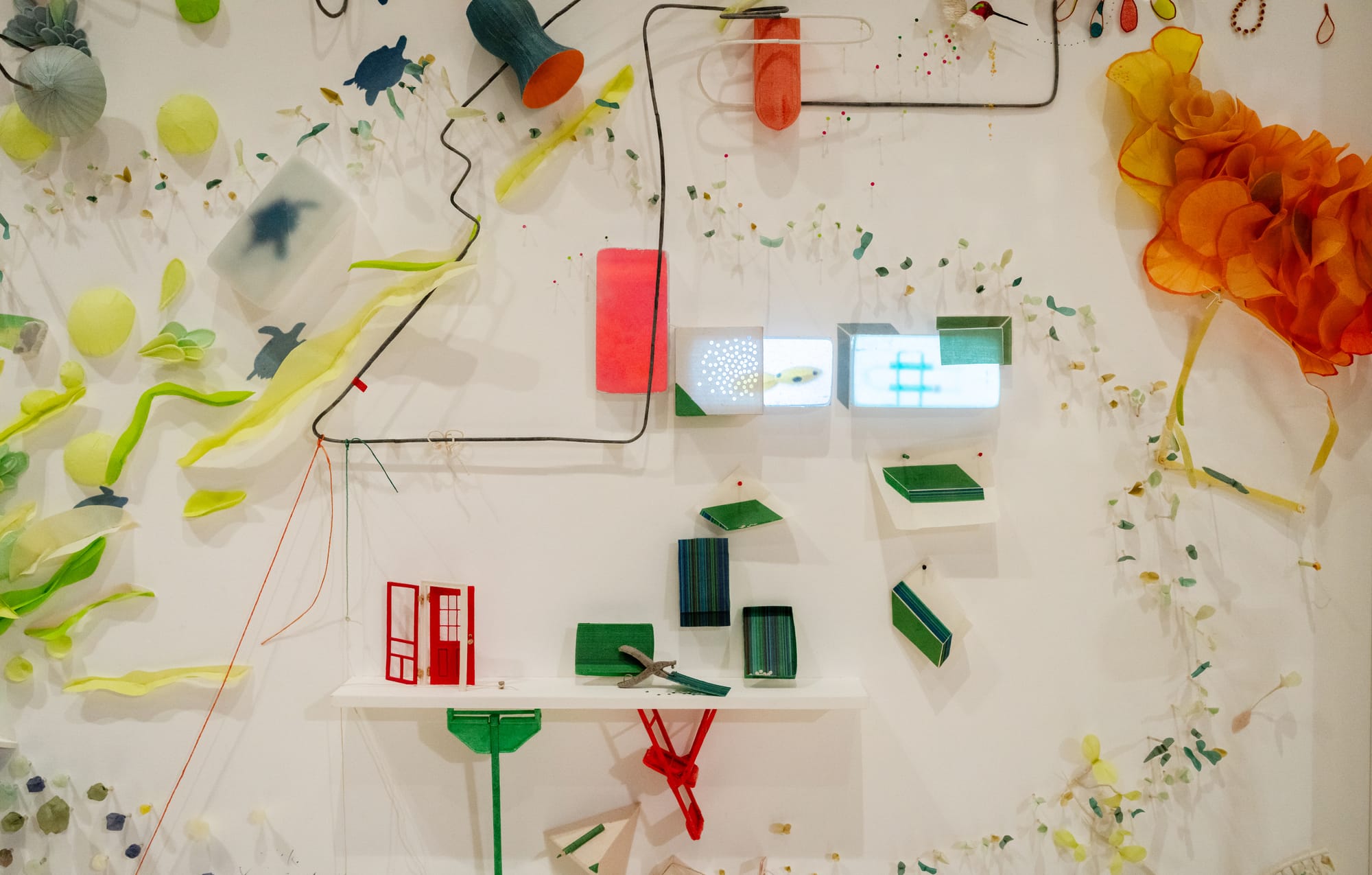
Installation view of Kamiphony at Koffler Gallery; at right, Shape of Wind detail, Japanese paper sculpture, video stop animation, crystals. (Photos: Shay Markowitz)
Going back to one of your earliest inspirations, what was the appeal of Alexander Calder?
My parents would’ve made him known to me, they were definitely fans of his work. But it immediately resonated with me. The real clincher was Cirque Calder, the idea that you could put the experience of a circus into a couple of suitcases. There are all these characters and you don’t question this world he’s created.
I’ve always found him so refreshing; he was an easy personality to love. And you never got the sense that he was being driven by anything other than play. Whether that means there’s a void of ego, I don’t know. But he’s not stepping forward from a place of, “I need to be the guy.” He's inviting you in to play with him.
That persistent sense of play is certainly a thread that connects your work and his.
There’s a lightness of energy around almost everything that he did. So I strive for that, but I also know that my voice is something different.
Cybèle Young’s Kamiphony runs at the Koffler Gallery until December 13, 2026.
Share this post