Marina Abramović’s Creative Anthropology of the Balkan Erotic
Approaching 80, the celebrated Belgrade-born artist insists with her new exhibition at Gropius Bau that "Now it is the right time to talk about eroticism."
Marina Abramović’s five decades of work is filtered through the prism of body-as-art: the female body, her body, an intersection of politics, mythology, culture, anthropology, endurance, pain, joy, desire. In short: the whole gamut of life and death. Her embodied art has not only challenged our assumptions of what art is or can be, but deconstructs embedded suppositions of what is beautiful, what is meaningful, and what is a body. If it is a response to Spinoza’s 17th-century question “What can a body do?”, Abramović answers: Well, let’s see.
Her pioneering work began in Belgrade in the 1970s, where she made visceral, often brutal pieces testing her body against political and gendered ideologies. The trajectory from there to global superstar—Venice Biennale Golden Lion, landmark MoMA piece The Artist is Present—is well documented. Now comes Abramović’s latest exhibition, at the Gropius Bau, pointing the way to what comes next for the ever-restless 79-year-old.
In her first Berlin show since the 1990s, Abramović brings together an oeuvre of her philosophy and obsessions in an ambitious 10-room experience called Balkan Erotic Epic. Originally premiering in October 2025 at Aviva Studios in Manchester as a live performance, the Gropius exhibition stands alone as both testimony to past work and a current culmination of her practice (the live show will premiere at the Berliner Festspiele in October 2026). Always evolving and forever penetrating in her artistic interrogations, Abramović takes her work to places both familiar and new. It is not just impressive, it is transformative. It’s also damn funny.
In an interview with Gropius Bau artistic director and curator Jenny Schlenzka, Abramović said, “For me, it’s about understanding that now, approaching 80 next year, it is the right time to talk about eroticism.” This is not exactly what we expect in our youth-obsessed, hypersexualized culture where the young may wonder, “Do people after 60 even have sex?” Abramović wants to remind people, aging women in particular, that “it’s never too late. That we have to find out who we are, what our body is and what our sexuality is—and learn from this experience.”
This perspective gives the show its power. Not only is it a rare celebration of older women and their sexuality, but we are privy to Abramović’s lifespan of artistic evolutions, reflections, and embodied wisdom. In this way Balkan Erotic Epic defies our pornographic age, an era of sex as something to be packaged, consumed, and binged on, for and by the young and beautiful. Eros, Abramović might be saying, is much more than fucking. But it is also just fucking.
Speaking to Schlenzka, Abramović defines the erotic more generally: “All the energy we have in our bodies is sexual energy. It is the energy of recreation, of creating new life—because of it, humanity exists. And it is very important how we use this energy. We can use it for creativity, for spirituality, or we can suppress sexual energy, and then it becomes aggression, war, anger, and torture.” Abramović uses this creative energy in playful and meaningful ways, digging into an anthropology and politics of the Balkan erotic.
The first piece is in the atrium, a huge video projection called Tito’s Funeral (2025), showing rows of black-clad senior aged women beating their chests, echoing Balkan mourning rituals in general, and in particular, the response to the death of the Yugoslav autocrat in 1980. It is both disarming and hypnotizing to watch these women hitting themselves in unison, a ritual of mass mourning, the power of collective grief taking on a sexual dimension. Abramović explains to Schlenzka: “When Tito died, there was an incredible eroticism to it, because women of all ages were crying. There was this blue train going from Ljubljana through the entire country and it was just people standing there, beating themselves in the chest—especially women—and they were showing their naked breasts, saying, ‘Why did you take him and not me?’ This mourning together with so much passion was erotic.” Necropolitical eroticism: death as state spectacle, grief as bodily surge.
Abramović’s project isn’t limited to the political upheavals of the 20th century, she wants to go much further back in time, reaching deep into our base erotic impulses, exploring the ritual of sexual energy and its polytheistic creativity that may have once featured in Balkan culture. The first object in the galleries, a 6th century BCE figurine of a vulva, on loan from North Macedonia, sets the tone for what follows, embodying a central concern of Abramović’s work: the translation of ancient beliefs and ritual forms into a contemporary context.
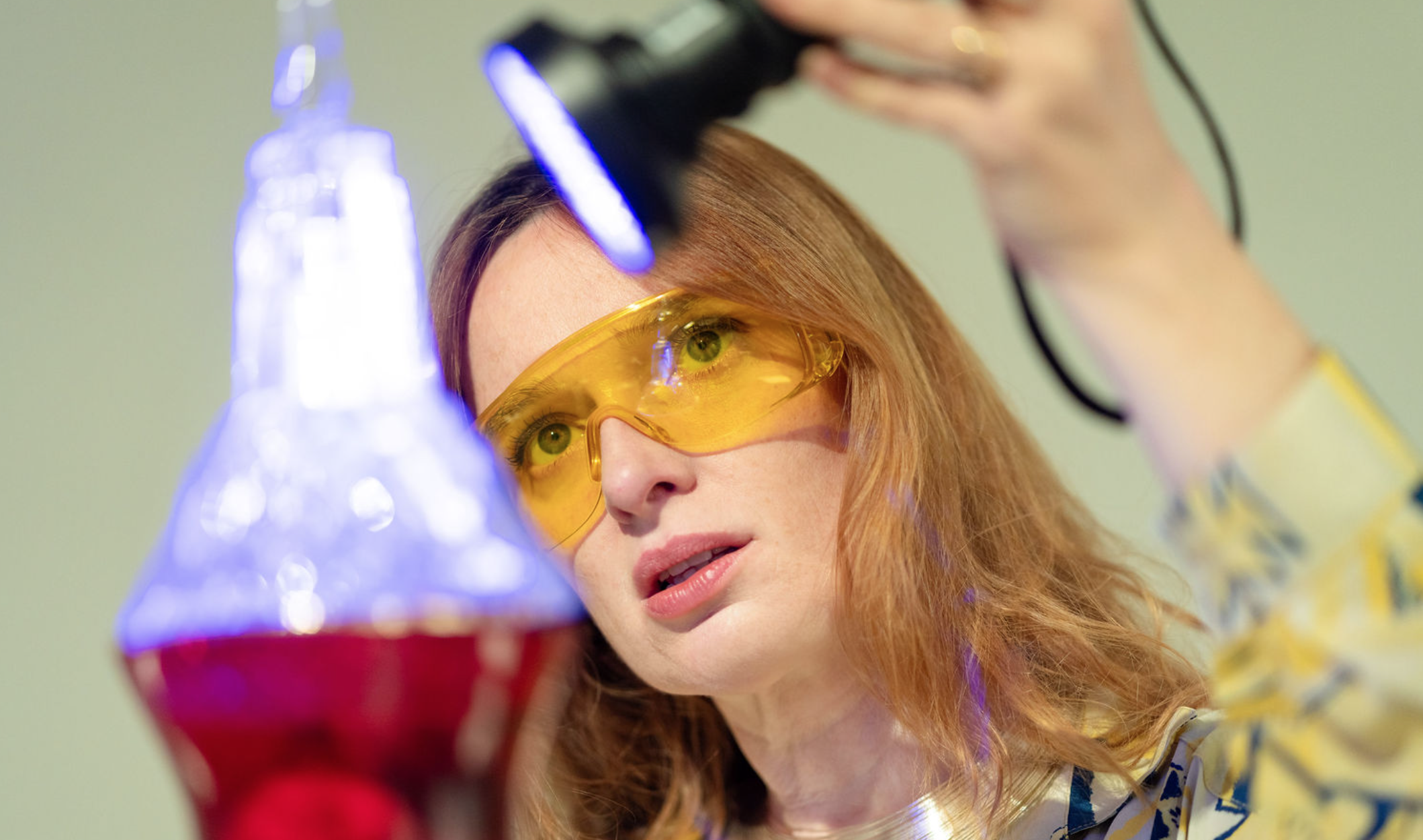
One such exploration is in Magic Potions (2025), in which a video projection of a performer dressed in a white lab coat introduces visitors to Balkan erotic rituals from across the centuries. Speaking in a detached monotone, the performance scientist enunciates erotic formulas while a forest of enormous projected phallic mushrooms eerily creep across the screen, followed by a series of animated videos. “Onions seen by the vagina will grow faster and better,” utters our deadpan expert, as we watch an animated peasant woman flash herself to a root vegetable. And in another: “If a woman wants her husband to love her, she leaves a fish in her vagina overnight. When the fish dies in the morning, she takes the fish out and makes a powder of it, mixes it with coffee, and gives it to her husband or lover. If he drinks the coffee, he will always love her.” The animation follows the instructions playfully, contrasting the giant, frightening phallus sculptures foisted throughout the room.
How much of this is anthropologically true, and how much of it is Abramović’s imagination? The answer doesn’t really matter—this isn’t a science exhibition—but her mischievousness in both form and content expands notions of sexuality by inviting the mythical into our thoughts, while toying with the over-seriousness of the scientific. As she explained in the interview, “I was interested in all these rituals from the Balkans—from Albania, Romania, Bulgaria, Serbia, Montenegro. In these rituals, there is a relation between the body and the universe. If you wanted the crops to grow better or the rain to stop, you would always have rituals that involved bodily or sexual aspects. I was thinking how important it is for us to rediscover this past, put it in a contemporary context and learn from it. Because we always think of anything sexual as pornography.” Like the erotic, myths are to be drawn on, recreated and played with. In this reinterpretation, something new is born.
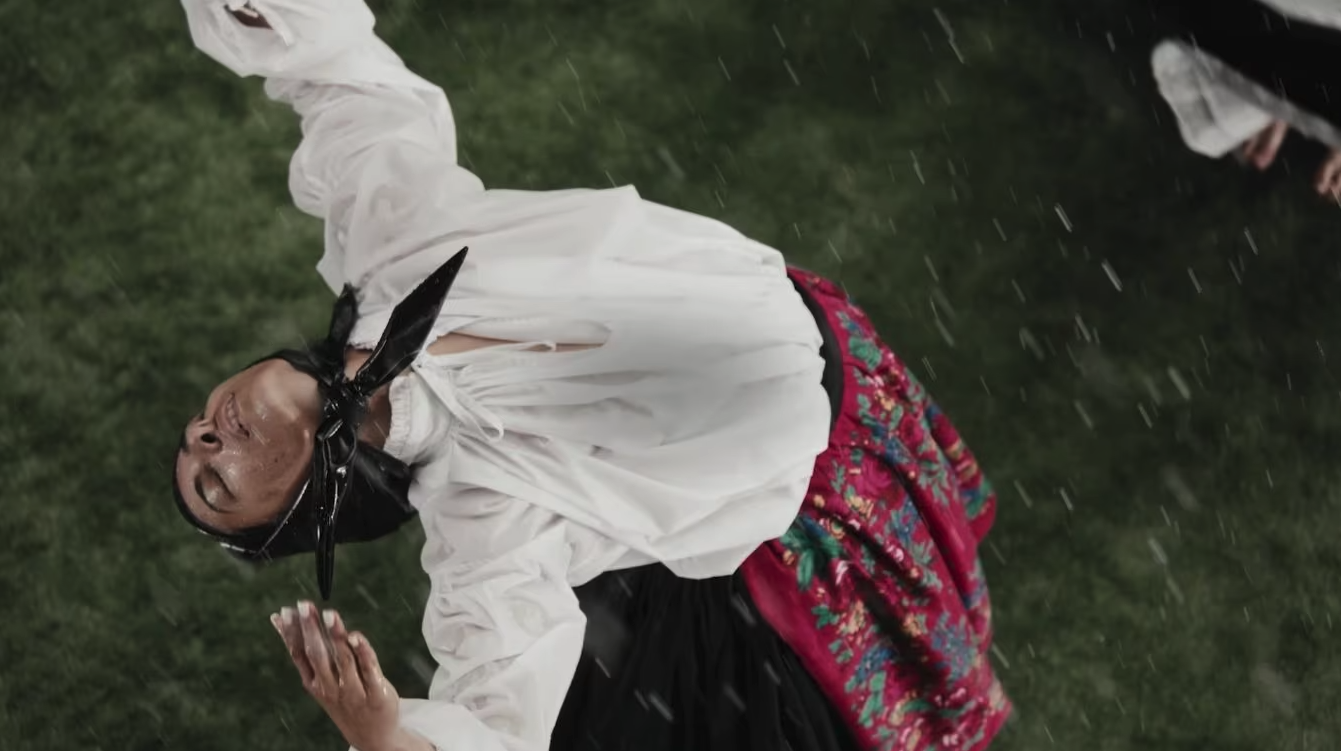
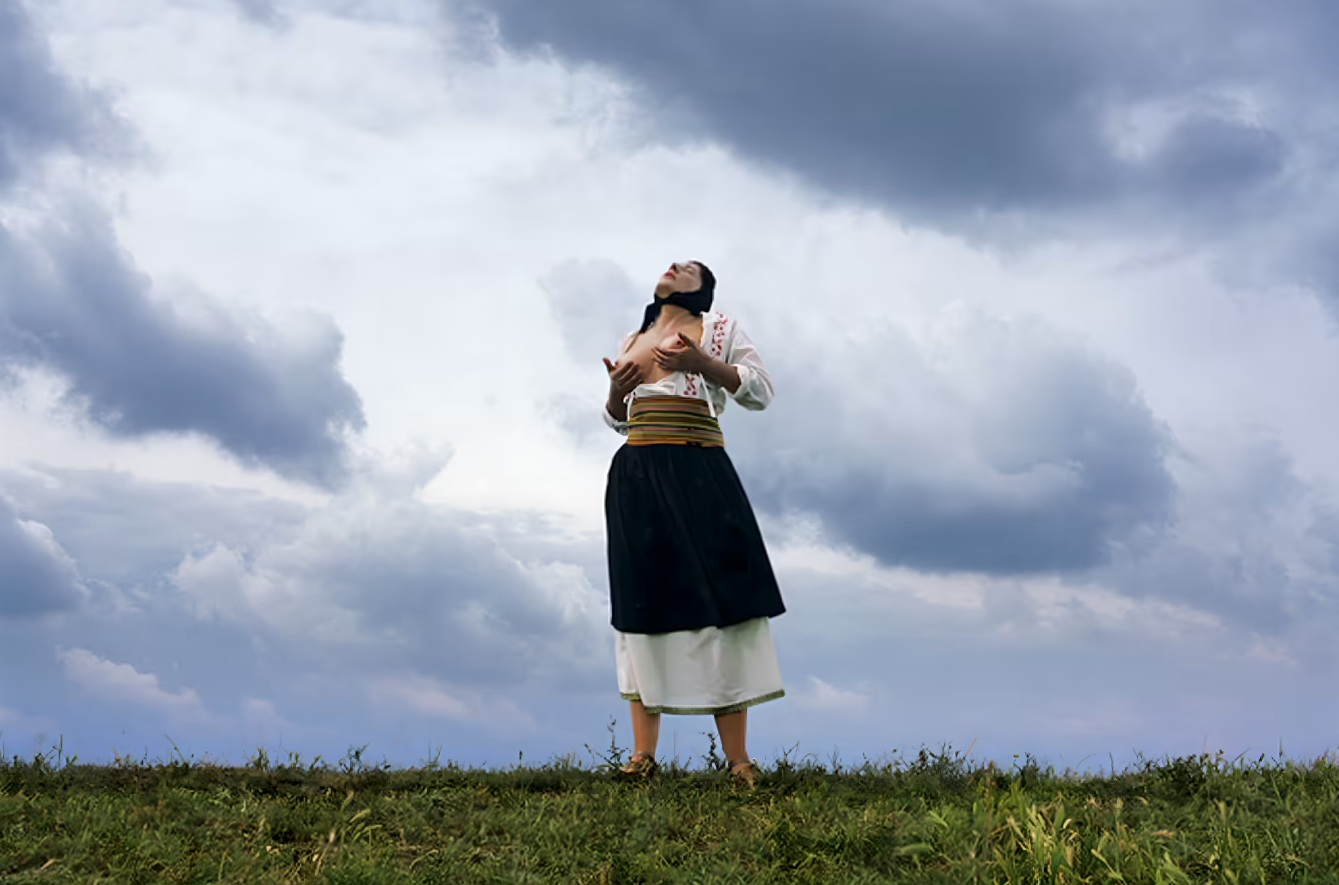
Turning left to the rooms with more contemporary pieces, Abramović’s mythologies continue. Fucking the Ground/Fertility Rites (2025) is a video installation of naked men penetrating the earth, a chaotic dance to channel sexual energy into the soil, rather than war and destruction. Beside this is the video, Scaring the Gods to Stop the Rain (2025), where a group of women clad in stereotypical Balkan peasant dress lift their skirts and flash their vulvas at the sky. Abramović globalizes the ritual, using an ethnically diverse cast of women wearing black PVC headscarves. This mixture of past and present mythologies re-imagines a pre-patriarchal world, one where women’s sexuality is not transgressive but elemental.
The playfulness of the erotic is anchored by the darkness of death. In the video installation Nude with a Skeleton, Abramović inhabits the spirit of Georges Bataille—whose definition of the erotic as “the affirmation of life up to the point of death” is explicitly invoked in the exhibition. We see a video of Abramović in 2002, lying backside down and naked on the floor with a skeleton over top of her. The piece is influenced by the Tibetan Buddhist practice of a monk sleeping next to a recently dead person, accompanying the body as its soul escapes to the next world. While this is also performed live daily by a dancer (on the day I was there the performance wasn’t yet on), I enjoyed the slow, meditative stillness of watching Abramović experience death’s intimate presence. In what is probably the most powerful and mesmerizing piece in the whole show, the viewer is forced to watch, slow down, and reflect on the naked Abramović pressed against the naked skeleton: pelvis, ankle, skull. It is a vulnerability of life in the face of death, a mirrored tenderness and desire.
Continuing her erotic dance with death, we turn to the piece Orgy (2005)—which is not, as you might expect, a foray into the famous sex clubs of Berlin where anything goes if you’re dressed right and can afford the entry fees. Orgy is a choreographed piece of nude men and women slowly moving and entangling in a graveyard. In eerie silence, tombstones emerge like mushrooms amidst the bodies of the living. The graves are not ignored by the performers; they are a third body watching, haunting. While a man holds up a cross, a woman caresses a man who lies on top of a woman lying on top of a grave. The tombstones spill out into the exhibition space, beyond the video, as we carefully position ourselves away from the graves to watch the screens.
Turning to the other side of the exhibition, we travel into a selected retrospective of Abramović’s past work that both speak to and anchor the current pieces. Rhythm 5 (1974) takes us back to where it all began—Belgrade, the Yugoslavia of her childhood, a strict socialist upbringing she was determined to burn through. An enormous wooden communist star adorns the floor for the spectator to grasp its dimensions. On the wall a video shows us a young Abramović soaking the star in 100 litres of petroleum then setting it ablaze, discarding pieces of her hair and nails into the fire. Abramović then steps into the centre of the star and lies down and remains perfectly still. Passing out on account of the rapidly depleting oxygen, it was only when the flames touched her skin that spectators drew her out of the fire, something that angered Abramović since the performance hadn’t ended.
A video of her performance Balkan Baroque is a haunting piece about the genocide and ethnic cleansing that took hold as Yugoslavia disintegrated in the 1990s. The piece won her the Golden Lion at Venice in 1997, and it's easy to understand why—over four days, six hours a day, scrubbing blood from 1,500 cow bones while singing Balkan mourning songs. Other pieces, including Lips of Thomas (1975), where Abramović self-flagellates and pierces herself with a razor emblazoning a bloodied socialist star on her stomach, illuminate the different tenor and tone of Abramović’s early work, an Abramović challenging her body through acts of self-destruction, blood, isolation and pain. By protesting the strictness of Yugoslavian socialism and mourning the trauma of its tragic end, she forces the audience into acts of complicit witnessing, watching her performances of pain, sometimes intervening.
Afterward, I return to look at her work from 2025. Given the wisdom of age and perhaps a nod to her own evolution as an artist, it is more playful, communal, and immersive. Rather than confronting the audience, she challenges our assumptions and comfort levels. This is not to suggest one part is better than the other; rather, both eras speak and inform each other in gratifying and surprising ways, demanding the viewer to revisit this work to extrapolate new meanings, again and again. As I sit one more time with Nude and a Skeleton, I think of my own faltering body. What can a body do? In Abramović’s hands—at nearly 80— it makes us reckon with the question in profound ways.
Marina Abramović: Balkan Erotic Epic. The Exhibition runs until August 30, 2026, at the Gropius Bau in Berlin.
Share this post