Atom Egoyan Meets Vera Frenkel at the Scene of the Chase
The pioneering Toronto multidisciplinary artist speaks with filmmaker Egoyan about the thinking and creative process behind her latest work, As If by Chance..., and the two types of prejudice faced by elder artists.
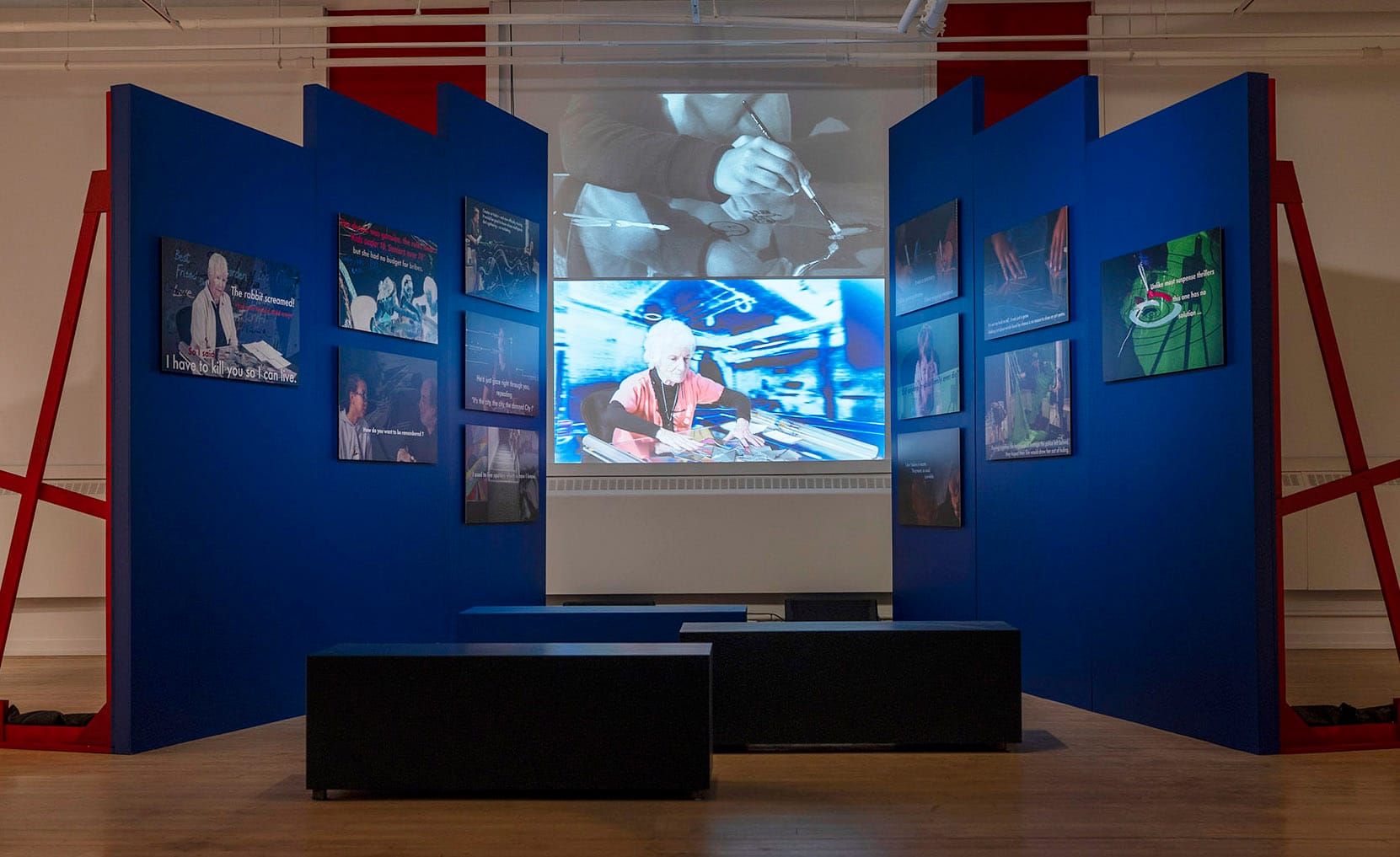
For as long as each has been active, multidisciplinary artist Vera Frenkel and filmmaker Atom Egoyan have been preoccupied with how technology records, distorts, meditates, and preserves human experience. Egoyan’s work, especially in such early films as Family Viewing, Speaking Parts, and The Adjuster, often examines the role of video, media, and surveillance in shaping personal experience and identity, while Frenkel’s installations, dating back to her landmark 1974 piece String Games, mobilize video, text, and archival materials to address themes of displacement, authority, and historical memory.
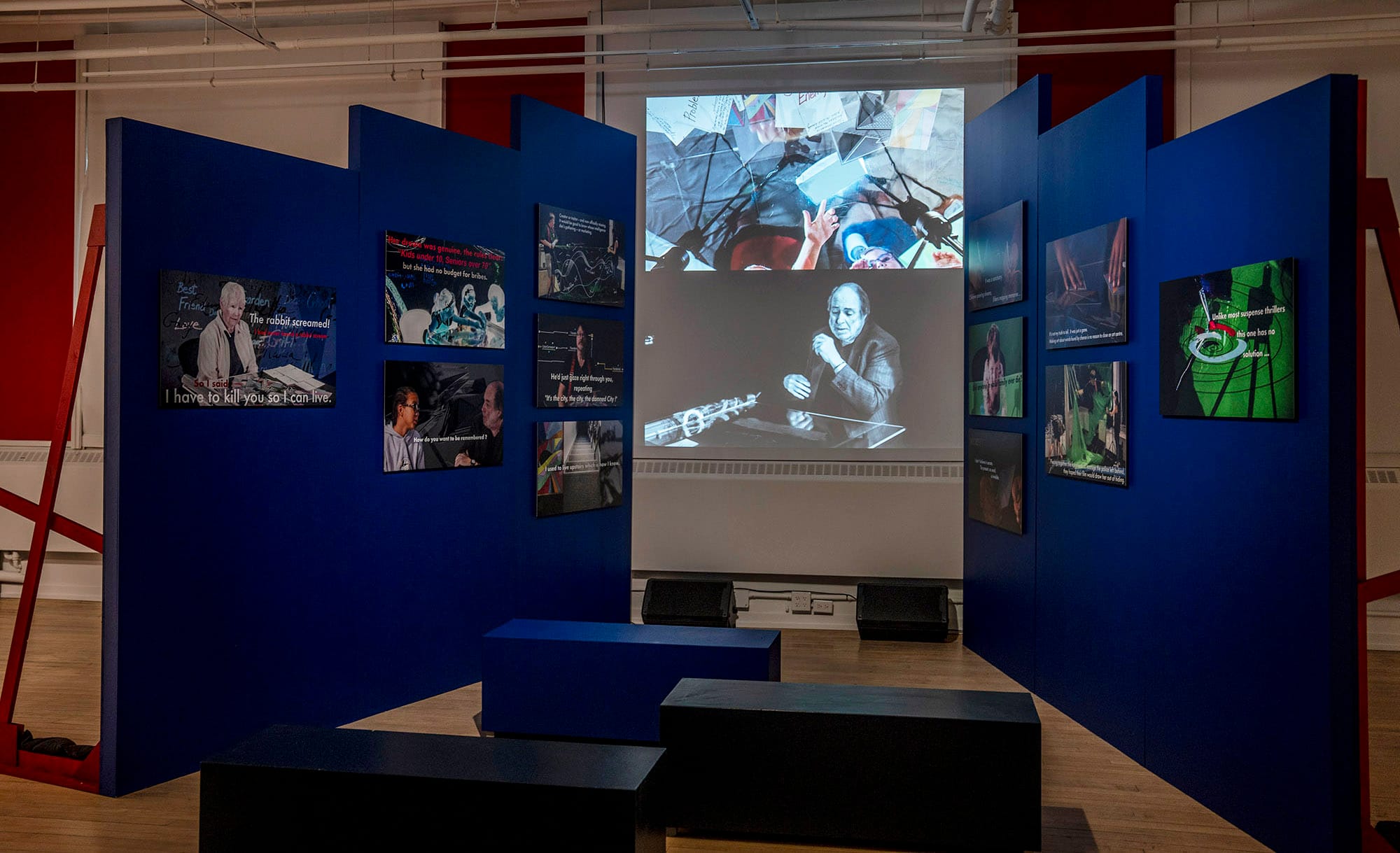
The affinities are more than just incidental, as Egoyan explained during a recent conversation between the two seminal Toronto artists hosted at Koffler301, where Frenkel’s 2-channel video and photo installation As If by Chance… is now showing. “When I was a young artist, seeing Vera’s work opened so many doors to me,” said Egoyan. “ There were a lot of things that I wanted to explore, and it’s important to have role models and artists like Vera who are inviting the right questions.”
“From the very beginning, it was clear that Vera was obsessed with this notion of how identities are formed, and creating a certain type of conversation between the viewer and the subject, and keeping that very fluid. There were things that were up to the viewer’s engagement and curiosity in terms of being able to fit pieces together.”
“This idea of narratives which can exist in our imagination,” Egoyan continued, “which are built up through the media, through hearsay, through snippets of conversation which may or may not be directly related to the construction of an identity, but which we seem to be designed to absorb in a certain manner and form into something that feels coherent. And here we are now in this extraordinary new exhibition, As If by Chance…, which seems to be the summation of this investigation.”
As If by Chance… continues at Koffler301 until June 14.
ATOM EGOYAN: This particular project was not an easy path, Vera will tell us about it. But what we have is something very unique, where, as she puts it very succinctly, near the end of the first part: “Every suspense thriller provides a chase, hero after culprit, crook after competitor, police after suspect.” I love the next line: “Police dog after witness. It seems necessary to centre a narrative with chase at its core.”
These are your words, Vera. As you’re putting together this particular “chase”, as you’re trying to create this sense of a missing person who ran an arts collective, which we are seeing the evidence of, I’m dying to know how you constructed this so organically, because from my understanding, the character of Natasha only began to emerge as the project itself came together. Is that correct?
VERA FRENKEL: I should mention that I’ve been binge-watching Atom Egoyan’s films all week. And because my vision is slightly blurry after last week’s cataract operation, it’s like watching one long beautiful dream, like mainlining the filmmaker’s unconscious. So everything you’re saying to me now, Atom, is coming in the context of my having had this long dream. And what you’re saying about the scripting and the anticipation of the audience and the fact that it’s a very different world, it’s very interesting for me because that really contextualizes a lot of what you’ve done.
To come back to your question, Natasha is the so-called protagonist of the narrative, and I didn’t plan the narrative at all. It emerged from the editing process. I was just curious about what very young children and elders 10 times their age would have to say to each other, and they satisfied my curiosity. I didn’t know most of these people. I had a really excellent production manager, and she put out the word and people came. We only had a couple of days to film. And thank you to the Theatre Centre for letting us use their incubation space. Over at the coffee stall is a print that shows you the setting that we worked in. All of it was very modest, it’s a community-based practice.
I didn’t script this at all. It was intuitively devised. The second half has the man who is introduced as the media expert; he is, in fact, Konrad Skreeta, my editor. I just turned to him in the edit suite and said, “I think I need you in this shot.” It was as impulse-driven as that. That can make it hard to pull the pieces together, but eventually they come together.
EGOYAN: I’m very curious specifically about the casting process, because this is something that takes up a lot of my time, our alchemy tests, to see who gets along and what’s being generated. Did you cast the pairs of young people and elders together?
FRENKEL: No. A lot depended on scheduling and availability. So I lived with whatever pairs happened. They got to know each other, and I didn’t want to disturb their bonding. The children and the elders were curious about each other and at times apprehensive. The seniors were more scared of the kids than vice versa. I guess they didn’t want to do anything wrong. They wanted to be tender, they wanted to be sensitive to the child. The children had questions and didn’t feel they needed to be that sensitive to the elders.
What emerged in some of those pairings was a kind of delight in each other, some more than others. The older the child was, the more skeptical the child might have been. But the very young ones were absolutely immersed in the conversation, and they were curious about this older person that was taking an interest in them. The interest was important.
EGOYAN: Your earlier work that I mentioned, The Secret Life of Cornelia Lumsden, a fictional character who has gone missing was the origin of that piece, I imagine.
FRENKEL: Yes.
EGOYAN: In this case, we have a central character who emerged out of this community that you created. This is absolutely fascinating. How did Natasha emerge? At what stage? In terms of her escape, how clear is that in your own mind as to what has happened?
FRENKEL: Natasha is the founder of an art centre for very young children and elders, and she invents programs and games that both age levels enjoy. But the City of Toronto has closed it down. It was as I was looking at the footage that that story emerged, it wasn’t before the shoot. Then the city continued doing stupid things, and unfortunately it invaded the narrative. So the piece had both a local and an allegorical meaning about misguided authority that connects to much of my work.
For me, a story takes its own path. I was at that point photographing the stairs from my second floor to my studio. And I was looking at all these photographs of stairs, and I thought, “Okay, I’ll be living upstairs from the art centre in this story, and now I need to have someone that runs the art centre.” So I just invented her. I didn’t like her very much, and she certainly didn’t like me. That comes into the narrative. She’s suspicious of me. She kicks me out of my upstairs apartment in the story. The rest of it, you’ll have to watch for yourselves.
EGOYAN: It comes out of the blue, but at one point there’s a reference to Soviet political history, and then you begin to talk about possible Russian interference in the federal election.
FRENKEL: What Atom is referring to is one of the elders, who has written a book about Russian history, and he says that he found a woman in Toronto who’s a Russian speaker, and also speaks perfect English. His comment invited my speculation that the art centre was a cover for espionage.
EGOYAN: I love that. I mean, it seems so outlandish and yet in this project it feels very real and possible.
FRENKEL: It’s plausible and we have a government crazy enough to be surveilling art centres for just that reason. I may have started rumours, but it’s not true. The art centre was not a centre for espionage. But you’re quite right. I was triggered by his remark and also by his almost grieving the fact that his book didn’t find its audience. I just gave it a larger world to consider.
EGOYAN: We are feeling the energy of you discovering these issues as you’re creating your voiceover, as you’re bringing this all together. Talk to us about that magic. You said before, in our private conversation, that you’re often full of doubt. But it feels like such a confident and bold thing to embark on. Is there a moment where you just know that it’s going to work?
FRENKEL: No. There are moments when passages seem to work. What I said to Atom when we were talking before you all arrived is that “doubt” is my middle name. I never know when I’ve made a work whether it works or not, and it takes time for me to learn whether it’s going to live. I follow the thread of the story as it leads me, it’s not something that I anticipate.
What struck me in viewing your films was the intricacy of the layered engagements, at different time levels, and different memory access. I have a partnered question for you, and that is how can you anticipate that well, how can you script in such detail? Because I don’t know how to do that.
EGOYAN: My criticism of my own work is that there’s this feeling of contrivance very often. If the actors are good enough, and if they’re able to saturate their roles with enough humanity, that can be blurred. That the things that are clearly manufactured about the narrative feel organic because the actors are so good. In your case, because you’re dealing with real people, and these lovely young people and elders, who are being so sincere, there’s no question of their intention. They’re just being themselves.
I’m often rewriting during the editing process, wes. And I’m working with other effects. I’m working with music, I’m working with camera movement, and there are things that I’m using to soften the narrative fissures, I suppose. But in your case, there’s a space that you’re giving, and there’s not the same degree of surveillance on the production system itself. In my case, at a certain point, if I’m working with a certain budget, there has to be a test screening. And perhaps the argument can be made that the most successful films are the ones that haven’t gone through the test screening, which are low budget enough that they don’t need to do that. Because I am convinced that if you ask any audience, "Were you confused at any point?" Hands will go up.
And if there are people who have invested money, seeing those hands go up, they will be concerned. You don’t have to deal with that. And in fact, that ambiguity, that sense of play is inherent in the production system that you’re using. But you told me before that you even had problems with Canada Council coming on board with this. I’m talking about the pressures I feel in my system, but it’s remarkable to think that Vera was refused two Canada Council grants for what is clearly a defining work.
FRENKEL: I did have a Canada Council grant years ago to start this project. The working title then was Flute and Drum, because I was interested in the timbre of young voices and elder voices. But when I later sent them some short edited passages from it, they presumably were not pleased. The last two rejections were not fun. There was no budget and that prolonged things. I love the camera work in your films, and the sensitivity to light and dark, and the use of music. We ran out of time and everything else, so there’s no music in this, the only music is in the voices of the people that are speaking.
This brings me to one of the notions that prompted the work, which is the way in which elders are perceived. I get two versions of prejudice, the so-called real world and the so-called art world. The real world looks at me and says, “Oh, at your age? Nice to have a hobby.” And the art world says, “You had your turn. Step aside. Let me pass, but maybe write me a letter of recommendation on the way.” And I’m sensitive to that, and I also see the ways in which children are dismissed. And children say the wisest things imaginable that are not taken seriously. So that’s what prompted the work.
Vera Frenkel’s As If by Chance… runs at Koffler301 until June 14, 2026.
Share this post