A Protest Made of Glass: Natalia Romik on Repair in a Time of Polycrisis
Polish artist and architect Natalia Romik speaks with Arcade about her exhibition Plague Crystals, now at Koffler Arts, and why fragile, translucent towers of crystal might hold what haunts us better than any stone monument.
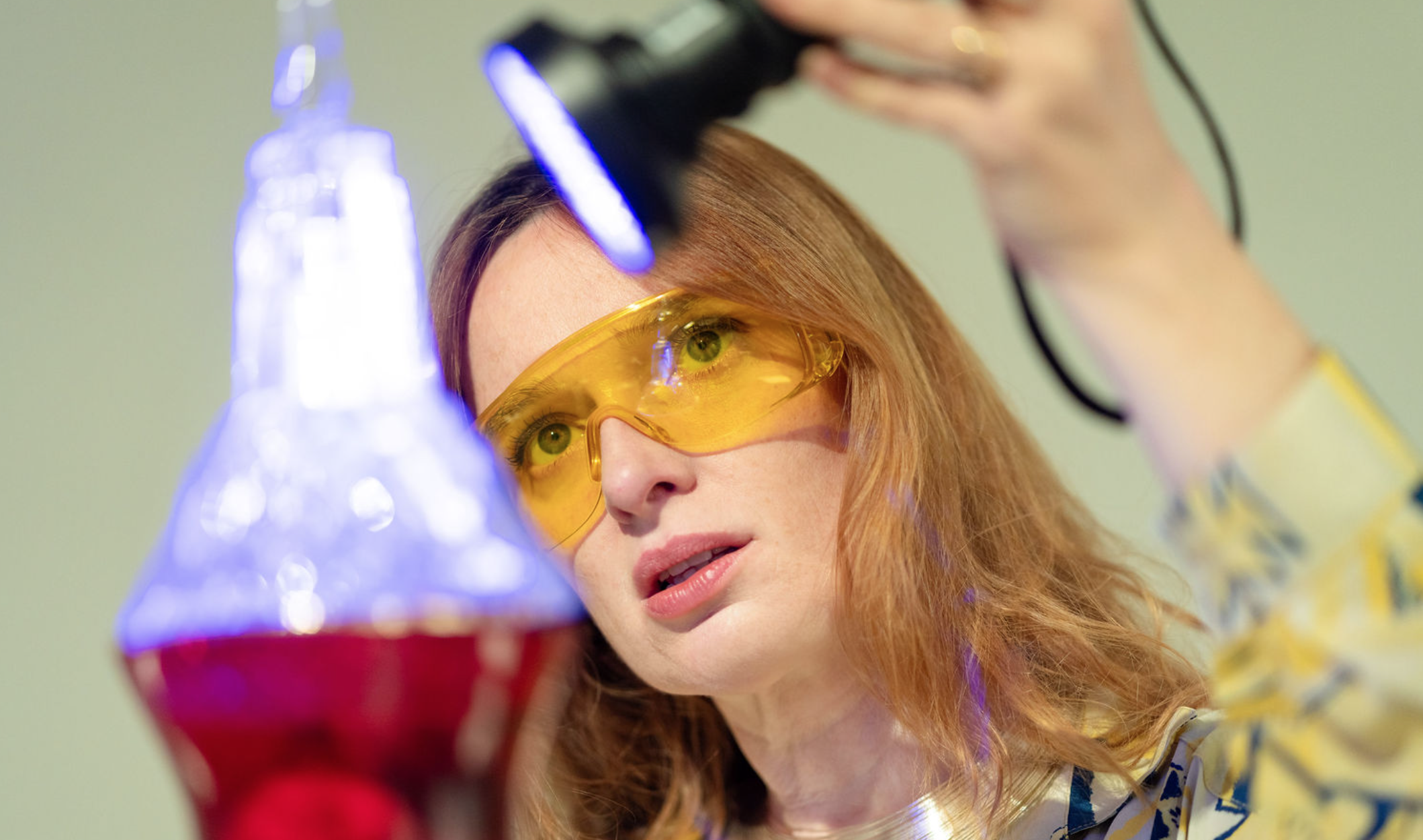
What does it mean to reconstruct a space that was never meant to be found? Over the past decade, Polish artist and architect Natalia Romik has explored the hidden architectures of survival, tracing the bunkers, shelters, and improvised refuges where people kept themselves alive under extraordinary conditions.
Moving fluidly between contemporary art, architecture, and historical research, Romik’s practice occupies a territory where excavation becomes both a material and ethical practice—not simply recovering fragments of the past, but asking how histories of displacement, persecution, and resilience are carried into the present.
Whether it was her groundbreaking early project, Nomadic Shtetl Archive, or her more recent Hideouts, which documented the hiding places of Jews during World War Two, largely in Poland and Ukraine, Romik’s work resists the certainty of memorialization. Instead, her projects linger on questions of absence, evidence, and the limits of representation, proposing architecture as something more than the construction of buildings: a medium through which memory is spatialized and political histories become tangible. At a moment when debates around borders, migration, and collective memory have acquired renewed urgency across Europe, her work offers a quietly insistent reminder that the most consequential spaces are often those that remain overlooked.
Her latest project, Plague Crystals, now showing at Koffler Arts until September 6, consists of a growing series of towering, translucent, and fragile-seeming sculptures assembled from crystal vessels, each enclosing an object that serves as a symbolic embodiment of some contemporary or personal “plague”: from political extremism and environmental collapse, to displacement, loneliness, and other forms of precarity. Some of these objects are chosen by Romik herself, while others are nominated by scholars, artists, activists, and members of the communities where the work is exhibited. At Koffler Arts, the installation expands with new contributions from Toronto participants, making the exhibition both site-specific and cumulative.
If Romik’s earlier work excavated forgotten spaces of refuge, Plague Crystals asks what forms of care might emerge when the crises of the present are given material form. Arcade recently spoke with Romik while she was in Toronto, during a break in preparations for the opening of Plague Crystals.
Why the crystal vessels and glassware as your main medium of choice for the project?
I’ve always been quite obsessed with glass. I worked at the architecture studio Nizio Design for seven years and one of my first projects was to help rebuild the interior of the 18th century synagogue in Chmielnik, which was demolished by Germans and then during the communist period used for different purposes. My task was to rebuild the bimah, which is like the heart in a synagogue, the place where you read the Torah from. I found pictures from the 1930s at the Jewish Historical Institute in Warsaw showing what the bimah looked like and began to think about how to rebuild the bimah at one-to-one scale but entirely from glass.
This glass bimah is massive, it weighs more than two tons, but I love the spiritual element with glass, also how it references Derrida’s concept of hauntology. This bimah is like a monument to the people who are not there anymore, in a small community where Jews made up 79% of the population before the Second World War and now there are none.
This project was created during the regime of Poland’s right-wing Law and Justice Party and they were obsessed with monuments—very heavy monuments. They built like a thousand monuments of Pope John Paul II, monuments for the Righteous Among the Nation. They were all very heavy and visually overwhelming, in many cases within the urban fabric of small towns. I always thought of glass as the opposite. It’s delicate. Sometimes because of how the light hits it creates optical illusions. It’s there but not there. Using glass became my protest against what the government was doing back then.
Later with my architecture collective SENNA, which includes Agata Korba, Sebastian Kucharuk and Piotr Jakoweńko, I designed a glass monument for Warsaw’s Jewish cemetery dedicated to the heroes of Oneg Shabbat, the few dozen people who created the secret archive of the Warsaw ghetto. We know so much about the Warsaw ghetto and the Holocaust only because of them.
Then one day I thought, “You know, I work so closely with so many different organizations—Jewish organizations, NGOs, women’s associations—what if I started to speak with those people, person-to-person, about their sorrows and plagues, what really haunts us in life.”
What is your personal plague? What kind of object would you nominate as its symbolic expression? The project is also related to the idea from the Lurianic Kabbalah of the universe as this shattered vessel and how through Tikkun olam we can repair the world. I thought it would be a very fruitful way of working with people from different groups and organizations and having a beautiful discussion.
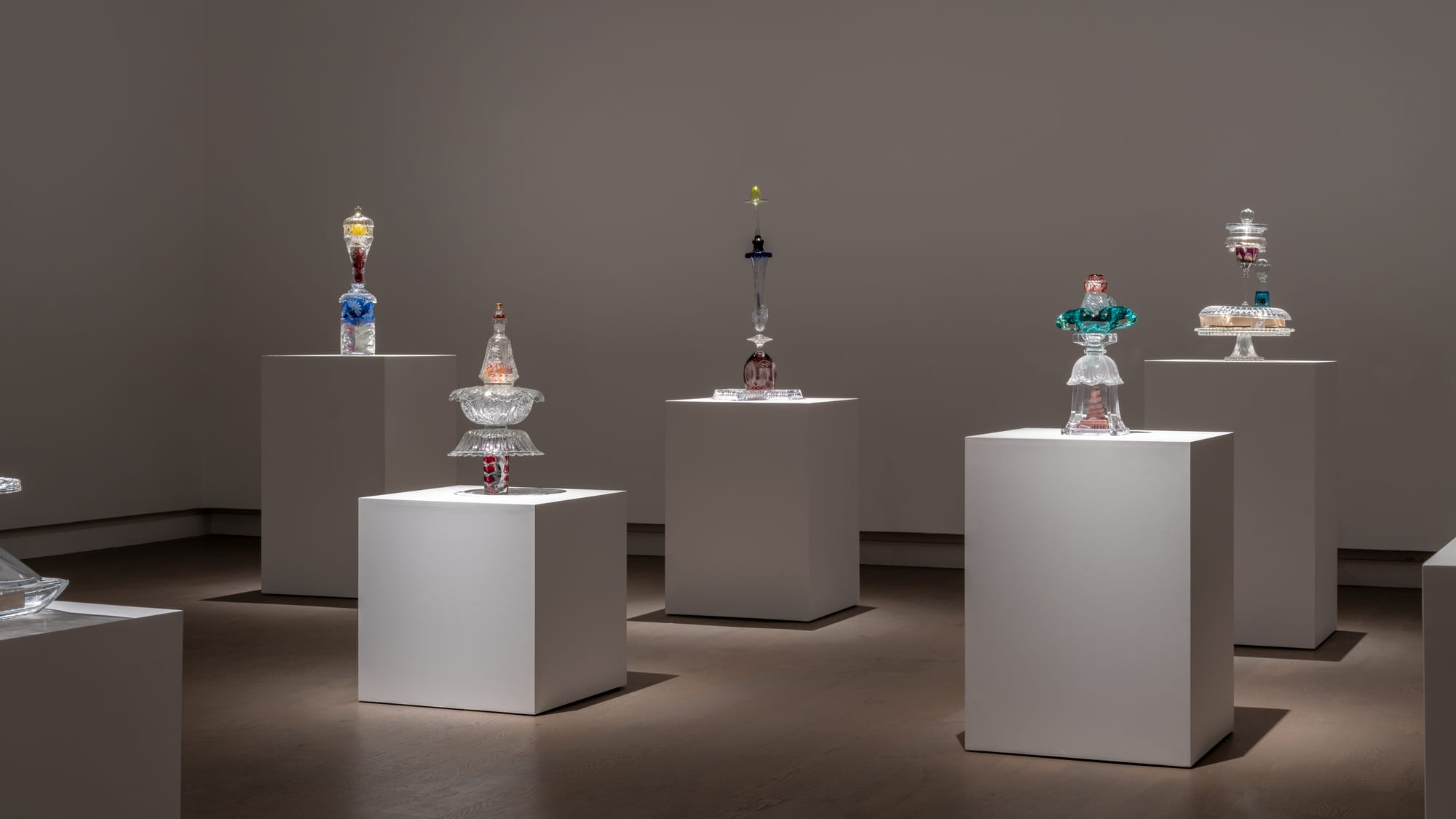
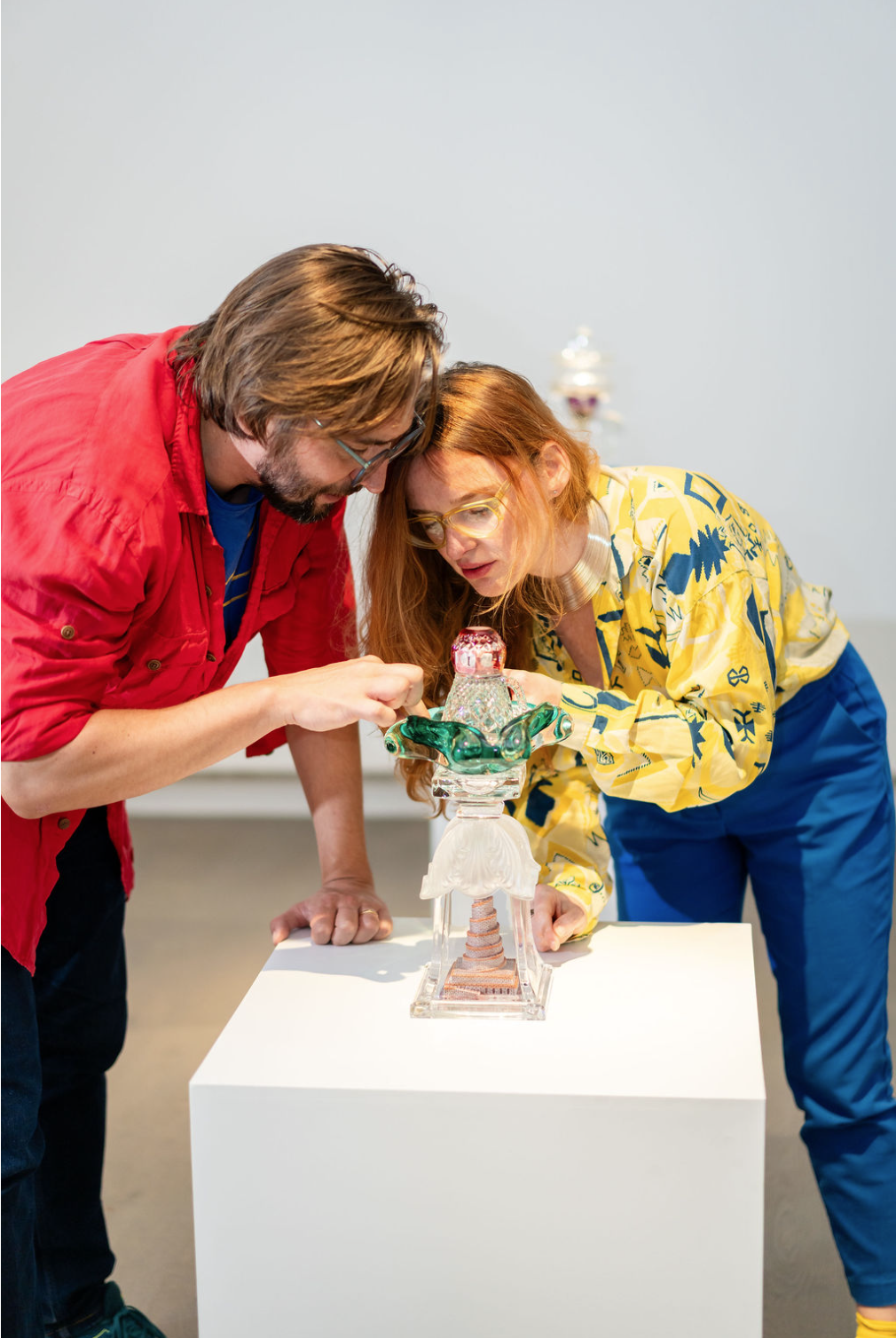
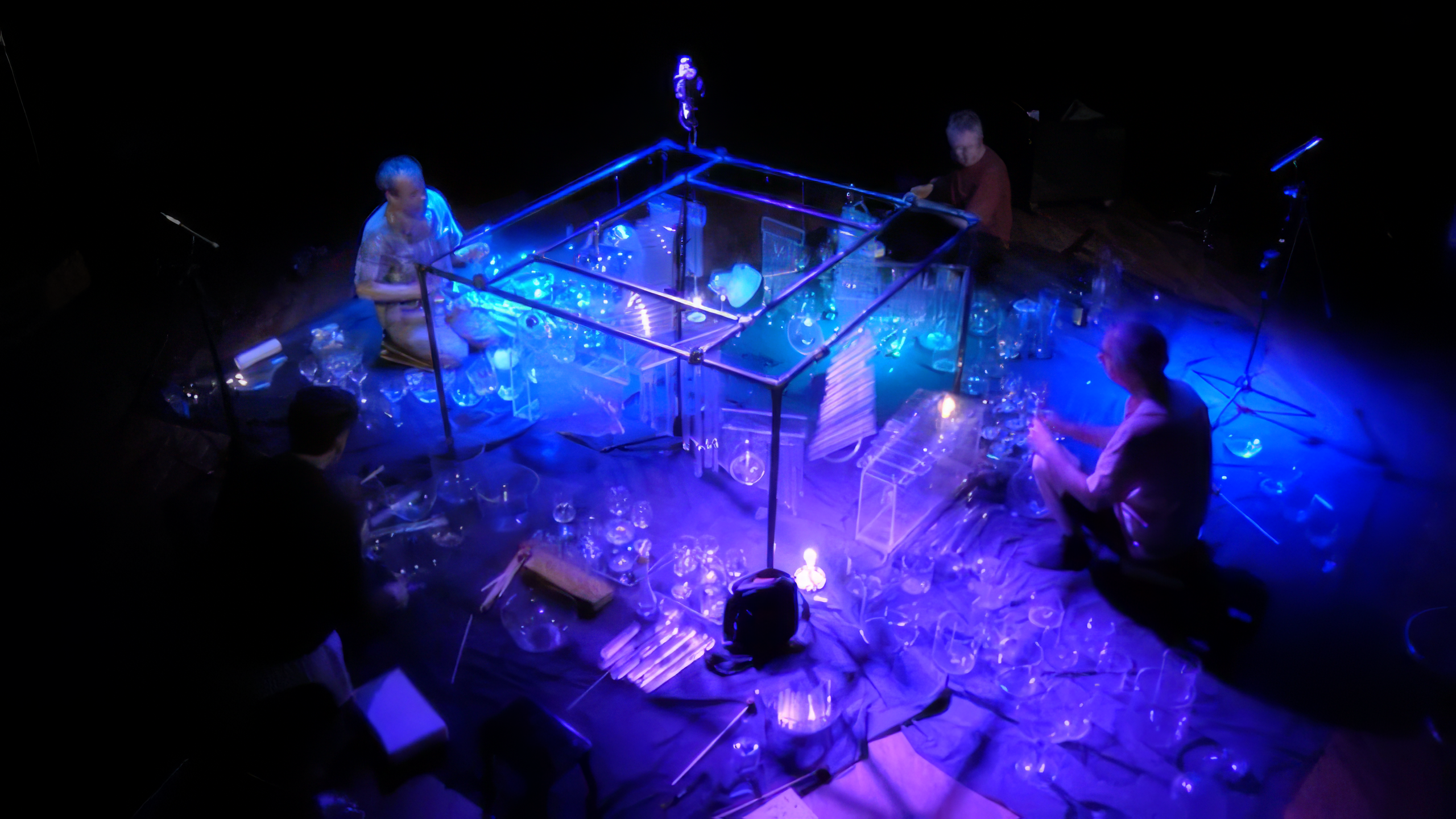
Left: Exhibition view of Plague Crystals by Natalia Romik (photo: Jeremie Warshafsky). Right: Romik preparing crystal towers with curator Kuba Szreder (photo: Shay Markowitz).
Was this element of co-creation always integral to the exhibition, with people suggesting “plagues” and donating artifacts and mementos? You also source some of the crystalware locally.
It was important that people always nominate their plagues. The first time I built one of the crystal towers was in Venice during pandemic times, when I was working with the amazing anthropologist Michal Murawski. I acquired a few objects from colleagues and people I met, including a Palestinian scholar who gave me a piece of porcelain from a pot found in Jaffa Park, where her family lived before the Nakba. My personal object was a COVID mask, or a bottle of honey, symbolizing endangered bees, and antisemitic leaflets that I had collected over the years
The next series consists of beautiful glass sculptures created during my research fellowship at the Wissenschaftskolleg in Berlin in 2025. Outstanding scholars from around the world contributed objects to the project, and these are now presented in the exhibition. The following series is based on objects recovered during archaeological excavations in Będzin, at the site of the Ghetto Fighters’ House, where a Jewish uprising broke out in 1943.
The final series comprises six sculptures created at the Koffler Gallery. It was remarkable that so many people in Toronto brought us plague-themed commemorative objects and crystal vessels. When the curator, Kuba Szreder, and I saw all of these glass collections brought together in Toronto, we were deeply moved by the encounter.
Meanwhile I love flea markets, each one is a journey for me, I find so many things. But I thought I would build the first tower from the glass and the crystals I have at home. In communist times in Poland, glassware was something very special, especially in the 60s and 70s. You would show them off as decorative pieces in your home. They were like luxury goods for us.
There were a lot of glassworks in Poland back then, but after privatization in the early 90s that tradition came to an end. Factories were being shut down, and thousands of people were losing their jobs. I had some of these old glass pieces at home, so I started working with them in a local studio using this special liquid glue and UV light to attach them together, creating these towers. There’s something beautiful about this gesture of stitching them together.
It’s a beautiful way of capturing what’s been described as our current state of “polycrisis”—with multiple, distinct crises, or “plagues”, occurring simultaneously and amplifying each other—yet doing so with a bit of hopefulness.
It’s not only about the gesture of naming your plague, but how the viewer must sometimes really focus to see through the glass, how there are reflections and distortions, but ultimately the glass is to keep the plagues inside. At Passover there’s a part during the recitation of the Haggadah, where you make this important gesture of putting your finger in a glass of wine and naming the ten plagues.
I thought, “We need gestures like this.” We will not repair the world with these crystal towers, but it’s on the spectrum of things that we can do—the whole procedure of putting the objects inside the towers and how this sculpture serves as a ritualistic expression of containing these threats.
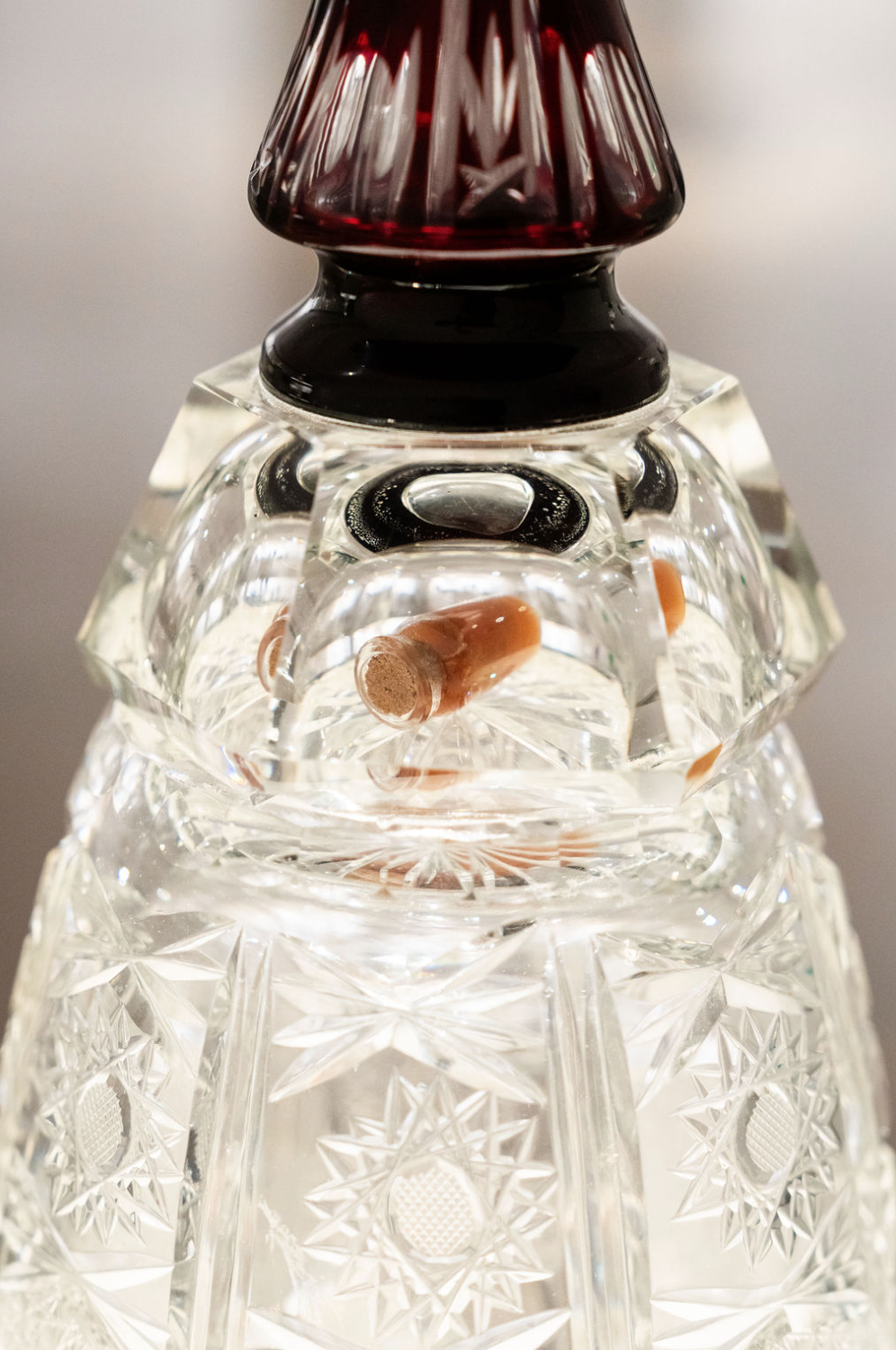
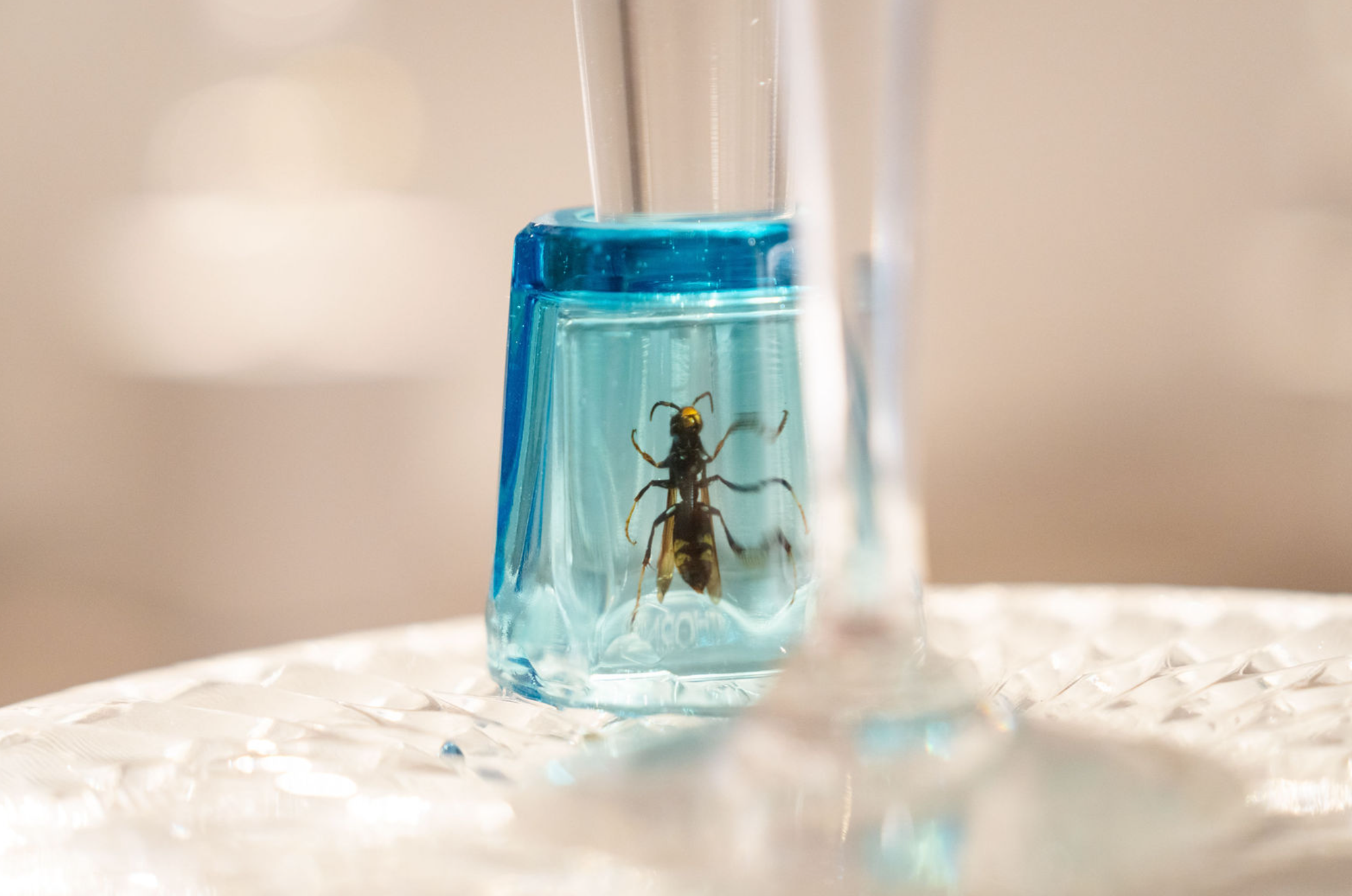
Details showing "plague objects" from works included in Plague Crystals. (Photo: Shay Markowitz)
There’s a great mystery to objects—whether artifacts, precious heirlooms, or trinkets bound for the dump, how over time they accrue some kind of meaning and significance, an aura even.
There’s the really great quote from Walter Benjamin about aura, how objects possess aura when they have a distance from the viewer and can return his or her gaze. This is possible when the objects are constituted specifically in time and space—that is to say, when they are unique and cannot be reproduced.
This is really the core of the exhibition, how meaning is transferred onto an object by people, and how we capture it in that moment. The story is there in its aura.
Has any of the work on your Hideouts project continued?
It’s ongoing and moving from one place to the other. A few years ago when [Belarusian president] Alexander Lukashenko was pushing refugees from Syria, Eritrea, Palestine toward the dense forest of Bialowieza in Poland, Poland and the European Union responded by building a massive fence, 180 kilometres long, and the refugees got stuck there. 180 people died in the forests. With activist friends, we thought to make a 3D scan of the hideout built by a Syrian refugee family.
Fortunately the family is safe now, but this shelter or hideout serves as kind of evidence of what the Polish government did back then.
I get the impression that each project of yours requires a different approach. Like there’s no one methodology.
It always starts with archival research, that’s my method. Before producing work for the Nomadic Shtetl Archive or the Hideouts project, I spent a year in the archive. Every day you spend a few hours. There’s not only reading the testimonies, you must translate them, compare them with facts at the site. This process of diving into the politics and history of a place is super close to me.
There is a strong element of commemoration in your work, acts of active, public remembrance. It makes me think of how approaches to commemoration through architecture have traditionally been very sombre and heavy in tone. When Arcade spoke with architect Manuel Herz about his design for the commemorative synagogue at Babyn Yar in Kyiv, he said that the problem with monuments is their very monumentality. Which is why he went for something light and playful, inspired by a children’s story book rather than some heavy stone marker. Do you have any thoughts on Herz’s approach?
I love it. Creating the monument of Oneg Shabbat with glass was very important to the development of my visual language. How can we think of commemoration in a more delicate, fragile, and even invisible way, while also working with different tools?
We also still commemorate hiding places in Warsaw, in a former ghetto area, which was completely demolished by Germans, but we do it using a lighting system and glass, which possesses the aura of the light for a few hours. These are the kinds of exhibition designs I am passionate about creating in a public sphere.
Plague Crystals runs at Koffler Arts until September 6, 2026.
Share this post