Learning How to Imagine a Future Again
At a time when art’s potential to change minds and lives is often met with skepticism, Berlin exhibition The Opposite of Now explores the utopian impulse in art.
As I write this, the melting glaciers of the Dolomites are exposing caches of hidden World War One ammunition. After a summer of record heat, the ice is giving the shells back, much of it still live. It’s a metaphor for our times. Beneath the smooth surface of a peaceful, civilized Europe, the violence of the last century was never defused, only frozen. Today, militarism, nationalism, and the far right are thawing out with it. Yet perhaps the most destabilizing conflicts of the present are invisible, fought across social media algorithms and AI. You might even be asking: is it a human who has written these lines? As I write this, the melting glaciers of the Dolomites are exposing caches of hidden World War One ammunition. After a summer of record heat, the ice is giving the shells back, much of it still live. It’s a metaphor for our times. Beneath the smooth surface of a peaceful, civilized Europe, the violence of the last century was never defused, only frozen. Today, militarism, nationalism, and the far right are thawing out with it. Yet perhaps the most destabilizing conflicts of the present are invisible, fought across social media algorithms and AI. You might even be asking: is it a human who has written these lines?
Amidst this violence and uncertainty, I walked into the Jewish Museum in Berlin to see the special exhibition The Opposite of Now: Artistic Paths to a Different Present, though I was skeptical of art’s ability to deliver what the museum calls a “search for something different, something better.” In an era where even authorship is up for grabs, I wondered: how do we imagine a human, livable alternative to a present that feels entirely out of our control? And what does art have to do with any of this?
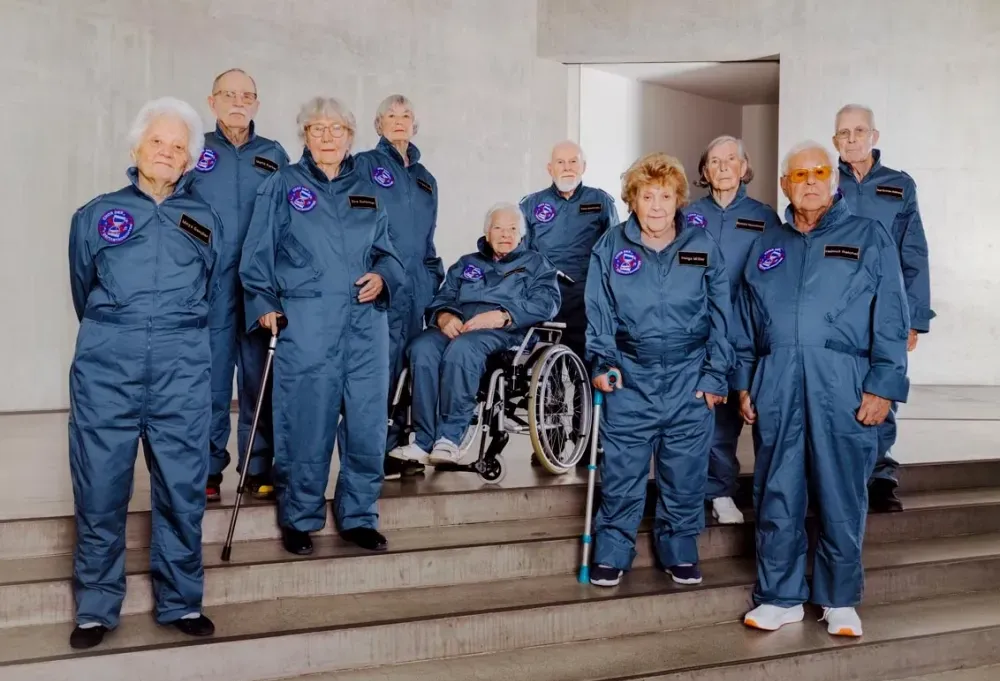
While the permanent exhibition in the Libeskind building was mobbed with young travellers and tourists, my first thought upon entering the exhibition was: why is no one here? The first room held an installation by Ari Benjamin Meyers, Choir of the Time Astronauts. A rack of hanging orange astronaut suits greeted me. Without bodies, they felt empty and haunted. A documentary on a 1960s vacuum-tube television shaped like an astronaut’s helmet showed nonagenarians in those same suits. Meyers had assembled a choir of singers over 90, all born in the mid-1930s or earlier, who never perform, only rehearse, for as long as they live. Having witnessed so much of the past century, they now live largely outside our society, in a different kind of time, as though, Meyers suggests, they were travelling through outer space.
In glass cases lay the objects the singers would take with them into space: a Swiss Army knife, a red plastic rose, photos of grandchildren. In the documentary, when asked about the past, the Time Astronauts answer in a word or a phrase: “perpetual,” “limited,” “cannot be repeated,” “can be very beautiful.” In Germany, anyone born in the 1930s is usually asked to be a Zeitzeuge, a witness to the Nazi years. Meyers offers his singers something else: freedom from that role, a future instead of a past. It’s a generous idea, perhaps the show’s truest opposite of now. And still the past intruded on the present. In the centre of the room sat a grand piano. It belonged, I later learned, to Helga Bassel, a Berlin concert pianist and a cantor’s daughter, who took it with her when she fled to South Africa in 1936. Her children grew up never knowing she was Jewish; her daughter found out from documents in this museum’s archive, and later donated the piano.
In the next room, choreographer William Forsythe’s Backwards gave simple instructions: sit on a bench, stand up, walk toward the window, close your eyes, and walk backwards to the bench. Hopelessly lost, I collided with a side wall before nearly falling into the bench. So much for looking backward to find a way forward. Wishing I’d had an astronaut helmet, I left the room with a second instruction from Forsythe: “attempt to walk without rhythm.”
I used to believe in art’s power to change, affect, and shape people. In recent years, my skepticism has only deepened. Elite artists, wealthy patrons, state money: what is art for today, and for whom? And what change can it effect in a society that so badly needs it?
These questions were the rhythm I walked to. In another room, a circle of grey stools, each with its own headphones, invited me to sit and listen to Dor Zlekha Levy’s Esperoj (Hopes), a choral reworking of “La Espero,” the anthem of Esperanto, the universal language devised by the Polish-Jew L.L. Zamenhof in the 19th century. The music was ethereal and beautiful. A translation on the wall read: “Walls of millennia stand firmly between the divided people; but the stubborn barriers will jump apart, knocked apart by the sacred love.” I wished I wasn’t seated alone. Only later did I read that the piece is built for company: each listener who puts on headphones opens another layer of voices. Alone, I had heard only the first. The “sacred love” felt remote and hollow. And the question kept coming back: who and what is this for?
The “Room for Reflection” tried to answer this, though it felt less like a place to think than a kindergarten. On a square of raw plywood, two pairs of headphones dangled from the ceiling and invited participants to listen to the show’s intellectual source, a radio conversation on utopia between Theodor Adorno and Ernst Bloch, recorded in May 1964, during the Frankfurt Auschwitz trial. While SS men who had served at the camp were being prosecuted, two philosophers of Jewish descent forced to flee Germany argued about the future. Adorno insisted that utopia must never be pictured: like a graven image, any portrait of it is a cheap copy, one that pretends death away. Bloch agreed, but maintained that the longing for a better world can’t be erased. “Something’s missing,” he said, quoting Brecht. Up to this point in the show, I couldn’t have put it better.
In the same room, a round table waited for children, who were meant to collect wooden story pieces from boxes throughout the show and assemble them into larger narratives. A panel asked, “What if everything was completely different?”, a cheerful echo of Adorno’s line on the wall nearby about losing “the capability to imagine the totality as something that could be completely different.” The wall text also pointed visitors to M.O.O.N., an AI chatbot the museum built to help people imagine their own “opposite of now.” It turns your answers into a text, a manifesto, a screenplay, or a dictionary entry, chosen at random. I didn’t try it. I’d come to the museum to get away from machines that think for me.
Beside the headphones, a row of books stood between bookends like a university syllabus: More, Bloch, Arendt, Scholem, Tokarczuk. But I was less interested in concepts of utopia than in getting lost in something (I already spend a good amount of time reflecting on how shitty the world is). Perhaps I was hoping for transcendence, or something beautiful I couldn’t listen to on my stereo at home. (The Bloch–Adorno conversation, as it happens, is on YouTube.) So far, the show had felt like a seminar. You can almost hear the curators: Let’s get people involved! Let’s make sure art still matters! But when art is powerful, it does the work. We, the viewers, do the difficult part: interpreting, making meaning and complexity alongside the artist. It’s only in the second half of the show that this begins to happen.
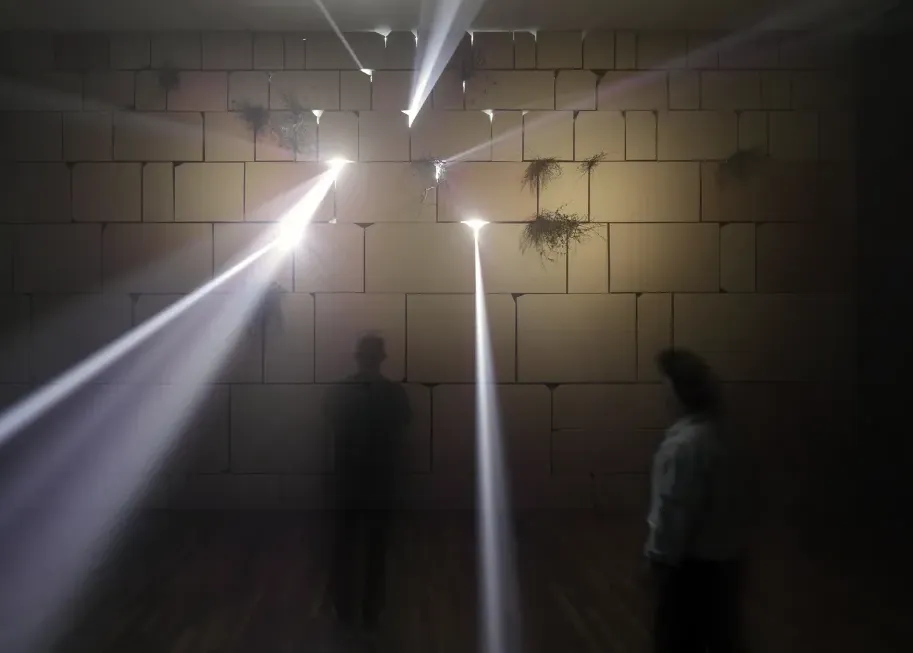
I wander through curtains, immersed in a thick darkness. When I pull one aside, I’m greeted by more darkness. It takes a few seconds to understand I’m looking at the Western Wall in Jerusalem, rebuilt from cardboard boxes. Music pulses. A beam of light breaks through a crack in the wall, then another, then another. I’m not sure if I should dance or meditate, which turns out to be the point. Alona Rodeh’s Above and Beyond takes its cue from the Orthodox philosopher Yeshayahu Leibowitz, who believed that after the Six-Day War the Wall had become profaned by turning it into a nationalist shrine. He proposed turning it into a “diskotel”: a disco at the Kotel, as the Wall is called in Hebrew. The strobe recedes, and again I am plunged into darkness.
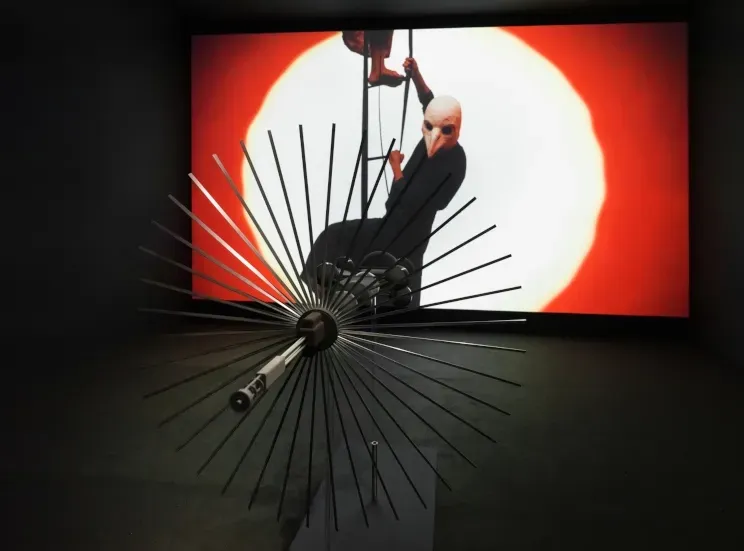
Next door, a video projects a soldier crawling across the desert with a gun. Oddly, his face is covered in an eerie bird mask, white with an enormous golden beak. This haunting image demands that I sit. For the first time, I’m immersed in the show, completely.
The film is Yael Bartana’s The Birds. Its title nods to Aristophanes’ comedy, in which a flock builds a city in the sky. The masks are drawn from the Birds’ Head Haggadah, a manuscript from around 1300 CE that depicts Jews with beaked heads. Biblical images emerge from a desert that resembles the Negev: the bird-soldier, in a uniform that echoes the IDF, taps a rock and out pours water, flowing into his army canteen. He drinks greedily. Other human-bird soldiers appear. At one point they lie on the desert floor, abandoning their weapons, refusing military service. At another, they dance in their military garb at a kind of rave, their clothes transforming into coloured robes. Eventually they end up at a Seder table perched on sand.
One bird-refusenik stands and recites in Aramaic, Ha lachma anya. “This is the bread of affliction,” words my father would say over the matzah every year at Passover. The others nod and shake their beaks in unison, dropping wine from their little fingers onto their plates as they recite the ten plagues. Copies of Rabbi Nathan Goldberg’s ubiquitous Haggadah, with red trim and yellow pastel background, line the table. This is and isn’t the Passover I am accustomed to. I’m not sure where I am: the desert of the Bible, or the possibility of another world.
Suddenly the screen and soundscape swell; the sky pulsates with storm. A computer-generated sea parts. We travel between walls of water. Maybe it’s outer space. It is, as Benjamin Seroussi writes in the exhibition catalogue, “a mix of Exodus with the Great Flood.” Somewhere in this surrealistic blur, back in the desert, the bird-refuseniks’ rifles turn into snakes. Beneath a huge glowing sun a ladder drops from the sky: a way out of the mess of this planet. In saying no to war, the birds are also saying no to earth. The vessel meant to carry them, I later learn, is called Generation Ship. A two-metre model of it stands in the room, part-satellite, part-space station, part-ancient geometrical map. The map is real: a companion print lays the ship out as the ten sefirot, the Tree of Life of medieval Kabbalah. It is built for the mystical task of tikkun olam, gathering the sparks of a shattered creation.
I know Bartana’s work from …And Europe Will Be Stunned (2007–11), her trilogy about a fictional movement calling on Jews to return to Poland. It borrowed the look of socialist propaganda films to tell the story backwards: “a Zionism inside out,” as Seroussi puts it. The Birds performs the same inversion on Passover: the Exodus is “no longer a return home, but the beginning of an exile.” Is Bartana saying we need to leave this planet to heal? Or is the voyage an inner one, putting down our weapons to engage in the kabbalistic act of redemption?
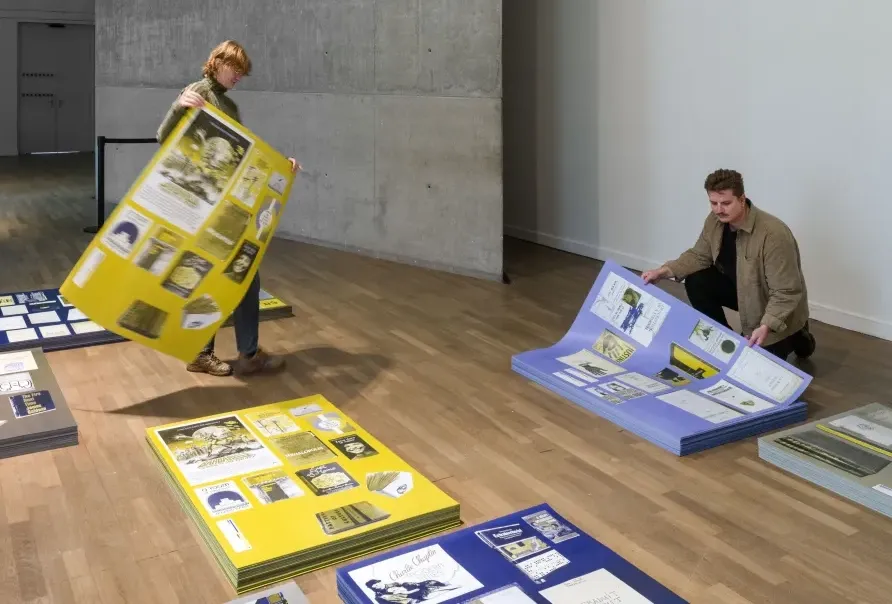
Later, I am brought back to earth in the imaginary library of the Egyptian-Jewish writer Jacqueline Kahanoff (1917–1979), assembled by Eran Schaerf in Through the Color Prism, and What Jacqueline Found There. Kahanoff championed Levantinism, the overlapping coexistence of peoples, languages, and faiths along the eastern Mediterranean: not a melting pot but, in her words, “more like a prism, whose various facets are joined by the sharp edge of differences.” Posters of book covers from her imagined shelves lie in stacks across the floor, free to take home. Abu Iyad’s Palestinien sans patrie, Buckminster Fuller’s Utopia or Oblivion, even a film poster for Barbarella. I wish I’d taken that one. At a moment when the two-state solution is dead, and when, here in Germany, even imagining one shared land can be branded antisemitic, it is both reassuring and tragic to conceive of a time when words of division, oppression, and war didn’t govern our thoughts. In promising a world that does not exist, I think of Bloch’s notion of utopia: a constant striving, a world without borders, not yet here, and likely never.
The Opposite of Now runs at the Jewish Museum Berlin until January 10, 2027.
Share this post