Considering Toronto's Third Spaces and Myths About the Urban/Nature Divide
A panel discussion on the uses and abuses of how urban dwellers think about their relationships with nature, patterns of gentrification in Toronto, and how people have been inhabiting spaces like the Don Valley much longer than people assume.
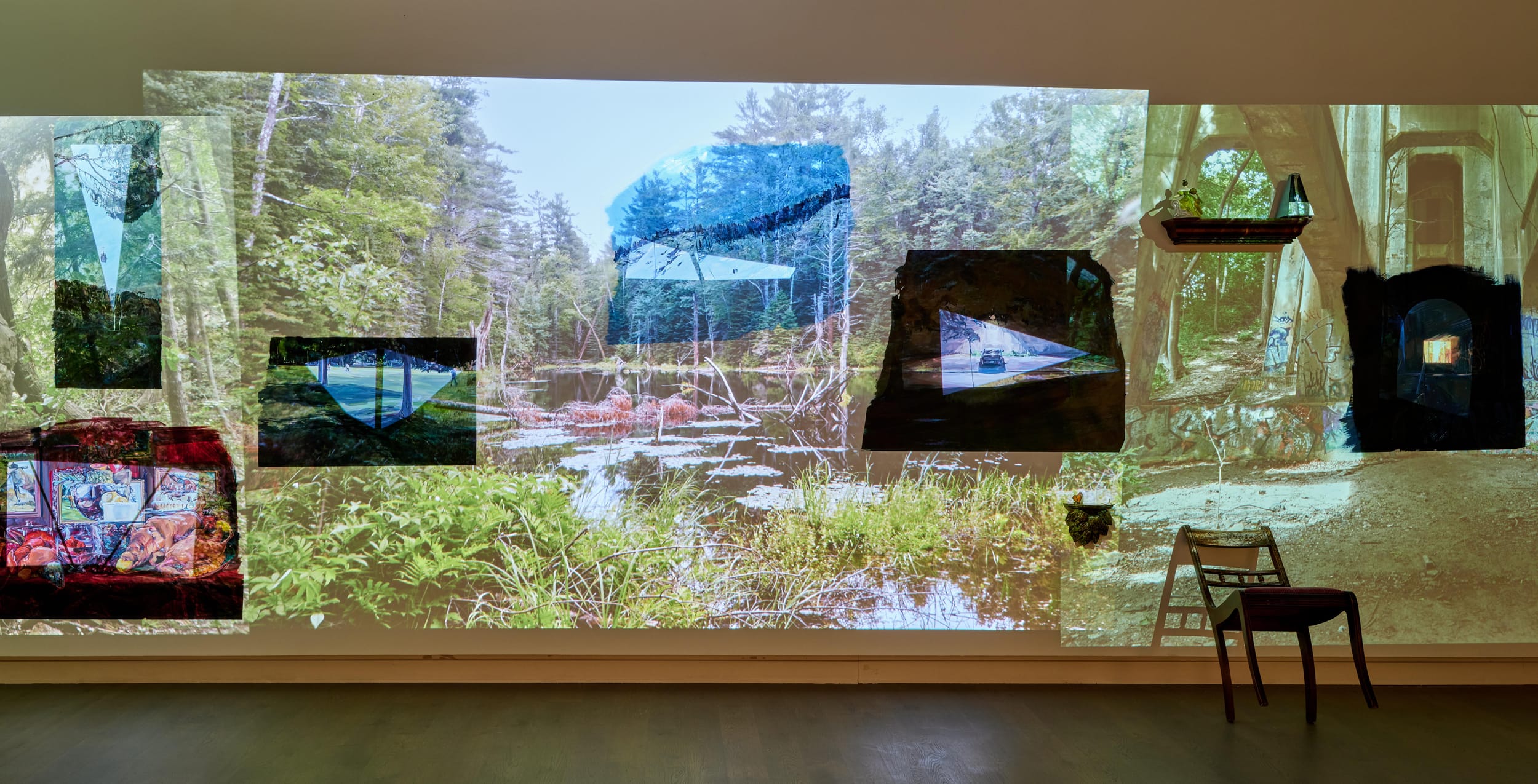
Inspired by Gillian Iles’s exhibition Glorious Catastrophe, Koffler Arts recently hosted the panel discussion “Toronto’s Urban/Nature (Ab)uses”, moderated by Toronto Star columnist and Spacing co-founder Shawn Micallef. Leaning into some of the themes examined in Glorious Catastrophe, such as extreme transformations and the effects of rapid urban development on people and nature, we were joined by: Jennifer Bonnell, a professor in the Department of History at York University and author of Reclaiming the Don: An Environmental History of Toronto’s Don River Valley; social justice activist, Anglican priest, and author Maggie Helwig; and social geographer Bryan Mark, a PhD candidate in the Department of Geography and Planning at the University of Toronto.
SHAWN MICALLEF: What’s your take on Toronto’s relationship, whether it’s the people or built forms, with the natural environment?
JENNIFER BONNELL: I’ve just come from visiting my family on Vancouver Island, so in some ways I feel like I left nature behind to return to Toronto. But one of the ways I came to know Toronto was by riding through the ravines, and loving that experience of emerging at various ravine exits and being completely disoriented. Especially as we wrestle with climate change, flood risk, and other urgent considerations, nature is constantly forcing this city to reconcile with a very dynamic and changing force. It’s something we increasingly have to be attentive to in city planning. Torontonians love and value the nature around them, and I see that every day during my walks through the city’s ravines and beach spaces.
MICALLEF: Bryan, do you think the city we’ve built is complimentary to the natural landscape, or in conflict with it?
BRYAN MARK: I’d say it sort of depends also whether you have the time to enjoy or use those natural landscapes.
MICALLEF: That’s a good point, who gets to have leisure time in an expensive city like Toronto. Your doctoral research touches on the conspicuous consumption of leisure activities—interacting with nature being one of them.
MARK: Yes. It’s interesting to think about interacting with nature as a form of status expression, but to use the beach as an example, there’s definitely something about it as a destination.
BONNELL: But it’s not just about recreating in these places though. Nature’s all around us, whether we have time to interact with it or not.
MAGGIE HELWIG: I’d actually like to query the binary we’re creating here. We’re talking as if there’s a clear binary between a thing that is nature and then human beings, and the things human beings make. Human beings are animals. We are a particular kind of animal, but we are also part of the natural world.
I’ve lived here for 42 years and my main work has been in urban poverty. One of the problems that’s created by that binary is that there can be a greenwashing of anti-poor attitudes. There can be a greenwashing of anti-homeless attitudes. Encampment evictions can be justified by homeless people damaging nature. If you compare the impact of someone living in a tent in the Don Valley or in a park with the proposed expansion of Billy Bishop Airport, I’m gonna query where your priorities lie.
If you’re talking also about who has time to appreciate the Don, it’s important to point out that the people who live in a particular ravine understand that ravine better than any of us do. The people who live in the parks understand the parks better than any of us do. The people who live in the yard of my church understand the rats. Now, I don’t have a very good relationship with the rats at my church, but my friend Allison does. So if we’re talking about connection with the natural world, these are people who have a very profound and very live connection with what we think of as the natural world in a way that most of us don’t.
Allison talks about this a lot. She’s talked about how she is privileged in a certain sense to experience every kind of weather directly and up close. She is in no way shielded from the weather, and that’s a source of suffering, but she also sees it as a source of privilege. So the whole question of humans and nature, their relationship, and how humans live in nature, I think we have to be very careful of some of the binaries and hierarchies we create and how they can be socially used.
MICALLEF: Jennifer, in your book, Reclaiming the Don, you write about the long history of people living in the Don Valley. People thought it was this new thing during the pandemic, but it was happening 100 years ago.
BONNELL: To understand the history of the Don, one of the things I wanted to look at was not only changes to the river channel, changes to that environment, but who has experienced this place over time, and who had left any records or traces.
For example, the parts of the Don around Riverdale Park and that area, there you had a series of 19th-century institutions built specifically to keep certain populations outside the view of people living in the centre—isolation hospitals for infectious disease, the Don Jail, the prisoner of war camp located where Todmorden Mills is today.
The Don Valley has a through-line as this place at the edges. It was literally the edge of the 19th-century city, forming the eastern boundary of Queen Street. Not only was it used as a place for storing hazardous and flammable materials, and dumping wastes people didn’t want to look at, but also for storing certain kinds of human populations.
Then there’s the history of people living rough in the valley, and that history went back just as far as I could find records. There are references from the early 1800s to a man who lived in a cave in the embankment at Queen Street and the Don. Apparently he had a garden and he travelled to the St. Lawrence Market in a canoe to sell the pitch he gathered in the valley. He was achieving a level of subsistence. That’s just one story.
Over history, the valley has provided many things—like refuge and relief from surveillance. Up until the construction of the Don Valley Parkway in the 1960s, it certainly was viewed as a place of danger, as a kind of underworld, by residents of the centre. Of course, I’m casting very wide brushes here, but when you think about the history of the parkway, it was viewed as a civilizing force over an unpredictable place.
MICALLEF: One of the things we’re talking about today is the idea of “third spaces”—that place which is neither work nor a home, but a place to hang out. Sometimes it’s a coffee shop, often it’s a park. To get here today I walked up Ossington, which is like “third space”-central with all its cafés and bars, but I couldn’t help but notice all these people lining up in the rain for some new place, and how third spaces can end playing a role in gentrification.
Bryan, this is something you’ve looked at in your doctoral research—at Ossington, in particular, how it went from auto body and tire shops to hipsterfication almost overnight. Sometimes I think of Ossington as the fastest gentrification I’ve ever seen.
MARK: In my previous graduate work, I looked at the gentrification of Ossington through the lens of ice cream commerce. What used to be a Portuguese-owned mechanic’s shop became a restaurant which was then dissected to also accommodate an ice cream boutique. You also have to look at the structural transformation of CAMH on Queen St. That played a big role in changing Ossington’s reputation from being this space of danger that repelled capital investment. Once CAMH was transformed it created new opportunities for capital investment and cultural entrepreneurs flooded the street.
MICALLEF: They even changed the address of CAMH from 999 Queen St. West to 1001.
MARK: Yes, there were many symbolic changes intended to distance Ossington from its previous stigmatized reputation, and the spatial marginality it held onto. This was driven by the media as well, you would have articles in The Globe and Mail mentioning how people with complex mental illnesses are no longer distinct on Ossington. So there’s been this camouflaging of mental illness, it’s no longer a deterrent to people coming to Ossington. CAMH’s redevelopment has been important for accelerating this change on the street.
MICALLEF: Has Toronto done a good job of taking care of its ravines and parks as “third spaces”?
BONNELL: I think we have this an older, 19th-century idea of park creation, which is you establish a boundary and then you’re done. However, we’re finding with our polycrises or whatever word we want to use to describe the moment we’re in, that that is not only insufficient, but harmful.
When we think about the history of national parks outside of the city, a number of exclusions were part of those parks’ creation, which highlights how, as Maggie was saying earlier, there’s this fiction that we create that these are spaces without people for people from somewhere else to come and enjoy.
There’s a similar thing at work with urban parks—we’ve protected it, we’ve preserved it, and like our national parks, we can’t step away. We need to maintain those spaces, and some of the most exciting work that’s happening in Canada right now is the collaboration with Indigenous groups across the country reopening park spaces as places where people might still hunt, might still fish, might still gather, and steward.
When it comes to urban parks, the City of Toronto doesn’t seem to have the time and resources to steward our parks. Instead, we are seeing citizen associations caring for the parks in our backyards, and I’ve been excited to see that. Toronto Nature Stewards, Don’t Mess With The Don, all these organizations recognize that bringing people into these places will cultivate a sense of love and protection for them.
There’s an interesting dynamic at work right now. People are feeling helpless to confront some of the bigger crises around us and are turning to the environments close to home. I’m sure Maggie has something to say about some of those same groups who are quite critical of encampments in the Valley—so, yeah, there’s a tension there.
HELWIG: There is. I would love to see a situation where we could have a decent conversation about coexistence, about coexistence and compromise. These have never been uninhabited spaces, that’s one of the valuable things about your research. They were not uninhabited pre-colonialism. They’ve never been uninhabited. So how do we manage the inevitable human habitation of these spaces alongside everything else about them?
How do we manage parks so that if people have nowhere else to go, they can in fact put up a tent in a park, and the park can still be available to families, to people wandering around. The park can be available to a multitude of uses, which could include habitation. It gets posed as: if there is this one homeless person in the park all the children must run away forever. That demonization of unhoused people makes it sound like all other park users are excluded because of the incredible danger posed by one unhoused person.
I’ve never been able to have that conversation in a constructive way. What do we need to do to start talking about coexistence and how all the different users of our city can actually constructively coexist? It would be a great conversation. No one wants to have it.
Glorious Catastrophe runs at the Koffler Gallery from March 26 - June 7, 2026.
Share this post